Author: track-tracesolutionsadmin

  • How Businesses Build a Complete Traceability Framework

    How Businesses Build a Complete Traceability Framework

    How Businesses Build a Complete Traceability Framework

    Businesses today need more than basic product tracking. They need complete visibility into where products come from, where they are located, how they move through the supply chain, and what happens at every stage. A complete traceability framework helps businesses connect people, processes, data, and technology to achieve end-to-end supply chain visibility.

    From manufacturing and logistics to retail, healthcare, food, and pharmaceuticals, traceability enables organizations to monitor products, identify problems quickly, improve compliance, and make better operational decisions.

    What Is a Complete Traceability Framework?

    A complete traceability framework is a structured system that enables businesses to track and record the movement, transformation, and history of products, materials, or assets throughout the supply chain.

    Definition of Supply Chain Traceability

    Supply chain traceability involves collecting and connecting information from different stages of the supply chain. This may include suppliers, manufacturers, warehouses, distributors, transportation providers, retailers, and customers.

    A well-designed framework creates a connected flow of information that allows businesses to determine the origin, location, status, and movement of products.

    Why Traceability Matters for Businesses

    Without proper traceability, businesses may struggle to identify where a product came from or where a problem occurred. A traceability framework makes it easier to detect issues, investigate disruptions, manage recalls, and maintain accurate records.

    Key Components of a Traceability Framework

    A complete framework generally includes:

    • Product or asset identification
    • Data collection
    • Real-time tracking
    • Supply chain integration
    • Data storage
    • Monitoring and analytics
    • Reporting and compliance

    Why Businesses Need End-to-End Traceability

    Modern supply chains involve multiple suppliers, facilities, transportation networks, and distribution channels. This complexity makes visibility increasingly important.

    Improving Supply Chain Visibility

    End-to-end traceability allows businesses to understand what is happening across different stages of their supply chain. Managers can monitor inventory, shipments, production processes, and product movement from a centralized system.

    Reducing Product Loss and Errors

    Accurate tracking can help organizations identify misplaced products, inventory discrepancies, shipment errors, and process inefficiencies.

    Meeting Compliance and Regulatory Requirements

    Many industries require businesses to maintain detailed records about products and processes. A digital traceability framework can help organizations maintain accurate records and provide information when required.

    Improving Customer Trust

    Customers increasingly want information about product origin, quality, safety, and authenticity. Transparent traceability can help businesses provide greater confidence in their products.

    Key Components of a Complete Traceability Framework

    A successful traceability system combines several technologies and processes.

    Product and Asset Identification

    Every product, batch, shipment, or asset should have a unique identifier. Businesses can use barcodes, QR codes, RFID tags, serial numbers, or other identification methods.

    Data Collection and Capture

    Data should be captured at important points throughout the supply chain. Information can include production details, warehouse movements, shipment information, timestamps, and product status.

    Real-Time Tracking

    Real-time tracking provides businesses with current information about products and assets. This can be particularly valuable for logistics, warehousing, cold-chain operations, and high-value assets.

    Supply Chain Data Integration

    A traceability framework should connect information from different systems, including ERP, WMS, TMS, CRM, IoT platforms, and other business applications.

    Data Storage and Management

    Collected information needs to be stored securely and organized so that authorized users can quickly access the required information.

    How to Build a Complete Traceability Framework

    Building a complete traceability framework requires a structured approach.

    Step 1: Define Traceability Goals

    Businesses should first identify what they want to achieve. Objectives may include improving inventory visibility, reducing losses, meeting compliance requirements, improving product quality, or tracking shipments.

    Step 2: Map the Supply Chain

    The next step is to map the complete product journey. Identify suppliers, production facilities, warehouses, transportation stages, distributors, and other important points.

    This helps businesses determine where tracking and data collection should take place.

    Step 3: Select Tracking Technologies

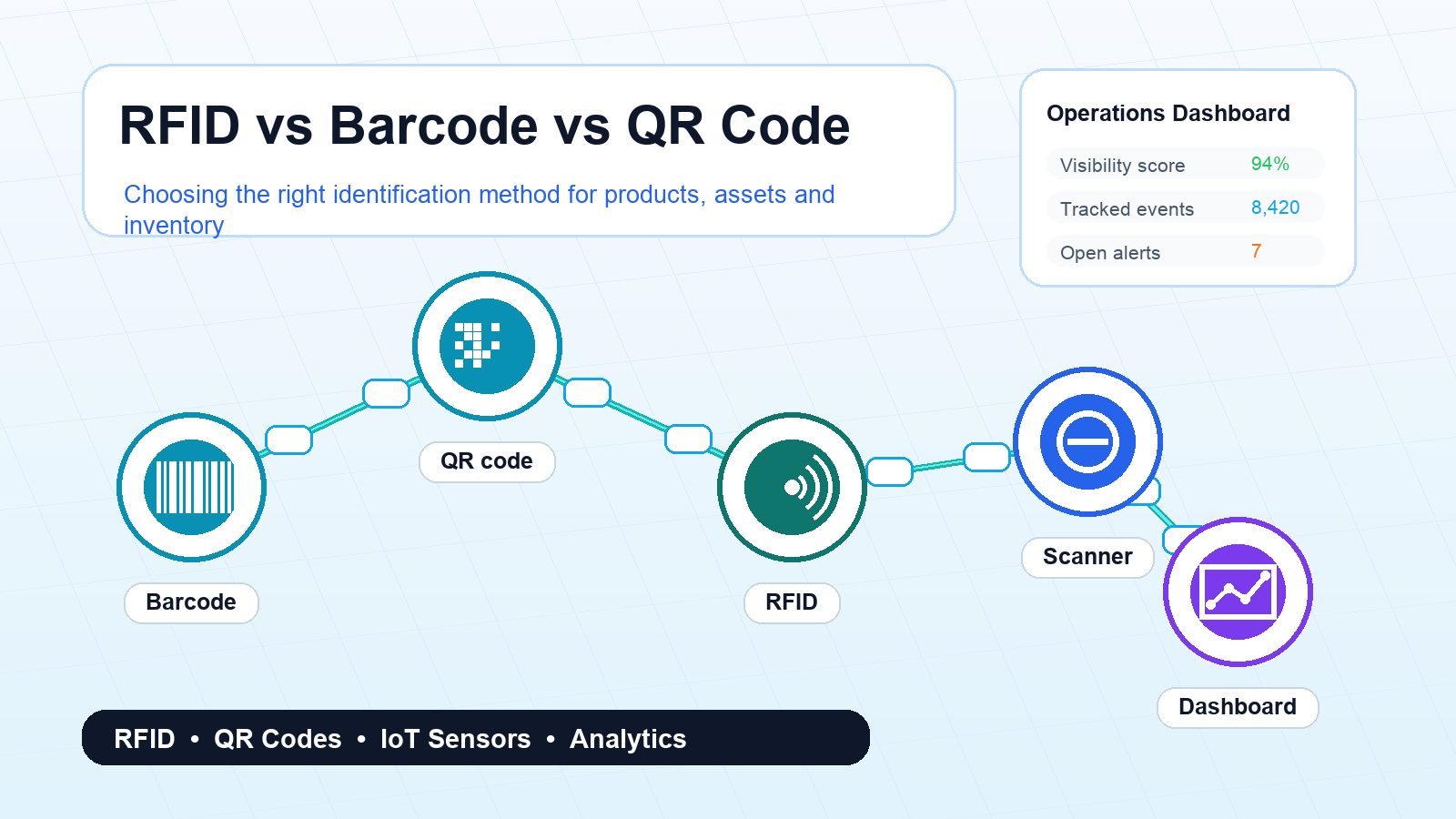
    Businesses should choose technologies according to their operational requirements. RFID may be suitable for automatic identification, while QR codes and barcodes can provide cost-effective product tracking.

    IoT sensors can be useful when businesses need real-time information about location, temperature, humidity, or other environmental conditions.

    Step 4: Connect Data Sources

    The next step is integrating tracking technologies with existing business systems. Integration allows information collected from different sources to be connected and analyzed.

    Step 5: Implement Real-Time Monitoring

    Businesses can use dashboards and monitoring platforms to track products, shipments, inventory, and assets in real time.

    Real-time alerts can also help teams respond quickly to delays, unexpected movements, or operational problems.

    Step 6: Analyze and Optimize Traceability Data

    Traceability should not only be used for tracking. Businesses can analyze historical and real-time data to identify trends, bottlenecks, risks, and opportunities for improvement.

    Technologies Used in Traceability Frameworks

    Modern traceability frameworks can combine multiple technologies.

    RFID Technology

    RFID enables businesses to identify and track products or assets using radio-frequency signals. It can support automated data capture without requiring direct line-of-sight scanning.

    Barcode and QR Code Tracking

    Barcodes and QR codes provide a simple and cost-effective way to identify products, packages, and shipments throughout the supply chain.

    IoT and Sensors

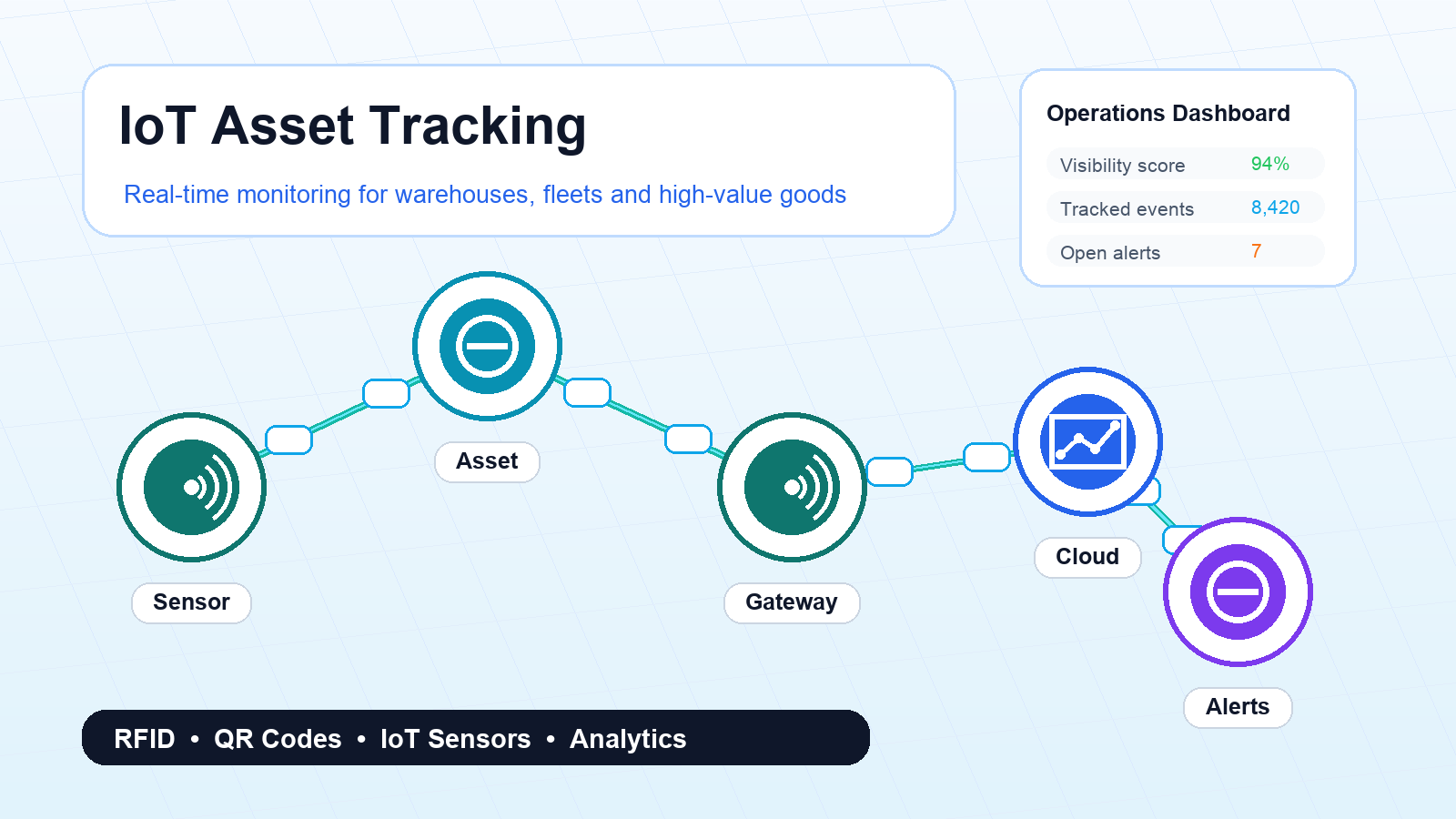
    IoT devices and sensors can collect real-time information such as location, temperature, humidity, movement, and equipment status.

    Cloud-Based Traceability Platforms

    Cloud platforms allow businesses to centralize traceability data and provide authorized users with access to information across different locations.

    AI and Analytics

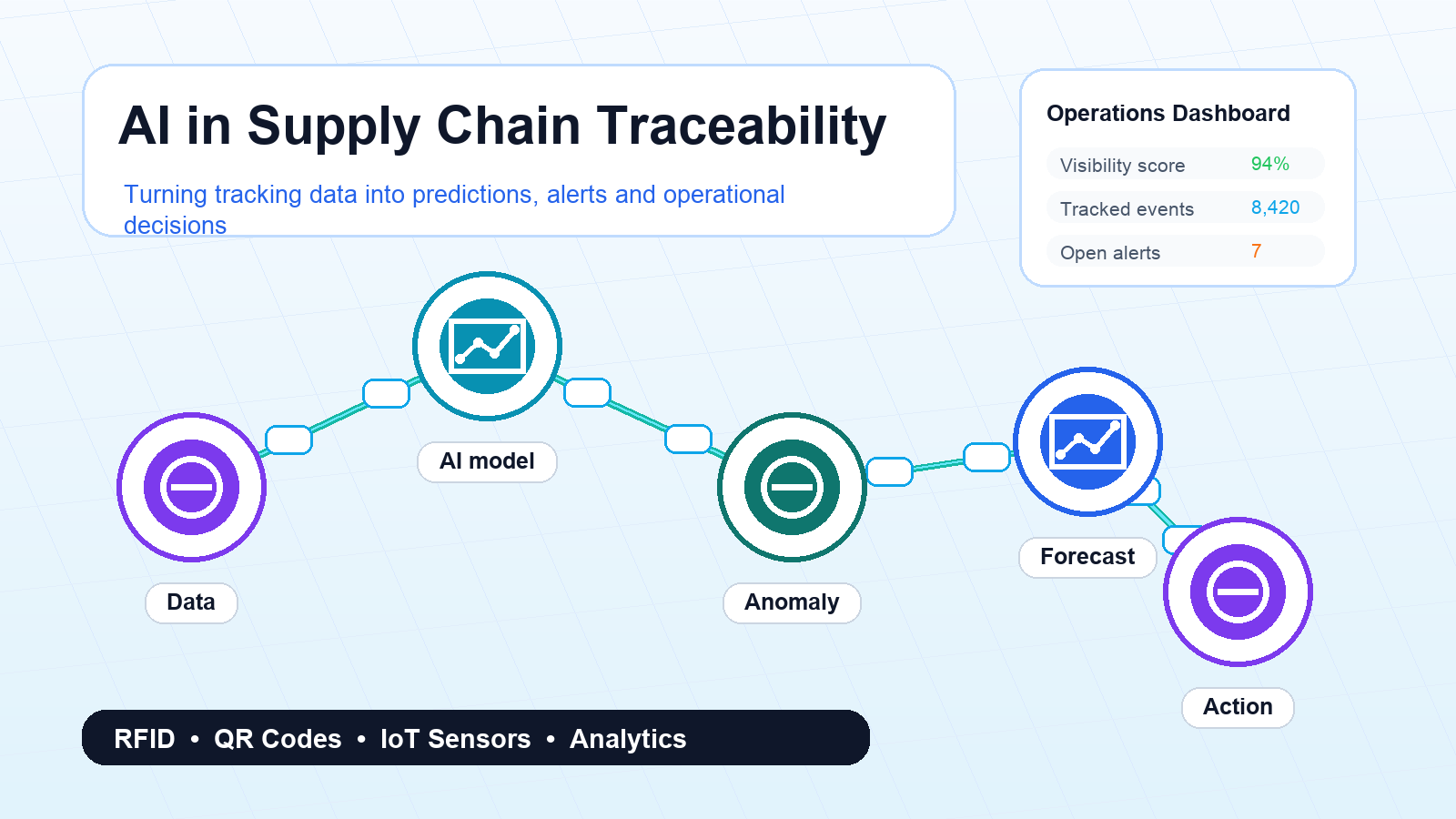
    Artificial intelligence and analytics can help organizations identify patterns, detect anomalies, forecast potential problems, and improve supply chain decision-making.

    Blockchain for Traceability

    Blockchain can provide a shared and tamper-resistant record of transactions and product information. It can be useful in supply chains where multiple organizations need to share trusted information.

    Benefits of a Complete Traceability Framework

    A properly implemented framework can deliver several operational benefits.

    Greater Supply Chain Visibility

    Businesses gain a clearer view of product and asset movement across the supply chain.

    Faster Issue Detection and Resolution

    When problems occur, organizations can use traceability data to identify the affected products, locations, and processes more quickly.

    Improved Inventory Management

    Accurate tracking can help businesses maintain better inventory records and reduce discrepancies.

    Better Compliance

    Digital records can make it easier to maintain documentation and demonstrate compliance with applicable standards and regulations.

    Reduced Operational Costs

    Automation and better visibility can reduce manual data entry, errors, product losses, and unnecessary operational activities.

    Challenges in Building a Traceability Framework

    Despite its benefits, implementing traceability can present several challenges.

    Data Integration Challenges

    Businesses often use multiple legacy systems that were not originally designed to communicate with each other. Integrating these systems can require careful planning.

    Implementation Costs

    Hardware, software, integration, training, and maintenance can create initial implementation costs.

    Data Accuracy and Quality

    A traceability system is only useful when the information it receives is accurate. Businesses need processes to maintain data quality.

    Legacy System Integration

    Older ERP, warehouse, manufacturing, or logistics systems may require additional integration layers to work with modern traceability technologies.

    Scalability and Security

    As businesses grow, the volume of traceability data can increase significantly. Systems need to be scalable while protecting sensitive business information.

    Best Practices for Implementing Traceability

    Businesses can improve implementation results by following several best practices.

    Standardize Data Across the Supply Chain

    Using consistent product identifiers, data formats, and processes makes information easier to connect and analyze.

    Automate Data Collection

    Automated data capture through RFID, IoT devices, scanners, and sensors can reduce manual errors and improve efficiency.

    Use Real-Time Monitoring

    Real-time dashboards and alerts help businesses respond quickly to supply chain disruptions and operational issues.

    Ensure Data Security

    Access controls, authentication, encryption, and secure integrations should be used to protect traceability information.

    Continuously Measure Performance

    Businesses should monitor KPIs such as tracking accuracy, inventory accuracy, order visibility, data quality, and response time to identify areas for improvement.

    Future of Supply Chain Traceability

    Traceability is becoming increasingly connected, automated, and data-driven.

    AI-Powered Traceability

    AI can help businesses analyze large volumes of supply chain information and identify potential risks before they become major problems.

    IoT-Enabled Supply Chain Visibility

    IoT devices will continue to provide real-time information about products, vehicles, equipment, and environmental conditions.

    Predictive Analytics

    Predictive analytics can help businesses anticipate delays, demand changes, equipment problems, and other supply chain risks.

    Digital Product Passports

    Digital product passports can provide structured information about products, including their origin, materials, lifecycle, and other relevant information.

    Conclusion

    Building a complete traceability framework requires more than implementing a tracking technology. Businesses need to connect identification systems, data collection, real-time monitoring, business applications, analytics, and well-defined processes.

    A strong framework provides end-to-end visibility across the supply chain, helping organizations improve operational efficiency, reduce errors, support compliance, and respond faster to problems.

    As technologies such as RFID, IoT, AI, cloud computing, and advanced analytics continue to develop, traceability will become an increasingly important part of modern supply chain management.

    Businesses that invest in scalable and connected traceability frameworks can create greater visibility, accountability, and resilience across their operations.

    FAQs: Complete Traceability Framework

    Q1. What is a complete traceability framework?

    A complete traceability framework is a system that tracks products, materials, assets, and related information throughout the supply chain, from origin to final destination.

    Q2. Why is a complete traceability framework important?

    It helps businesses improve supply chain visibility, reduce errors and losses, identify problems faster, support regulatory compliance, and improve customer confidence.

    Q3. What are the key components of a traceability framework?

    Key components include product identification, data collection, real-time tracking, system integration, centralized data management, monitoring, analytics, and reporting.

    Q4. Which technologies are used for supply chain traceability?

    Common technologies include RFID, barcodes, QR codes, IoT sensors, cloud platforms, AI, analytics, and blockchain.

    Q5. How does RFID support traceability?

    RFID enables businesses to automatically identify and track products or assets using radio-frequency signals, reducing manual scanning and improving tracking accuracy.

    Q5. How can businesses build a complete traceability framework?

    Businesses can start by defining objectives, mapping the supply chain, selecting appropriate tracking technologies, integrating data sources, implementing monitoring systems, and continuously analyzing performance.

    Q6. What are the benefits of end-to-end traceability?

    End-to-end traceability can provide better supply chain visibility, improved inventory management, faster issue resolution, better compliance, reduced operational errors, and greater supply chain efficiency.

    Q7. What challenges do businesses face when implementing traceability?

    Common challenges include integration with legacy systems, implementation costs, data quality issues, employee training, scalability, and data security.

    Q8. Can AI improve supply chain traceability?

    Yes. AI can analyze traceability data to identify anomalies, predict potential disruptions, detect patterns, and support faster and more informed supply chain decisions.

    Q9. What is the future of supply chain traceability?

    The future of traceability is expected to involve greater use of AI, IoT, real-time analytics, cloud platforms, automation, and digital product passports to create more connected and transparent supply chains.

  • How Digital Traceability Improves Supply Chain Visibility

    How Digital Traceability Improves Supply Chain Visibility

    How Digital Traceability Improves Supply Chain Visibility

    Supply chains have become increasingly complex, involving multiple suppliers, manufacturers, warehouses, logistics providers, and customers. With products and information moving across different locations, businesses need greater transparency and control over their operations. Digital traceability in supply chain management helps organizations track products, materials, and processes throughout their journey.

    By combining technologies such as RFID, IoT, GPS, cloud computing, and data analytics, digital traceability provides real-time information about what is happening across the supply chain. This enables businesses to improve visibility, reduce delays, manage risks, and make faster decisions.

    What Is Digital Traceability in Supply Chain?

    Digital traceability is the ability to digitally track and trace products, materials, components, and related information throughout different stages of the supply chain.

    Instead of relying on manual records or disconnected systems, organizations can collect and share data digitally. This creates a more transparent view of where products are, where they came from, and what processes they have passed through.

    How Digital Traceability Works

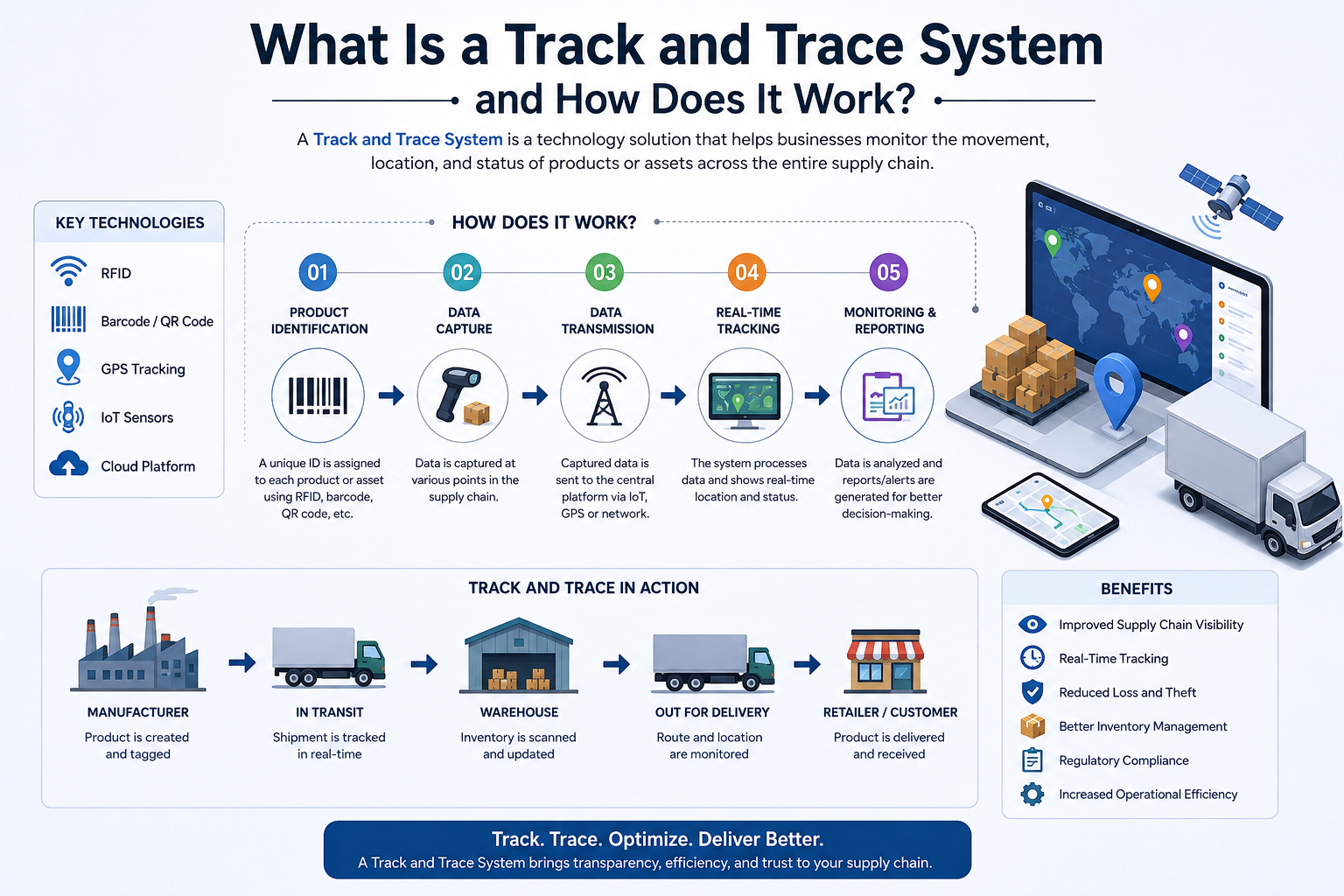
    Digital traceability typically involves several steps:

    1. Data Collection: Product and shipment information is collected using sensors, RFID tags, barcodes, QR codes, or other technologies.
    2. Product Identification: Each product, package, or asset can be assigned a unique identifier.
    3. Real-Time Tracking: Location and status information can be monitored as products move through the supply chain.
    4. Data Integration: Information from warehouses, transportation systems, suppliers, and other sources can be connected.
    5. Monitoring and Reporting: Businesses can analyze the collected information to identify delays, risks, and operational issues.

    Key Technologies Used in Digital Traceability

    Several technologies support modern digital traceability systems, including:

    • RFID: Enables automatic identification and tracking of products and assets.
    • IoT: Uses connected sensors and devices to collect real-time information.
    • GPS: Helps monitor the location of vehicles and shipments.
    • Barcodes and QR Codes: Provide digital identification and product information.
    • Cloud Computing: Stores and provides access to supply chain data.
    • AI and Analytics: Helps identify patterns, predict disruptions, and support decision-making.
    • Blockchain: Can provide a shared and tamper-resistant record of selected supply chain transactions.

    What Is Supply Chain Visibility?

    Supply chain visibility refers to the ability of a business to monitor and understand activities across its supply chain.

    It can include visibility into procurement, manufacturing, inventory, warehousing, transportation, distribution, and delivery. Good visibility allows businesses to understand what is happening at different stages and respond quickly when problems occur.

    Why Supply Chain Visibility Matters

    Poor visibility can result in inventory shortages, excess stock, shipment delays, inaccurate information, and difficulty identifying the source of problems.

    Improved visibility helps organizations:

    • Monitor inventory levels
    • Track shipments
    • Identify bottlenecks
    • Reduce delays
    • Improve forecasting
    • Respond to disruptions
    • Improve customer service
    • Make data-driven decisions

    How Digital Traceability Improves Supply Chain Visibility

    Digital traceability provides businesses with the data required to create a more connected and transparent supply chain.

    Provides Real-Time Product Tracking

    One of the major advantages of digital traceability is real-time tracking. Businesses can monitor products and shipments as they move between suppliers, warehouses, distribution centers, and customers.

    For example, IoT sensors and GPS technology can provide information about shipment location and status. This helps logistics teams identify delays and take corrective action before they significantly affect customers.

    Improves End-to-End Supply Chain Visibility

    Digital traceability can connect information from multiple stages of the supply chain. Instead of viewing procurement, manufacturing, warehousing, and transportation as separate processes, businesses can create a more connected flow of information.

    This end-to-end visibility makes it easier to understand how an issue at one stage could affect another stage.

    Reduces Supply Chain Delays and Disruptions

    Supply chain disruptions can occur because of transportation problems, supplier delays, inventory shortages, or unexpected operational issues.

    Digital traceability helps businesses identify problems earlier. Real-time alerts and monitoring can allow teams to investigate an issue and take action before it creates larger disruptions.

    Improves Inventory Management

    Accurate inventory information is essential for efficient supply chain operations.

    Digital traceability systems can provide information about inventory quantities, locations, movement, and status. This reduces dependence on manual inventory checks and helps businesses minimize both stockouts and excess inventory.

    Enhances Product and Data Accuracy

    Manual data entry can introduce errors into supply chain records. Automated identification and data collection technologies can reduce the need for repetitive manual processes.

    Technologies such as RFID, barcode scanning, and IoT sensors can automatically capture information and improve the accuracy of supply chain records.

    Helps Identify Supply Chain Bottlenecks

    A lack of visibility can make it difficult to determine where delays are occurring.

    Digital traceability provides data about product movement and operational processes. Businesses can analyze this information to identify bottlenecks in manufacturing, warehousing, transportation, or distribution.

    Improves Compliance and Product Traceability

    Many industries require businesses to maintain accurate records about products, materials, suppliers, and processes.

    Digital traceability creates a structured record of product movement and related information. This can help organizations maintain documentation, support audits, and improve regulatory compliance.

    Supports Faster Decision-Making

    When accurate supply chain information is available in real time, managers can make decisions based on current data rather than outdated reports.

    For example, a business can quickly identify a delayed shipment, check available inventory, investigate a supplier issue, or redirect resources when necessary.

    Benefits of Digital Traceability for Supply Chains

    Digital traceability can provide several operational and strategic benefits.

    Increased Transparency

    Businesses gain a clearer understanding of where products and materials are located and what stage of the supply chain they have reached.

    Reduced Operational Costs

    Automation can reduce manual tracking activities and help organizations identify inefficiencies, unnecessary inventory, and avoidable delays.

    Better Risk Management

    Real-time information helps businesses detect potential problems earlier and develop faster responses to supply chain disruptions.

    Improved Customer Trust

    Customers increasingly want reliable information about product availability, delivery status, and product origin. Better traceability can support greater transparency and confidence.

    Faster Recall Management

    If a defective or contaminated product needs to be recalled, traceability data can help businesses identify affected products and determine where they were distributed.

    Improved Supply Chain Efficiency

    When information flows more effectively across different supply chain stages, organizations can coordinate operations more efficiently and improve overall performance.

    Digital Traceability Use Cases Across Industries

    Digital traceability is useful across many industries because organizations in different sectors need to monitor products, assets, materials, or shipments.

    Manufacturing

    Manufacturers can track raw materials, components, work-in-progress inventory, and finished products throughout production and distribution.

    Retail and E-commerce

    Retailers can use traceability to monitor inventory across stores, warehouses, fulfillment centers, and delivery networks.

    Food and Beverage

    Food businesses can track products from suppliers through processing, packaging, distribution, and retail. This can improve product safety and support faster recalls.

    Pharmaceuticals and Healthcare

    Pharmaceutical supply chains require accurate tracking of medicines and other products. Digital traceability can help monitor product movement and maintain records throughout distribution.

    Logistics and Transportation

    Logistics providers can use GPS, IoT, RFID, and other technologies to monitor shipments, vehicles, and assets in transit.

    Challenges of Implementing Digital Traceability

    Although digital traceability offers significant benefits, implementation can present challenges.

    High Initial Implementation Costs

    Organizations may need to invest in tracking devices, software platforms, sensors, infrastructure, and employee training.

    Data Integration Challenges

    Businesses often use multiple systems for inventory, logistics, manufacturing, and procurement. Connecting these systems can require careful planning and technical integration.

    Data Security and Privacy

    Supply chain systems may contain sensitive business information. Organizations need appropriate security controls to protect data from unauthorized access.

    Employee Training and Adoption

    Employees need to understand how to use new systems and technologies effectively. Training and change management can therefore be important parts of implementation.

    Integration With Legacy Systems

    Older systems may not easily communicate with modern traceability platforms. Businesses may need APIs, middleware, or system upgrades to create a connected environment.

    How to Implement Digital Traceability in Your Supply Chain

    Organizations should approach digital traceability as a structured transformation rather than simply installing a tracking tool.

    Identify Traceability Requirements

    First, identify what needs to be tracked, where visibility gaps exist, and which supply chain processes create the greatest risks.

    Select the Right Tracking Technology

    Choose technologies based on business requirements. RFID may be suitable for automated asset identification, while IoT sensors can be useful for monitoring environmental or operational conditions.

    Integrate Data Sources

    Connect information from suppliers, warehouses, manufacturing systems, transportation platforms, and other relevant sources.

    Implement Real-Time Monitoring

    Use dashboards, alerts, and monitoring systems to provide teams with timely information about products, assets, inventory, and shipments.

    Analyze Supply Chain Data

    Collected data can be analyzed to identify inefficiencies, recurring delays, inventory problems, and potential risks.

    Continuously Improve the System

    Digital traceability should evolve with business requirements. Organizations should regularly review system performance and identify opportunities for automation and improvement.

    Future of Digital Traceability and Supply Chain Visibility

    The future of supply chain visibility will increasingly depend on connected technologies and intelligent data analysis.

    AI can help businesses predict potential disruptions and identify patterns in supply chain data. IoT devices can provide continuous information about assets and shipments, while RFID can automate product identification and movement tracking.

    Digital twins and predictive analytics may also help organizations simulate supply chain scenarios and evaluate potential risks before they occur.

    As these technologies continue to develop, digital traceability will become an increasingly important part of building resilient, transparent, and data-driven supply chains.

    Conclusion

    Digital traceability in supply chain management gives businesses greater visibility into the movement of products, materials, assets, and information. By combining technologies such as RFID, IoT, GPS, cloud computing, and analytics, organizations can monitor supply chain activities more effectively.

    Better traceability can help businesses reduce delays, improve inventory management, identify risks, increase transparency, and make faster decisions. As supply chains become more complex, adopting digital traceability can help organizations build more efficient, responsive, and resilient operations.

    FAQs: Digital Traceability and Supply Chain Visibility

    Q1.  What is digital traceability in supply chain?

    Digital traceability in supply chain is the process of digitally tracking products, materials, assets, and information as they move through different stages, from sourcing and manufacturing to warehousing, transportation, and delivery.

    Q2.  How does digital traceability improve supply chain visibility?

    Digital traceability provides real-time information about product location, inventory, shipment status, and supply chain activities. This helps businesses identify delays, bottlenecks, and risks faster while improving decision-making.

    Q3. What technologies are used for digital traceability?

    Common technologies include RFID, IoT sensors, GPS, barcodes, QR codes, cloud computing, AI, analytics, and blockchain. Businesses can combine these technologies depending on their tracking and visibility requirements.

    Q4. What are the benefits of digital traceability?

    Key benefits include improved supply chain visibility, real-time tracking, better inventory management, reduced delays, improved transparency, faster recalls, better compliance, reduced operational costs, and improved customer satisfaction.

    Q5. What is the difference between digital traceability and supply chain visibility?

    Digital traceability focuses on tracking the history, movement, and status of products or materials. Supply chain visibility is broader and provides an overall view of activities and information across the supply chain. Digital traceability is one of the key technologies for achieving better supply chain visibility.

    Q6. Can digital traceability help reduce supply chain disruptions?

    Yes. Digital traceability can provide real-time data and alerts that help businesses detect shipment delays, inventory shortages, supplier issues, and other problems earlier, allowing them to respond more quickly.

    Q7. Which industries use digital traceability?

    Digital traceability is widely used in manufacturing, retail, logistics, transportation, food and beverage, pharmaceuticals, healthcare, and e-commerce to monitor products, assets, inventory, and shipments.

    Q8. Is digital traceability expensive to implement?

    Implementation costs depend on the size and complexity of the supply chain and the technologies being used. Businesses may need to invest in software, RFID tags, IoT devices, integration, infrastructure, and employee training.

    Q9. How does RFID support digital traceability?

    RFID enables businesses to automatically identify and track tagged products, assets, or inventory without requiring direct line-of-sight scanning. This can improve inventory accuracy and provide more efficient tracking across supply chain operations.

    Q10. What is the future of digital traceability?

    The future of digital traceability will increasingly involve AI, IoT, predictive analytics, RFID, digital twins, cloud platforms, and automated monitoring. These technologies can help organizations build more transparent, intelligent, and resilient supply chains.

  • Key Components of a Modern Track and Trace Architecture

    Key Components of a Modern Track and Trace Architecture

    Key Components of a Modern Track and Trace Architecture

    Modern supply chains require more than basic product tracking. Businesses need real-time visibility into where products, assets, shipments, and materials are located, what condition they are in, and what happens to them throughout their journey. This is where a Track and Trace Architecture becomes important.

    A modern track and trace system combines technologies such as RFID, IoT, cloud computing, APIs, analytics, GPS, artificial intelligence, and enterprise software to provide end-to-end supply chain visibility. This architecture helps organizations improve operational efficiency, reduce losses, meet regulatory requirements, and make faster data-driven decisions.

    What Is Track and Trace Architecture?

    Definition of Track and Trace Architecture

    Track and Trace Architecture is the technology framework used to identify, capture, transmit, store, process, and analyze information about products, assets, shipments, or materials as they move through a supply chain.

    It connects physical tracking technologies with digital systems so organizations can monitor the movement and status of goods in real time or near real time.

    Why Modern Track and Trace Architecture Matters

    Traditional tracking systems often provide limited information and may depend on manual data entry. A modern architecture creates a connected environment where information can flow automatically between devices, applications, warehouses, transportation systems, and business platforms.

    This allows organizations to identify delays, monitor inventory, improve traceability, and respond quickly to supply chain disruptions.

    Role of Track and Trace in Supply Chain Visibility

    Track and trace technology provides organizations with visibility across different stages of the supply chain, including manufacturing, warehousing, transportation, distribution, and delivery.

    With better visibility, businesses can understand product movement, identify bottlenecks, monitor inventory levels, and improve customer communication.

    Key Components of a Modern Track and Trace Architecture

    Identification and Data Capture

    The first component of a track and trace system is the identification of products, assets, packages, or shipments.

    Technologies such as RFID tags, barcodes, QR codes, NFC, and digital identifiers can be used to assign unique identities to physical objects.

    Accurate identification ensures that the correct information is associated with the correct product or asset throughout its lifecycle.

    IoT and Connected Devices

    IoT devices allow physical objects to generate and transmit data.

    Sensors can collect information such as:

    • Location
    • Temperature
    • Humidity
    • Movement
    • Shock and vibration
    • Inventory status
    • Equipment condition

    This information can help businesses monitor products and assets continuously rather than relying only on manual inspections.

    Edge Computing and Data Processing

    Large track and trace environments can generate significant volumes of data. Edge computing allows some data to be processed closer to where it is generated.

    For example, an IoT gateway in a warehouse can process sensor information locally before sending relevant information to a central platform.

    This can reduce latency and improve response times for time-sensitive events.

    Track and Trace Data Platform

    A central data platform acts as the foundation for collecting and managing traceability information.

    It can combine data from RFID readers, IoT devices, GPS systems, enterprise applications, warehouses, transportation systems, and other sources.

    The platform provides a unified view of product and asset movements.

    Cloud Infrastructure

    Cloud computing provides the scalability and flexibility required by modern track and trace systems.

    Cloud-based platforms can support large amounts of data and allow authorized users to access tracking information from different locations.

    Cloud infrastructure also makes it easier to scale a solution as the number of products, facilities, users, and transactions increases.

    APIs and System Integration

    Track and trace platforms rarely operate independently. They need to communicate with existing business applications.

    APIs can connect the track and trace system with:

    • ERP systems
    • Warehouse Management Systems (WMS)
    • Transportation Management Systems (TMS)
    • Manufacturing Execution Systems (MES)
    • Customer Relationship Management (CRM) platforms
    • E-commerce platforms

    Integration creates a connected information flow between operational and business systems.

    Data Analytics and Reporting

    Collecting tracking data is only useful when organizations can turn it into actionable information.

    Analytics tools can provide dashboards and reports covering inventory movement, delivery performance, asset utilization, shipment delays, and other important KPIs.

    Advanced analytics can also help organizations identify patterns and potential supply chain problems.

    Alerts and Event Management

    A modern architecture should be capable of identifying important events and generating alerts.

    For example, the system could send an alert when:

    • A shipment is delayed
    • A product leaves an authorized location
    • Temperature exceeds a defined threshold
    • Inventory reaches a critical level
    • An asset remains stationary for too long
    • Unauthorized movement is detected

    Event-based monitoring allows teams to respond before small problems become major disruptions.

    Security and Access Control

    Track and trace systems handle important operational and business data, making security a critical architectural component.

    Security measures may include authentication, role-based access control, encryption, audit trails, secure APIs, and continuous monitoring.

    Organizations should ensure that only authorized users and systems can access sensitive tracking information.

    How a Modern Track and Trace Architecture Works

    Step 1: Product or Asset Identification

    Each product, package, shipment, or asset receives a unique identifier using technologies such as RFID, barcode, QR code, or another digital identification method.

    Step 2: Data Collection

    Readers, scanners, sensors, GPS devices, and other connected technologies collect information about the item’s location, movement, and condition.

    Step 3: Data Transmission

    Collected information is transmitted through networks such as Wi-Fi, cellular networks, Bluetooth, LoRaWAN, or other connectivity technologies.

    Step 4: Data Processing and Storage

    The information is processed and stored within the track and trace platform or connected cloud infrastructure.

    Step 5: Real-Time Monitoring

    Users can view tracking information through dashboards and monitoring interfaces.

    The system can show where products or assets are located and whether they are moving according to the expected process.

    Step 6: Analytics and Decision-Making

    Analytics tools convert tracking data into useful business insights.

    Organizations can use these insights to improve inventory management, transportation planning, operational efficiency, and customer service.

    Technologies Used in Track and Trace Systems

    RFID Technology

    RFID enables automatic identification using radio-frequency signals. It can be particularly useful for warehouse inventory, asset tracking, manufacturing, and supply chain applications.

    IoT Sensors

    IoT sensors enable continuous monitoring of physical conditions such as temperature, humidity, movement, and location.

    Barcode and QR Code Technology

    Barcodes and QR codes provide cost-effective methods for identifying and tracking products, packages, and inventory.

    GPS and Location Tracking

    GPS technology enables organizations to monitor the location of vehicles, shipments, and mobile assets.

    Cloud Computing

    Cloud platforms provide scalable infrastructure for storing, processing, and accessing tracking data.

    Artificial Intelligence and Machine Learning

    AI and machine learning can analyze historical and real-time data to identify patterns, predict potential delays, detect anomalies, and support proactive decision-making.

    Blockchain for Traceability

    Blockchain can provide a shared and tamper-resistant record of selected supply chain transactions. It can be useful in scenarios where multiple organizations need greater confidence in the integrity of traceability records.

    Benefits of a Modern Track and Trace Architecture

    End-to-End Supply Chain Visibility

    Organizations can gain better visibility into products, assets, and shipments across different stages of the supply chain.

    Improved Inventory Management

    Real-time tracking can help businesses understand inventory movement and reduce situations such as overstocking, stockouts, or misplaced inventory.

    Faster Identification of Supply Chain Issues

    Automated alerts and real-time monitoring allow teams to identify delays, abnormal events, and operational problems more quickly.

    Reduced Product Loss and Theft

    Location tracking and event monitoring can help organizations detect unauthorized movement and improve asset security.

    Better Regulatory Compliance

    Detailed traceability records can help organizations demonstrate where products originated, how they moved through the supply chain, and what happened during different stages.

    Improved Customer Transparency

    Businesses can provide customers with better information about shipment status, delivery progress, and product traceability.

    Data-Driven Decision-Making

    Centralized tracking data provides management teams with information that can support better operational and strategic decisions.

    Challenges in Implementing Track and Trace Architecture

    Data Integration Challenges

    Connecting multiple technologies and legacy systems can be complex. Organizations need standardized data formats and reliable integration mechanisms.

    Legacy System Compatibility

    Older ERP, warehouse, manufacturing, and logistics systems may not easily support modern tracking technologies.

    Data Security and Privacy

    The increasing number of connected devices and systems creates additional security considerations. Organizations need appropriate access controls and security monitoring.

    Implementation Costs

    Hardware, software, connectivity, integration, training, and maintenance can increase the initial investment required to implement a track and trace solution.

    Scalability and Performance

    The architecture must be capable of handling increasing numbers of products, devices, locations, users, and data transactions without affecting performance.

    Best Practices for Building a Modern Track and Trace Architecture

    Use a Scalable Architecture

    Design the system so it can support future increases in users, products, locations, devices, and data volumes.

    Integrate Existing Enterprise Systems

    Instead of creating another isolated platform, connect track and trace capabilities with ERP, WMS, TMS, MES, and other relevant business systems.

    Standardize Data Collection

    Use consistent identification methods, data structures, and event definitions to improve data quality and interoperability.

    Prioritize Real-Time Visibility

    Identify business processes where real-time information can provide the greatest operational value and prioritize those use cases.

    Implement Strong Security Controls

    Protect devices, APIs, applications, databases, and user accounts with appropriate security measures.

    Design for Future Technologies

    The architecture should be flexible enough to support emerging technologies such as AI, advanced IoT, digital twins, and new connectivity standards.

    Future of Track and Trace Architecture

    AI-Powered Predictive Traceability

    AI will increasingly help businesses move from reactive tracking to predictive monitoring. Systems can analyze historical and real-time information to identify potential delays and operational risks.

    Digital Twins and Supply Chain Simulation

    Digital twins can create virtual representations of physical assets, facilities, or supply chains. Organizations can use these models to understand processes and evaluate potential changes.

    Advanced IoT Connectivity

    More connected devices and improved connectivity will enable organizations to collect tracking information from an increasing number of physical objects.

    Blockchain-Based Traceability

    Blockchain may continue to support selected traceability applications where organizations require shared and verifiable transaction records.

    Autonomous Supply Chain Monitoring

    Future track and trace platforms may combine IoT, AI, automation, and analytics to detect problems and trigger predefined actions with limited human intervention.

    Conclusion

    A modern Track and Trace Architecture connects identification technologies, IoT devices, connectivity, cloud platforms, APIs, analytics, security, and enterprise systems into a unified traceability environment.

    By implementing the right architecture, organizations can achieve better supply chain visibility, improve inventory management, reduce operational risks, strengthen compliance, and make faster data-driven decisions.

    As AI, IoT, cloud computing, and automation continue to evolve, modern track and trace systems will become increasingly important for organizations seeking greater transparency, resilience, and efficiency across their supply chains.

    Frequently Asked Questions (FAQs)

    Q1. What is Track and Trace Architecture?

    Track and Trace Architecture is a technology framework that enables businesses to identify, monitor, capture, store, and analyze information about products, assets, shipments, and materials throughout their supply chain.

    Q2. What are the key components of a Track and Trace system?

    The key components include identification and data capture, RFID and IoT devices, connectivity, edge computing, cloud infrastructure, data platforms, APIs, analytics, alerts, security, and integration with enterprise systems.

    Q3. How does a modern Track and Trace Architecture work?

    A modern architecture identifies an item, captures its data through technologies such as RFID or IoT, transmits the information to a central platform, processes the data, and provides real-time visibility through dashboards, analytics, and alerts.

    Q4. What technologies are used in Track and Trace systems?

    Common technologies include RFID, barcodes, QR codes, IoT sensors, GPS, cloud computing, APIs, artificial intelligence, machine learning, and blockchain.

    Q5. What are the benefits of Track and Trace Architecture?

    It can improve supply chain visibility, inventory management, product traceability, compliance, shipment monitoring, asset utilization, customer transparency, and operational decision-making.

    Q6. How does IoT improve Track and Trace?

    IoT devices and sensors can continuously collect information such as location, temperature, humidity, movement, and asset condition, enabling businesses to monitor items in real time.

    Q7. Can Track and Trace integrate with ERP and WMS?

    Yes. Modern Track and Trace solutions can integrate with ERP, WMS, TMS, MES, CRM, and other enterprise applications using APIs and integration platforms.

    Q8. Is Track and Trace useful for supply chain management?

    Yes. Track and Trace provides visibility into the movement and status of products, shipments, and assets, helping organizations identify delays, reduce losses, and improve supply chain performance.

    Q9. How does AI support Track and Trace systems?

    AI can analyze tracking data to identify patterns, detect anomalies, predict delays, and provide insights that help organizations make proactive supply chain decisions.

    Q10. What is the future of Track and Trace Architecture?

    The future is likely to include greater use of AI-powered predictive analytics, IoT, digital twins, cloud platforms, automation, advanced connectivity, and blockchain-based traceability for selected use cases.

  • Why Product Traceability Matters for Modern Businesses

    Why Product Traceability Matters for Modern Businesses

    Why Product Traceability Matters for Modern Businesses

    In today’s competitive and interconnected marketplace, businesses need greater visibility into how products move from suppliers to customers. Product traceability helps organizations track a product’s journey across manufacturing, warehousing, transportation, distribution, and retail. By implementing a reliable product traceability system, businesses can improve supply chain visibility, product quality, regulatory compliance, operational efficiency, and customer trust.

    As supply chains become more complex, technologies such as RFID, barcodes, QR codes, IoT, cloud platforms, and blockchain are helping businesses create more transparent and connected operations.

    What Is Product Traceability?

    Product traceability is the ability to track and document the history, movement, location, and status of a product throughout its lifecycle. It provides businesses with information about where a product originated, which processes it went through, where it was stored, and where it was delivered.

    A product traceability system connects information from different stages of the supply chain, enabling organizations to quickly identify the origin and movement of products.

    How Does Product Traceability Work?

    Product traceability generally begins by assigning a unique identifier to a product, component, batch, shipment, or asset. This identifier may be represented using a barcode, QR code, RFID tag, or another digital identification method.

    As products move through manufacturing, storage, transportation, and distribution, relevant information is captured and stored. Authorized employees can then access this information to monitor product movement and history.

    Key Components of a Product Traceability System

    A modern traceability system may include:

    • Unique product identification
    • Barcode and QR code scanning
    • RFID-based tracking
    • Data collection and storage
    • Inventory monitoring
    • Supply chain visibility
    • Reporting and analytics
    • ERP and WMS integration
    • Real-time tracking capabilities

    Why Is Product Traceability Important for Modern Businesses?

    The importance of product traceability has increased as supply chains have become more global and complex. A single product may involve multiple suppliers, manufacturers, warehouses, logistics providers, distributors, and retailers.

    Without proper traceability, it can be difficult to identify where a product came from, where it is currently located, or where a quality problem occurred.

    Improves Supply Chain Visibility

    Product traceability provides businesses with greater visibility into the movement of products across the supply chain. Teams can monitor products from production to final delivery and identify delays or bottlenecks more efficiently.

    Enhances Product Quality and Safety

    Traceability allows businesses to maintain records related to production batches, raw materials, inspections, and handling processes. If a quality problem occurs, organizations can identify potentially affected products more quickly.

    Supports Regulatory Compliance

    Many industries require organizations to maintain detailed product and production records. A traceability system can help businesses maintain accurate information and retrieve relevant records when needed.

    Reduces Product Recalls and Losses

    When a defective product is identified, businesses can use traceability data to determine which products or batches may be affected. This can help organizations respond faster and potentially reduce the scope and cost of recalls.

    Builds Customer Trust

    Modern customers increasingly value transparency. Businesses that can provide reliable information about product origin, quality, and supply chain movement can strengthen customer confidence.

    Key Benefits of Product Traceability

    Implementing product traceability solutions can provide benefits across manufacturing, logistics, inventory management, and customer service.

    Better Inventory Management

    Accurate product tracking helps businesses understand what inventory they have and where it is located. This can reduce inventory discrepancies and improve stock management.

    Faster Issue Identification

    When an issue occurs, businesses can use traceability information to identify the affected product, batch, supplier, or process. This can reduce investigation time.

    Improved Operational Efficiency

    Automated product tracking can reduce manual data entry and paperwork. Employees can spend less time searching for product information and more time focusing on productive activities.

    Data-Driven Decision Making

    Traceability systems generate valuable operational data. Businesses can analyze this information to identify trends, improve processes, and make better supply chain decisions.

    Increased Supply Chain Transparency

    End-to-end product traceability provides greater transparency between suppliers, manufacturers, warehouses, distributors, and retailers.

    Industries That Need Product Traceability

    Product traceability is valuable across industries where product quality, safety, compliance, and supply chain visibility are important.

    Pharmaceutical and Healthcare

    Pharmaceutical organizations can use traceability to monitor medicines, batches, packaging, and distribution. This can support inventory management, product authenticity, and compliance requirements.

    Food and Beverage

    Food manufacturers and distributors can track ingredients and products from suppliers through production and distribution. This can help organizations respond quickly to food safety issues and recalls.

    Manufacturing

    Manufacturers can track raw materials, components, work-in-progress products, production batches, and finished goods throughout their operations.

    Automotive

    Automotive companies can use product tracking and traceability to monitor components and parts throughout manufacturing and distribution while maintaining supplier and production records.

    Retail and E-commerce

    Retailers can use traceability technology to improve inventory visibility, order fulfillment, returns management, and product information.

    Logistics and Supply Chain

    Logistics companies can track shipments, packages, containers, and other assets as they move between different locations.

    Technologies Used in Product Traceability

    Modern product traceability solutions combine identification technologies, data collection, connectivity, and analytics.

    RFID Technology

    RFID technology allows businesses to identify and track products and assets using radio-frequency communication. It can support automated tracking and inventory visibility.

    Barcodes and QR Codes

    Barcodes and QR codes provide cost-effective ways to identify products, packages, and shipments. They are widely used in manufacturing, warehouses, retail, and logistics.

    IoT and Smart Sensors

    IoT devices and sensors can collect information such as location, temperature, humidity, and other environmental conditions. This can be particularly useful for products that require controlled storage or transportation.

    Blockchain

    Blockchain can provide a shared digital record of product events and transactions. It can be useful in supply chains where multiple parties need access to a consistent record of information.

    Cloud-Based Traceability Platforms

    Cloud-based platforms can centralize product information and provide authorized users with access from different locations. They can also integrate with ERP, WMS, inventory, and analytics systems.

    Challenges of Implementing Product Traceability

    Although product traceability provides significant benefits, businesses may face several implementation challenges.

    Integration With Existing Systems

    A traceability platform may need to connect with ERP, warehouse management, manufacturing, inventory, and logistics systems. Poor integration can create data silos.

    Data Management and Accuracy

    Reliable traceability depends on accurate data. Incorrect product identification, missing information, or duplicate records can affect system performance.

    Implementation Costs

    Businesses may need to invest in software, hardware, RFID tags, scanners, sensors, cloud infrastructure, integration, and employee training.

    Employee Training and Adoption

    Employees need proper training to use new traceability technologies correctly. Clear processes and ongoing training can improve adoption and data quality.

    How Businesses Can Implement Product Traceability

    Businesses should approach traceability implementation systematically.

    Identify Traceability Requirements

    First, determine which products, processes, locations, and supply chain stages need to be tracked.

    Choose the Right Technology

    Select technology according to business requirements. Barcodes may be suitable for basic product identification, while RFID can support automated tracking and IoT can provide environmental monitoring.

    Integrate Traceability With Business Systems

    Connect the traceability platform with relevant ERP, WMS, inventory, manufacturing, and logistics systems to create a connected flow of information.

    Monitor and Improve the System

    After implementation, businesses should monitor tracking accuracy, data quality, system performance, and operational results. Continuous improvement can help maximize the value of the solution.

    Future of Product Traceability

    The future of product traceability is closely connected with AI, IoT, automation, and real-time analytics.

    AI-Powered Traceability

    AI can analyze large volumes of supply chain data to identify unusual patterns, detect potential problems, and support predictive decision-making.

    Real-Time Supply Chain Visibility

    Businesses are increasingly moving toward real-time supply chain visibility, allowing teams to monitor products, shipments, and assets more continuously.

    IoT-Enabled Product Tracking

    Connected IoT sensors can provide real-time information about product location and environmental conditions during transportation and storage.

    Predictive Analytics and Automation

    Traceability data can be combined with predictive analytics to identify potential delays, inventory problems, quality issues, and supply chain risks before they become major problems.

    Conclusion

    Product traceability is becoming an essential capability for modern businesses operating complex supply chains. It provides greater visibility into product movement, improves quality management, supports regulatory compliance, reduces operational risks, and helps build customer trust.

    By combining RFID, barcodes, QR codes, IoT, cloud platforms, blockchain, and analytics, businesses can create more transparent and efficient supply chains. As organizations continue adopting digital transformation and automation, product traceability solutions will play an increasingly important role in improving supply chain visibility, efficiency, and resilience.

    Frequently Asked Questions (FAQs)

    Q1. What is product traceability?

    Product traceability is the process of tracking and recording a product’s journey throughout the supply chain, from raw materials and manufacturing to warehousing, transportation, distribution, and final delivery.

    Q2. Why is product traceability important for businesses?

    Product traceability helps businesses improve supply chain visibility, product quality, inventory management, regulatory compliance, and customer trust. It also helps organizations identify and respond to product issues more quickly.

    Q3. What are the benefits of product traceability?

    Key benefits include better inventory management, improved supply chain visibility, faster identification of quality issues, reduced recall risks, improved operational efficiency, regulatory compliance, and greater customer confidence.

    Q4. Which technologies are used for product traceability?

    Common technologies include RFID, barcodes, QR codes, IoT sensors, cloud-based platforms, blockchain, and data analytics. Businesses can select technologies according to their specific tracking and operational requirements.

    Q5. Which industries use product traceability?

    Product traceability is widely used in pharmaceuticals, healthcare, food and beverage, manufacturing, automotive, retail, e-commerce, logistics, and supply chain management.

    Q6. How does RFID improve product traceability?

    RFID enables businesses to identify and track products and assets using radio-frequency technology. It can automate data collection and provide better visibility into inventory and product movement.

    Q7. What is the difference between product tracking and product traceability?

    Product tracking mainly focuses on knowing where a product is or where it has moved, while product traceability provides a broader record of the product’s history, origin, processes, movement, and related supply chain information.

    Q8. How can businesses implement a product traceability system?

    Businesses can start by identifying their traceability requirements, selecting appropriate technologies, assigning unique product identifiers, integrating the system with existing business software, training employees, and continuously monitoring system performance.

    Q9. Is product traceability useful for small businesses?

    Yes. Small businesses can also benefit from product traceability by improving inventory accuracy, reducing errors, monitoring product movement, managing recalls, and increasing supply chain visibility. The technology can be scaled according to business size and requirements.


  • How End-to-End Traceability Works Across Modern Supply Chains

    How End-to-End Traceability Works Across Modern Supply Chains

    How End-to-End Traceability Works Across Modern Supply Chains

    Modern supply chains involve multiple suppliers, manufacturers, warehouses, logistics providers, distributors, retailers, and customers. With so many moving parts, businesses need accurate information about where products come from, where they are, and what happens to them at every stage. This is where end-to-end traceability becomes important.

    End-to-end traceability provides visibility across the complete supply chain, from raw material sourcing to manufacturing, transportation, distribution, and final delivery. By using technologies such as RFID, IoT, barcodes, cloud platforms, and data analytics, organizations can improve visibility, quality control, compliance, and operational efficiency.

    What Is End-to-End Supply Chain Traceability?

    End-to-end supply chain traceability is the ability to track and record the history, movement, location, and transformation of products, materials, and components throughout the entire supply chain.

    Unlike basic shipment tracking, traceability provides a broader view of a product’s journey. It can help businesses identify:

    • Where a product or material originated
    • Which supplier provided it
    • When it entered production
    • Which batch or lot it belongs to
    • Where it was stored
    • How it was transported
    • Where it was delivered
    • Which customers or locations received it

    This information creates a connected view of the supply chain and helps businesses make faster, data-driven decisions.

    Traceability vs. Tracking

    Tracking generally focuses on knowing the current or previous location of an item. Traceability goes further by maintaining information about the item’s complete history.

    For example, tracking may tell a company that a shipment is currently in Delhi, while traceability can show the supplier of the product, production batch, manufacturing date, warehouse movements, transportation history, and final destination.

    How End-to-End Traceability Works

    End-to-end traceability works by capturing and connecting data at important points throughout the supply chain.

    1. Raw Material and Supplier Tracking

    The process begins with suppliers and raw materials. Businesses can record information about suppliers, material types, batches, quantities, origins, and delivery dates.

    RFID tags, barcodes, QR codes, and digital records can be used to identify materials and connect them with supplier information.

    This allows manufacturers to understand where materials came from and which products were created using specific materials.

    2. Manufacturing and Production Tracking

    Once materials reach the manufacturing facility, traceability continues through the production process.

    Companies can record information such as:

    • Production batches
    • Manufacturing dates
    • Machine or production lines
    • Components used
    • Quality inspection results
    • Employees or processes involved
    • Packaging information

    This creates a digital production history that can be useful for quality management and product recalls.

    3. Warehouse and Inventory Tracking

    After production, products often move through warehouses and distribution centers.

    Traceability systems can record when products enter a warehouse, where they are stored, when they are moved, and when they are dispatched.

    RFID and barcode technologies can automate identification and reduce manual inventory errors.

    4. Logistics and Transportation Tracking

    Products then move through transportation networks. Traceability systems can connect shipment information with transportation data.

    IoT-enabled devices can also provide real-time information about location and environmental conditions.

    For temperature-sensitive products, sensors can monitor conditions such as temperature and humidity during transportation.

    5. Distribution and Retail Tracking

    After transportation, products may move to distributors, retailers, or other business locations.

    Traceability allows organizations to maintain records of these movements and understand where products have been distributed.

    This is particularly useful when businesses need to identify specific products or batches across multiple locations.

    6. Final Product and Customer Traceability

    The final stage connects products with their destination. Depending on the business model, companies may be able to connect finished products with retailers, distributors, or customers.

    This creates a more complete picture of the product lifecycle and can support after-sales services, warranty management, recalls, and customer transparency.

    Technologies Enabling End-to-End Traceability

    Modern traceability systems combine several technologies to collect, store, and analyze supply chain data.

    RFID Technology

    RFID uses radio-frequency identification to identify and track tagged products, assets, or inventory.

    Unlike traditional barcode scanning, RFID can enable automated identification without requiring direct line-of-sight scanning in many applications.

    Businesses can use RFID for inventory management, warehouse operations, asset tracking, and product traceability.

    Barcodes and QR Codes

    Barcodes and QR codes remain widely used for product identification and tracking.

    They provide a relatively simple way to associate physical products with digital information, including product IDs, batch numbers, manufacturing information, or other relevant data.

    IoT Sensors

    Internet of Things (IoT) devices can collect real-time information from products, equipment, vehicles, and storage environments.

    For example, IoT sensors can monitor:

    • Location
    • Temperature
    • Humidity
    • Shock and vibration
    • Equipment conditions
    • Storage conditions

    This can be especially valuable for pharmaceuticals, food, chemicals, and other products that require controlled environments.

    Cloud-Based Traceability Platforms

    Cloud platforms allow organizations to collect and manage supply chain data from multiple locations.

    Instead of keeping information in isolated systems, businesses can create a centralized environment where authorized teams can access relevant traceability information.

    Blockchain for Supply Chain Traceability

    Blockchain can provide a shared digital record of selected supply chain transactions.

    When implemented appropriately, it can help multiple parties maintain a consistent record of transactions and product information.

    However, blockchain is not necessary for every traceability project. Businesses should select technologies based on their specific requirements, data architecture, cost, and operational needs.

    AI and Data Analytics

    AI and analytics can transform traceability data into actionable insights.

    Businesses can analyze historical and real-time data to identify unusual patterns, potential delays, quality issues, inventory problems, and supply chain risks.

    Key Benefits of End-to-End Traceability

    Improved Supply Chain Visibility

    Traceability gives organizations greater visibility into products, materials, inventory, and shipments.

    Instead of relying on disconnected information, teams can access data from multiple stages of the supply chain.

    Faster Product Recalls

    When a quality or safety problem occurs, companies need to identify affected products quickly.

    Traceability can help organizations identify specific batches, production records, distribution locations, and potentially affected products.

    This can make recall processes more targeted and efficient.

    Better Quality Control

    Traceability helps businesses understand where a problem occurred.

    For example, if a defective product is identified, the company can investigate its production batch, components, supplier, manufacturing process, and distribution history.

    Improved Regulatory Compliance

    Many industries require organizations to maintain detailed records about products and processes.

    Traceability systems can help businesses maintain organized digital records and improve their ability to demonstrate compliance.

    Reduced Operational Costs

    Better visibility can help companies reduce manual data entry, inventory discrepancies, product losses, unnecessary delays, and operational inefficiencies.

    Greater Customer Trust

    Customers increasingly want information about where products come from and how they are produced.

    Traceability can help businesses provide greater transparency and build customer confidence.

    Challenges of Implementing Supply Chain Traceability

    Although traceability provides significant benefits, implementing it across an entire supply chain can be challenging.

    Data Integration Across Systems

    Organizations often use multiple systems, including ERP, WMS, TMS, CRM, manufacturing platforms, and IoT systems.

    Connecting these systems and creating consistent data flows can require significant planning and integration work.

    Lack of Standardization

    Different suppliers and partners may use different identification methods, data formats, and technologies.

    Standardizing information across the supply chain is therefore an important part of successful traceability implementation.

    Implementation Costs

    Traceability may require investment in software, RFID readers, tags, sensors, scanners, cloud infrastructure, integration, and employee training.

    Companies should therefore identify high-value use cases before implementing traceability across every process.

    Data Accuracy and Quality

    A traceability system is only as useful as the data it receives.

    Incorrect product IDs, missing records, duplicate information, or delayed data can reduce the accuracy of supply chain visibility.

    Supplier and Partner Adoption

    End-to-end traceability often requires participation from multiple organizations.

    If suppliers, logistics providers, distributors, and other partners do not share the required information, complete visibility can be difficult to achieve.

    Industries Using End-to-End Traceability

    Manufacturing

    Manufacturers use traceability to monitor raw materials, components, production batches, work-in-progress, and finished products.

    Food and Beverage

    Food companies can use traceability to monitor ingredients, production batches, packaging, distribution, and product recalls.

    Pharmaceuticals and Healthcare

    Pharmaceutical traceability can support product identification, serialization, supply chain monitoring, quality management, and regulatory requirements.

    Retail and Consumer Goods

    Retail businesses can use traceability to improve inventory visibility, product movement, distribution, and product information.

    Automotive

    Automotive manufacturers can track components and materials across suppliers, production facilities, and assembly processes.

    Logistics and Transportation

    Logistics companies can use traceability to monitor shipments, assets, vehicles, delivery processes, and transportation conditions.

    How to Implement End-to-End Traceability

    Implementing traceability should be treated as a structured business and technology project.

    Step 1: Identify Traceability Requirements

    First, determine what needs to be tracked.

    This could include raw materials, products, components, assets, shipments, batches, or production processes.

    Step 2: Define Data and Tracking Points

    Identify where information needs to be captured.

    For example, tracking points may include supplier locations, manufacturing lines, warehouses, transportation hubs, distribution centers, and retail locations.

    Step 3: Select the Right Technologies

    Choose technologies based on operational requirements.

    Depending on the use case, businesses may use RFID, barcodes, QR codes, IoT sensors, cloud platforms, APIs, analytics, or other technologies.

    Step 4: Integrate Existing Systems

    Connect the traceability solution with existing enterprise systems such as ERP, WMS, TMS, manufacturing systems, and inventory platforms.

    Integration helps prevent data from becoming isolated in separate systems.

    Step 5: Create a Centralized Data Environment

    Create a reliable environment where relevant supply chain information can be collected, stored, accessed, and analyzed.

    This provides teams with a more consistent source of supply chain information.

    Step 6: Monitor and Optimize

    Traceability should not be treated as a one-time implementation.

    Businesses should continuously monitor system performance, data quality, operational KPIs, and user adoption.

    Real-World Example of End-to-End Traceability

    From Supplier to Customer

    Consider a manufacturer producing packaged consumer goods.

    The process may look like this:

    Supplier → Manufacturing → Quality Inspection → Warehouse → Transportation → Distributor → Retailer → Customer

    At the supplier stage, raw materials receive identification information.

    During manufacturing, the materials are connected with production batches. After quality inspection, finished products are recorded and moved into inventory.

    When products leave the warehouse, shipment information is recorded. During transportation, IoT devices may provide location or environmental data.

    Once the products reach distributors and retailers, their movements can continue to be recorded.

    This creates a connected traceability chain from the original material to the final destination.

    Future of Supply Chain Traceability

    AI-Powered Traceability

    AI will increasingly help businesses analyze large volumes of traceability data.

    AI-based systems can identify anomalies, predict potential disruptions, and support faster decision-making.

    Real-Time Supply Chain Visibility

    As IoT adoption increases, companies can collect more real-time information about products, vehicles, warehouses, and environmental conditions.

    This can move supply chain management from reactive monitoring toward proactive management.

    Digital Product Passports

    Digital product passports can provide structured information about products, materials, origin, lifecycle, and other relevant attributes.

    They can support greater transparency and product-level information sharing.

    Connected and Automated Supply Chains

    The combination of IoT, RFID, AI, robotics, cloud platforms, and automation can create increasingly connected supply chains.

    Future traceability systems are likely to become more automated, intelligent, and capable of identifying risks before they become major operational problems.

    Conclusion

    End-to-end traceability is becoming an important capability for modern supply chains. It connects information from suppliers and raw materials through manufacturing, warehousing, transportation, distribution, and final delivery.

    By combining technologies such as RFID, barcodes, IoT, cloud platforms, AI, and analytics, businesses can improve supply chain visibility, quality control, compliance, recall management, and operational efficiency.

    However, successful traceability requires more than technology. Organizations must also establish clear processes, reliable data standards, system integration, and collaboration across supply chain partners.

    For businesses looking to build a connected and transparent supply chain, end-to-end traceability can provide the foundation for better visibility, smarter decisions, and more resilient operations.

    Frequently Asked Questions (FAQs)

    Q1. What is end-to-end traceability in the supply chain?

    End-to-end traceability is the ability to track a product, material, or component throughout its entire supply chain, from raw material sourcing and manufacturing to warehousing, transportation, distribution, and final delivery.

    Q2. How does supply chain traceability work?

    Supply chain traceability works by collecting and connecting data at different stages of the supply chain. Technologies such as RFID, barcodes, QR codes, IoT sensors, cloud platforms, and analytics help businesses record product movements, batches, locations, and other important information.

    Q3. Why is end-to-end traceability important?

    End-to-end traceability improves supply chain visibility, quality control, regulatory compliance, inventory management, recall processes, and operational efficiency. It also helps businesses identify problems and respond to supply chain disruptions more quickly.

    Q4. What technologies are used for supply chain traceability?

    Common technologies include RFID, barcodes, QR codes, IoT sensors, GPS, cloud platforms, APIs, blockchain, artificial intelligence, and data analytics. The appropriate technology depends on the company’s products, processes, and traceability requirements.

    Q5. What is the difference between tracking and traceability?

    Tracking generally focuses on finding the current or previous location of an item, while traceability provides information about the item’s broader history, including its origin, production, movement, transformation, and destination.

    Q6. How does RFID improve supply chain traceability?

    RFID enables businesses to automatically identify and track tagged products, assets, and inventory. It can reduce manual scanning, improve inventory accuracy, and provide better visibility into product movements.

    Q7. Can IoT be used for end-to-end supply chain traceability?

    Yes. IoT sensors can collect real-time information such as location, temperature, humidity, shock, and other environmental conditions. This is particularly useful for food, pharmaceuticals, healthcare, and temperature-sensitive products.

    Q8. What are the main challenges of implementing supply chain traceability?

    Common challenges include system integration, data quality, lack of standardization, implementation costs, technology selection, and cooperation between suppliers, manufacturers, logistics providers, and other supply chain partners.

    Q9. Which industries benefit from end-to-end traceability?

    Industries such as manufacturing, food and beverage, pharmaceuticals, healthcare, automotive, retail, logistics, and consumer goods can benefit from end-to-end traceability.

    Q10. How can businesses implement end-to-end traceability?

    Businesses can start by identifying what needs to be tracked, defining data collection points, selecting suitable technologies, integrating existing systems, establishing centralized data management, and continuously monitoring and improving the traceability process.

  • Track and Trace vs Tracking: Understanding the Difference

    Track and Trace vs Tracking: Understanding the Difference

    Track and Trace vs Tracking: Understanding the Difference

    In today’s fast-moving supply chains, businesses need accurate visibility into products, shipments, inventory, and assets. Two commonly used terms are tracking and track and trace. Although they may sound similar, they serve different purposes and provide different levels of visibility.

    Understanding Track and Trace vs Tracking can help businesses choose the right technology for improving supply chain visibility, inventory management, compliance, and operational efficiency.

    What Is Tracking?

    Tracking is the process of monitoring the current location, status, or movement of an asset, vehicle, shipment, or product. It primarily answers the question: “Where is it now?”

    Tracking systems collect information at different points and provide businesses with real-time or near-real-time visibility.

    How Tracking Works

    Tracking generally uses technologies such as GPS, RFID, IoT sensors, barcodes, and mobile applications. The collected information is sent to a centralized system where users can monitor the current status or location of an asset.

    For example, a logistics company can use GPS tracking to monitor the location of a delivery vehicle while it is transporting goods.

    Key Features of Tracking

    Some common features of tracking include:

    • Real-time or near-real-time location monitoring
    • Shipment status updates
    • Fleet monitoring
    • Asset location management
    • Delivery notifications
    • Basic operational visibility

    Common Tracking Technologies

    Businesses commonly use:

    • GPS
    • RFID
    • Barcode systems
    • QR codes
    • IoT sensors
    • Mobile tracking applications

    What Is Track and Trace?

    Track and trace is a broader system that monitors an item throughout its journey and maintains information about its movement, history, origin, destination, and important events.

    While tracking mainly focuses on the current status or location, track and trace can answer questions such as “Where did it come from?”, “Where has it been?”, “What happened during its journey?”, and “Where is it now?”

     Track and Trace Works

    A track and trace system collects data at multiple stages of a product’s lifecycle. This can include manufacturing, packaging, warehousing, transportation, distribution, and delivery.

    Each event can be recorded and connected to the product or shipment, creating a detailed history of its journey.

    Key Features of Track and Trace

    Important features include:

    • End-to-end supply chain visibility
    • Product and shipment history
    • Origin and destination tracking
    • Event and transaction records
    • Product traceability
    • Compliance reporting
    • Recall management
    • Real-time monitoring and alerts

    Common Track and Trace Technologies

    Track and trace solutions can combine several technologies, including:

    • RFID
    • Barcodes and QR codes
    • GPS
    • IoT sensors
    • Cloud platforms
    • Artificial intelligence
    • Blockchain
    • Supply chain management software

    Track and Trace vs Tracking: Key Differences

    The main difference between tracking and track and trace is the level of visibility and historical information they provide.

    Feature Tracking Track and Trace
    Primary purpose Monitor current location or status Monitor and record the complete journey
    Main question Where is it now? Where has it been and where is it now?
    Visibility Current/real-time End-to-end and historical
    Data Location and status Location, history, events, origin, and destination
    Traceability Limited Comprehensive
    Compliance Basic Advanced
    Recall management Limited Strong
    Supply chain visibility Partial End-to-end

    Difference in Data Collection

    Tracking usually collects information related to the current location or status of an asset or shipment.

    Track and trace collects information throughout the supply chain and connects individual events to create a complete product or shipment history.

    Difference in Visibility

    Tracking provides visibility into the current position or status of an item.

    Track and trace provides a broader view by showing the item’s movement and important events throughout its lifecycle.

    Difference in Traceability

    Traditional tracking may not provide enough historical information to identify every stage through which a product has passed.

    Track and trace is specifically designed to maintain this history, making it useful for industries where product traceability is important.

    Difference in Use Cases

    Tracking is commonly used for fleet management, shipment monitoring, and asset location.

    Track and trace is often used in manufacturing, pharmaceuticals, food and beverage, logistics, retail, and other industries requiring detailed supply chain visibility.

    Difference in Compliance and Reporting

    Track and trace systems can maintain detailed records that support regulatory requirements, audits, product recalls, and supply chain reporting.

    Tracking alone may not provide the complete historical data required for these activities.

    Track and Trace vs Tracking: Which One Need Your Business?

    The right solution depends on the organization’s operational requirements.

    When Tracking Is the Better Choice

    Tracking may be suitable when the primary objective is to monitor the current location or status of assets, vehicles, or shipments.

    For example, a transportation company may only need GPS-based vehicle tracking to monitor fleet movement.

    When Track and Trace Is the Better Choice

    Track and trace is more appropriate when a business needs complete visibility into the movement and history of products or shipments.

    It is particularly valuable when businesses need traceability, compliance records, product authentication, or recall capabilities.

    When Businesses Should Use Both

    Many modern supply chains benefit from using both tracking and traceability.

    For example, IoT and GPS can provide real-time location information, while a track and trace platform can store historical events and connect information across manufacturing, warehousing, transportation, and delivery.

    Benefits of Track and Trace Solutions

    Track and trace solutions can provide several benefits to businesses.

    Improved Supply Chain Visibility

    Businesses can gain greater visibility into products, shipments, and assets as they move through different stages of the supply chain.

    Faster Problem Identification

    When an issue occurs, businesses can identify where and when the problem happened. This can help reduce delays and improve response times.

    Better Inventory Management

    Real-time information and historical records can help organizations improve inventory accuracy and reduce losses caused by misplaced or incorrectly recorded products.

    Regulatory Compliance

    Industries with strict traceability requirements can use track and trace systems to maintain digital records and support audits and compliance processes.

    Improved Customer Transparency

    Businesses can provide customers with better information about shipment status, product origin, and delivery progress.

    Technologies Used in Track and Trace Systems

    Modern track and trace solutions combine multiple technologies to collect, process, and analyze supply chain data.

    RFID

    RFID enables businesses to identify and monitor tagged products, assets, and inventory without requiring direct line-of-sight scanning.

    Barcodes and QR Codes

    Barcodes and QR codes provide a cost-effective way to identify products and record movement at different supply chain checkpoints.

    GPS and IoT

    GPS can provide location information, while IoT sensors can collect additional data such as temperature, humidity, movement, and other environmental conditions.

    Cloud-Based Platforms

    Cloud platforms allow businesses to centralize tracking and traceability information and provide access to supply chain data across different locations.

    Blockchain

    Blockchain can be used to create distributed records of supply chain transactions and events, particularly where multiple organizations need to share trusted information.

    Industries That Use Track and Trace

    Track and trace solutions are used across many industries where visibility and traceability are important.

    Manufacturing

    Manufacturers can monitor raw materials, components, work-in-progress products, and finished goods throughout production and distribution.

    Pharmaceuticals and Healthcare

    Pharmaceutical companies can use track and trace systems to monitor medicines, batches, and shipments while supporting product safety and regulatory requirements.

    Logistics and Transportation

    Logistics companies can monitor shipments, vehicles, delivery events, and transportation routes.

    Retail

    Retailers can use traceability systems to improve inventory visibility, product movement, and supply chain management.

    Food and Beverage

    Food businesses can track ingredients and finished products from suppliers through production and distribution, helping improve transparency and recall management.

    Track and Trace vs Tracking: The Future of Supply Chain Visibility

    Supply chains are becoming increasingly connected and data-driven. Technologies such as IoT, artificial intelligence, RFID, cloud computing, and automation are making it easier for businesses to monitor products and capture supply chain events.

    In the future, track and trace systems are expected to provide more predictive insights instead of simply recording past and current events. AI-powered analytics can help businesses identify potential delays, supply chain risks, inventory problems, and unusual patterns before they become major issues.

    Conclusion

    The difference between Track and Trace vs Tracking mainly comes down to the level of visibility provided.

    Tracking focuses primarily on monitoring the current location or status of an asset, shipment, or product. Track and trace goes further by recording the item’s journey, history, events, origin, and destination.

    For businesses that only need location visibility, a tracking solution may be sufficient. However, organizations that require end-to-end supply chain visibility, product history, compliance, and detailed traceability can benefit from a comprehensive track and trace solution.

    As supply chains become more connected, combining real-time tracking with end-to-end traceability can help businesses improve efficiency, transparency, and supply chain resilience.

    Frequently Asked Questions About Track and Trace vs Tracking

    Q1. What is the difference between tracking and track and trace?

    Tracking mainly monitors the current location or status of a product, shipment, vehicle, or asset. Track and trace provides broader visibility by recording an item’s movement, history, origin, destination, and important events throughout its journey.

    Q2. Is track and trace better than tracking?

    Not necessarily. The right solution depends on business requirements. Tracking is suitable when a business mainly needs current location or status information, while track and trace is more suitable for businesses that require end-to-end visibility and detailed product or shipment history.

    Q3. What technologies are used for track and trace?

    Track and trace systems commonly use RFID, barcodes, QR codes, GPS, IoT sensors, cloud platforms, artificial intelligence, blockchain, and supply chain management software.

    Q4. Why is track and trace important for supply chains?

    Track and trace improves supply chain visibility by helping businesses monitor products and shipments throughout their journey. It can also support inventory management, compliance, recall management, problem identification, and customer transparency.

    Q5. Can tracking and track and trace be used together?

    Yes. Businesses can combine real-time tracking technologies such as GPS and IoT with a track and trace platform. This provides both current location information and historical supply chain data.

    Q6. Which industries use track and trace solutions?

    Track and trace solutions are widely used in manufacturing, pharmaceuticals, healthcare, logistics, transportation, retail, food and beverage, and other industries that require detailed supply chain visibility and traceability.

    Q7. Does track and trace help with regulatory compliance?

    Yes. Track and trace systems can maintain digital records of products, shipments, and supply chain events. These records can help organizations meet applicable traceability, reporting, audit, and regulatory requirements.

    Q8. How does RFID support track and trace?

    RFID can automatically identify and capture information about tagged products or assets as they move through different checkpoints. When integrated with a track and trace platform, RFID data can contribute to real-time visibility and detailed movement histories.

    Q9. What is the main goal of a track and trace system?

    The main goal is to provide end-to-end visibility into the movement and history of products, shipments, or assets. It helps businesses understand where an item is, where it has been, and what events occurred during its journey.

  • What Is a Track and Trace System and How Does It Work?

    What Is a Track and Trace System and How Does It Work?

    A Track and Trace System is a technology-based solution that helps businesses monitor the movement, location, and status of products, shipments, assets, and inventory throughout the supply chain. It provides businesses with better visibility into where an item is, where it has been, and where it is going.

    Modern track and trace solutions use technologies such as RFID, barcodes, QR codes, GPS, IoT sensors, cloud platforms, and analytics to collect and manage tracking information. These systems are widely used across manufacturing, logistics, healthcare, retail, pharmaceuticals, food, and other industries.

    What is a Track and Trace System?

    A Track and Trace System is a digital system designed to track the current location of an item and trace its movement throughout its lifecycle.

    Tracking focuses on determining the current location and status of a product, shipment, vehicle, or asset. Tracing focuses on understanding the item’s historical journey, including where it originated, which locations it passed through, and what processes it went through.

    For example, when a product moves from a manufacturer to a warehouse and then to a retailer, a track and trace system can record each stage. Businesses can use this information to monitor shipments, identify delays, manage inventory, and investigate problems.

    Definition of a Track and Trace System

    In simple terms, a track and trace system answers two important questions:

    • Where is the item now?
    • Where has the item been?

    The system collects information at different points in the supply chain and stores it in a centralized platform. Authorized users can then access this information to monitor operations and make better decisions.

    Why Is Track and Trace Important for Businesses?

    Supply chains can involve manufacturers, suppliers, warehouses, transporters, distributors, retailers, and customers. Without proper visibility, it can become difficult to identify where products are located or why shipments are delayed.

    A track and trace system provides greater visibility and helps businesses:

    • Monitor products and shipments in real time
    • Improve inventory accuracy
    • Reduce losses and misplaced items
    • Identify supply chain delays
    • Improve customer service
    • Support regulatory compliance
    • Maintain product history and traceability

    How Does a Track and Trace System Work?

    A Track and Trace System generally works by identifying an item, collecting data about it, transmitting that data to a centralized platform, and making the information available for monitoring and analysis.

    Step 1: Product Identification

    The first step is assigning a unique identification number or digital identity to a product, shipment, asset, or package.

    Businesses may use:

    • RFID tags
    • Barcodes
    • QR codes
    • Serial numbers
    • GPS devices
    • IoT-enabled sensors

    This unique identification allows the system to distinguish one item from another.

    Step 2: Data Capture

    Once the item is identified, tracking information is captured at different points in the supply chain.

    For example, an RFID reader can automatically detect a tagged product when it enters a warehouse. Similarly, employees can scan a barcode when a shipment is dispatched.

    The collected information may include:

    • Product ID
    • Location
    • Date and time
    • Shipment status
    • Quantity
    • Temperature or environmental conditions
    • Movement history

    Step 3: Data Transmission

    The captured data is transmitted to tracking software or a centralized database.

    Depending on the system, data can be transferred using technologies such as Wi-Fi, cellular networks, Bluetooth, GPS, or other IoT communication technologies.

    Step 4: Real-Time Tracking

    The tracking platform processes incoming data and provides visibility into the current status and location of items.

    For example, a logistics company can monitor whether a shipment is:

    • In transit
    • At a warehouse
    • Delayed
    • Delivered
    • Returned

    This information can be displayed through dashboards, mobile applications, or web-based platforms.

    Step 5: Data Monitoring and Reporting

    The final step involves analyzing collected information to identify trends, delays, exceptions, and operational issues.

    Businesses can generate reports and alerts to improve supply chain performance and take corrective action when necessary.

    Key Components of a Track and Trace System

    A modern track and trace solution usually combines multiple hardware and software technologies.

    RFID Technology

    Radio Frequency Identification (RFID) uses radio waves to identify and track tagged objects. RFID can help businesses automatically capture information without requiring direct line-of-sight scanning.

    It is commonly used for inventory management, asset tracking, warehouse operations, and supply chain visibility.

    Barcode and QR Code Technology

    Barcodes and QR codes are widely used because they are relatively simple and cost-effective.

    A barcode or QR code can contain information associated with a product or shipment. Scanning the code allows the system to retrieve relevant information and update its status.

    GPS Tracking

    GPS technology is particularly useful for monitoring vehicles and shipments during transportation.

    Businesses can use GPS tracking to monitor vehicle locations, delivery routes, estimated arrival times, and potential transportation delays.

    IoT Sensors

    IoT sensors can collect information beyond location. Depending on the application, sensors can monitor temperature, humidity, vibration, pressure, and other environmental conditions.

    This can be particularly useful for sensitive products such as pharmaceuticals, food, and certain industrial materials.

    Cloud-Based Tracking Software

    Cloud-based platforms provide a centralized environment where tracking data can be stored, processed, analyzed, and accessed by authorized users.

    Businesses can use dashboards to view supply chain activity and generate reports without relying on disconnected tracking systems.

    Benefits of a Track and Trace System

    Implementing a Track and Trace System can provide several operational and strategic benefits.

    Improved Supply Chain Visibility

    Businesses gain greater visibility into the movement of products and shipments. This makes it easier to identify delays, bottlenecks, and operational problems.

    Real-Time Product Tracking

    Real-time tracking allows businesses to monitor the status and location of products or shipments as they move through the supply chain.

    Reduced Product Loss and Theft

    Tracking systems create a digital record of product movements. This can help organizations identify missing inventory and investigate unauthorized movement.

    Better Inventory Management

    Accurate tracking information can help businesses understand inventory levels and locations, reducing the risk of overstocking, stockouts, and misplaced products.

    Improved Regulatory Compliance

    Some industries require detailed records of product movement and history. Track and trace systems can help businesses maintain accurate records and support compliance requirements.

    Increased Operational Efficiency

    Automating data collection and tracking processes can reduce manual work and improve the speed and accuracy of supply chain operations.

    Track and Trace System in Different Industries

    Track and Trace in Manufacturing

    Manufacturers can use track and trace systems to monitor raw materials, work-in-progress inventory, finished goods, and assets.

    The system can help organizations identify where materials are being used and trace products through different production stages.

    Track and Trace in Logistics and Transportation

    Logistics companies can track shipments, vehicles, containers, and delivery routes.

    Real-time visibility can help logistics providers identify delays and provide customers with more accurate shipment information.

    Track and Trace in Healthcare and Pharmaceuticals

    Healthcare and pharmaceutical organizations can use track and trace systems to monitor medicines, medical equipment, and other products.

    Tracking can help improve product visibility, support inventory management, and strengthen product traceability.

    Track and Trace in Retail

    Retail businesses can track products from distribution centers to stores and customers.

    This helps retailers improve inventory accuracy, manage replenishment, and monitor product movement across locations.

    Track and Trace in Food and Beverage

    Food businesses can use traceability systems to monitor products from suppliers through processing, distribution, and retail.

    This can make it easier to identify the source and distribution path of products when quality or safety issues occur.

    Track and Trace System vs. Traditional Tracking

    Traditional tracking methods often depend heavily on manual data entry, spreadsheets, paperwork, phone calls, or disconnected systems.

    Modern track and trace platforms can automate much of the data collection and provide centralized visibility.

    Traditional Tracking Methods

    Traditional methods may involve:

    • Manual record keeping
    • Paper-based documentation
    • Phone-based status updates
    • Spreadsheet tracking
    • Limited shipment visibility

    These methods can increase the risk of human errors and make real-time monitoring difficult.

    Modern Track and Trace Systems

    Modern systems combine identification technologies, connected devices, software platforms, and analytics to provide more automated visibility.

    Businesses can monitor product movement and access historical tracking information from a centralized platform.

    Why Businesses Are Moving to Digital Track and Trace

    Growing supply chain complexity has increased the need for accurate and timely information. Digital track and trace systems can help businesses replace fragmented processes with more connected and transparent operations.

    Challenges of Implementing a Track and Trace System

    Although track and trace technology offers many advantages, businesses may face challenges during implementation.

    Integration With Existing Systems

    A new tracking platform may need to integrate with ERP, warehouse management, transportation management, inventory, or other business systems.

    Data Security and Privacy

    Tracking systems can collect significant amounts of operational data. Businesses need appropriate security controls to protect sensitive information.

    Implementation Cost

    Hardware, software, integration, maintenance, and employee training can contribute to the overall implementation cost.

    Employee Training

    Employees may need training to operate scanners, RFID readers, mobile applications, dashboards, and other components of the system.

    Data Accuracy and Quality

    A track and trace system is only as effective as the data it receives. Incorrect product IDs, missing scans, damaged tags, or incomplete information can affect tracking accuracy.

    How to Choose the Right Track and Trace System

    Businesses should evaluate their operational requirements before selecting a tracking solution.

    Define Your Tracking Requirements

    Determine what needs to be tracked, such as products, inventory, vehicles, shipments, containers, or assets.

    Consider Scalability

    Choose a system that can support increasing product volumes, additional locations, users, and future business requirements.

    Check Technology Integration

    The solution should be capable of integrating with existing business applications and databases.

    Evaluate Real-Time Visibility

    If real-time monitoring is important, evaluate the system’s ability to provide timely location and status information.

    Consider Security and Compliance

    Businesses should evaluate authentication, access controls, data protection, reporting capabilities, and industry-specific compliance requirements.

    Future of Track and Trace Systems

    The future of Track and Trace Systems is closely connected with AI, IoT, automation, cloud computing, and advanced analytics.

    AI-Powered Tracking

    Artificial intelligence can analyze tracking data to identify patterns, predict potential delays, and support more informed supply chain decisions.

    IoT-Based Supply Chain Visibility

    Connected IoT devices can continuously collect information about products, vehicles, environmental conditions, and assets.

    Predictive Analytics

    Predictive analytics can help businesses identify potential supply chain disruptions before they significantly affect operations.

    Blockchain for Product Traceability

    Blockchain technology can provide a distributed record of transactions and product movements, potentially improving transparency and data integrity in suitable applications.

    Automated Tracking and Reporting

    Automation can reduce manual tracking activities and enable systems to generate alerts, reports, and updates based on predefined conditions.

    Conclusion

    A Track and Trace System provides businesses with greater visibility into the movement and history of products, shipments, assets, and inventory. By combining technologies such as RFID, barcodes, GPS, IoT sensors, cloud platforms, and analytics, businesses can improve tracking accuracy and supply chain visibility.

    As supply chains become increasingly digital and complex, track and trace technology will continue to play an important role in improving operational efficiency, inventory management, transparency, compliance, and customer service.

    Frequently Asked Questions About Track and Trace Systems

    Q1. What is a Track and Trace System?

    A Track and Trace System is a technology solution that helps businesses monitor the location, status, and movement history of products, shipments, assets, or inventory throughout their lifecycle.

    Q2. How does a Track and Trace System work?

    A Track and Trace System identifies an item, captures tracking data, transmits the information to a centralized platform, and provides users with current and historical visibility.

    Q3. What technologies are used in Track and Trace Systems?

    Common technologies include RFID, barcodes, QR codes, GPS, IoT sensors, cloud platforms, databases, mobile applications, and analytics.

    Q4. What are the benefits of a Track and Trace System?

    Major benefits include improved supply chain visibility, real-time tracking, better inventory management, reduced losses, improved operational efficiency, and stronger product traceability.

    Q5. Which industries use Track and Trace Systems?

    Manufacturing, logistics, transportation, healthcare, pharmaceuticals, retail, food and beverage, automotive, and other industries can use track and trace technology.

    Q6. What is the difference between tracking and tracing?

    Tracking generally focuses on the current location or status of an item, while tracing focuses on understanding its historical journey, origin, and movement through different stages.

  • AI in Supply Chain Traceability: Practical Use Cases for Manufacturers and Logistics Teams

    AI in Supply Chain Traceability: Practical Use Cases for Manufacturers and Logistics Teams

    AI is useful in supply chain traceability when it helps teams make better decisions from tracking data. It should not be treated as a magic layer on top of messy operations. The value comes when AI can detect patterns, flag exceptions, predict risk, or reduce manual review.

    Manufacturers and logistics teams already collect data from scans, RFID readers, sensors, ERP systems, warehouse systems, transport platforms, and customer updates. AI can help turn that data into practical actions.

    Where AI fits in traceability

    Traceability systems record what happened to a product, batch, asset, or shipment. AI can analyze those records and identify what is unusual, what may happen next, and where the process can improve.

    The strongest AI use cases usually depend on good operational data. If locations, item IDs, timestamps, and exception codes are incomplete, AI will struggle to produce reliable recommendations.

    Use case 1: anomaly detection

    Anomaly detection helps teams identify unusual patterns that may indicate a problem. Examples include a shipment stopping at an unexpected location, an item moving backward in the process, a batch taking longer than normal between stages, or a temperature reading drifting outside the usual range.

    Instead of asking users to monitor every dashboard, the system can highlight events that deserve attention.

    Use case 2: predictive delay alerts

    AI can estimate whether a shipment, production batch, or warehouse task is likely to miss its planned milestone. The model may use route history, carrier performance, current location, dwell time, weather, hub congestion, or scan timing.

    Predictive alerts are valuable because they create time to act. A team can reroute, notify the customer, change a production plan, or escalate with a logistics partner before the delay becomes unavoidable.

    Use case 3: computer vision for quality and identification

    Computer vision can support traceability by reading labels, detecting damage, checking package condition, confirming counts, or verifying whether the right item is present at the right stage.

    This can reduce manual inspection in repetitive workflows. It can also create visual evidence that supports quality checks and dispute resolution.

    Use case 4: smarter recall analysis

    During a recall, teams need to identify affected batches, locations, shipments, and customers quickly. AI can help analyze traceability records to narrow the likely impact, spot related movement patterns, and prioritize the highest-risk records for review.

    The system should not replace quality approval, but it can reduce the time spent searching through disconnected records.

    Use case 5: demand and inventory signals

    Traceability data can improve inventory planning when combined with sales, production, and movement history. AI can identify slow-moving stock, recurring stockouts, route-level demand changes, and locations where inventory accuracy is weak.

    This helps planners work with fresher signals instead of relying only on historical averages.

    Use case 6: automated exception routing

    Many supply chain exceptions are not complicated, but they need fast routing. A missed scan may go to the warehouse lead. A temperature breach may go to quality. A route deviation may go to transport operations. A high-value item movement may go to security.

    AI can help classify exceptions and suggest the next action based on past resolutions, priority, and business rules.

    Data needed before AI

    AI projects fail when the base traceability data is weak. Before investing heavily, teams should check the basics:

    • Consistent item, batch, shipment, and location IDs
    • Reliable timestamps and scan events
    • Clear exception codes and reason categories
    • Integration with ERP, WMS, TMS, or production systems
    • Enough historical data to identify normal and abnormal patterns

    How to start with a small AI project

    The best first AI project is narrow. Choose one problem where the outcome is easy to measure. For example, predict late shipments on one lane, detect abnormal dwell time in one warehouse, or classify temperature exceptions for one product group.

    1. Define the business problem and the decision AI should support.
    2. Collect the minimum data required for that decision.
    3. Build or configure a model that produces explainable outputs.
    4. Test recommendations against historical events.
    5. Run a controlled pilot with human review.
    6. Measure whether response time, accuracy, or cost improves.

    Risks to manage

    • Bad data: AI cannot fix missing or inconsistent traceability records by itself.
    • Black-box decisions: Operations teams need to understand why an alert was raised.
    • Alert fatigue: Too many low-quality alerts will make users ignore the system.
    • Poor adoption: AI must fit the workflow of the people who act on the recommendation.

    What success looks like

    A successful AI traceability project should produce clear operational results. Examples include fewer late deliveries, faster exception response, reduced manual inspection time, improved recall analysis, better inventory accuracy, or fewer false alarms.

    The technology matters, but the workflow matters more. If nobody acts on the insight, the insight has little value.

    Final thoughts

    AI can make traceability systems more useful by turning event data into warnings, predictions, and recommendations. The practical path is to start with clean data, a focused problem, and a measurable outcome.

    For most teams, the right question is not “How can we use AI?” It is “Which traceability decision is slow, expensive, or error-prone today, and can AI help improve it?”

    FAQs

    Can AI replace a traceability system?

    No. AI needs traceability data to work. It improves analysis and decision support but does not replace item identification, scanning, sensors, and process records.

    What is the easiest AI use case to start with?

    Anomaly detection or predictive delay alerts are often good starting points because they use data many companies already collect.

    Does AI require a large data science team?

    Not always. Many platforms include built-in analytics and alerting. Complex custom models may need data science support, but small pilots can start with focused rules and basic machine learning.

  • IoT Asset Tracking: Real-Time Monitoring for Warehouses, Fleets, and High-Value Goods

    IoT Asset Tracking: Real-Time Monitoring for Warehouses, Fleets, and High-Value Goods

    Businesses lose time and money when they cannot see where critical assets are or how those assets are being used. Tools go missing. Returnable containers sit idle. High-value goods move without enough visibility. Cold chain shipments arrive with incomplete temperature records.

    IoT asset tracking addresses these problems by combining connected sensors, gateways, networks, and software. Instead of relying only on manual scans, teams can receive live or scheduled updates about location, condition, utilization, and exceptions.

    What IoT asset tracking means

    IoT asset tracking uses connected devices to monitor physical assets. The device may collect data such as GPS location, indoor location, temperature, humidity, vibration, movement, door open events, battery level, or usage status.

    The data is sent to a platform where teams can view dashboards, receive alerts, analyze trends, and connect asset events with business systems.

    Common assets tracked with IoT

    • Reusable transport items such as pallets, crates, bins, and containers
    • High-value equipment, tools, and machines
    • Medical devices and hospital equipment
    • Cold chain shipments for food, pharma, and healthcare
    • Vehicles, trailers, and mobile service assets
    • Construction equipment and field assets

    Why IoT is different from basic scanning

    Barcode, QR code, and RFID workflows usually depend on a scan event. That works well when employees or automated readers can capture each movement. IoT is useful when teams need status updates between scans.

    For example, a temperature sensor can report a cold chain breach during transit. A GPS device can show that a shipment has stopped unexpectedly. A vibration sensor can record mishandling. A utilization sensor can show whether an expensive asset is being used or sitting idle.

    Useful IoT tracking data

    • Location: GPS, cellular, Wi-Fi, BLE, UWB, or hybrid positioning.
    • Condition: Temperature, humidity, shock, tilt, vibration, and light exposure.
    • Movement: Motion, dwell time, route deviation, and unauthorized movement.
    • Utilization: Active usage time, idle time, run time, and maintenance indicators.
    • Device health: Battery level, signal strength, last seen time, and firmware status.

    Warehouse use cases

    In warehouses, IoT can help locate reusable assets, monitor storage conditions, and reduce time spent searching for equipment. Teams can track cages, forklifts, high-value inventory, temperature-controlled zones, and mobile tools.

    For many warehouses, the first benefit is simple: fewer searches and fewer manual checks. When employees know where assets are, operations move faster.

    Fleet and logistics use cases

    Fleet operations can use IoT to monitor vehicle location, trailer status, door events, temperature, route adherence, and delivery milestones. Logistics teams can receive alerts when shipments leave planned routes, stop too long, or experience condition breaches.

    This helps customer service teams give better updates and helps operations teams intervene before a delay becomes a failed delivery.

    High-value goods and cold chain

    IoT tracking is especially useful when the value or sensitivity of goods justifies the device cost. Pharmaceuticals, electronics, luxury goods, perishable food, medical samples, and critical spare parts often need stronger monitoring.

    For cold chain shipments, IoT can provide temperature evidence across the journey. That evidence supports quality checks, compliance, and faster decisions when an exception occurs.

    Network options

    IoT asset tracking can use different networks depending on the location and update frequency. Common options include cellular, NB-IoT, LoRaWAN, Bluetooth Low Energy, Wi-Fi, UWB, and satellite for remote routes.

    The network choice affects battery life, device cost, coverage, update frequency, and accuracy. A device that works well inside a warehouse may not work well for cross-country transport, so the environment matters.

    Implementation steps

    1. Identify assets that create the most cost or risk when they are missing or unmanaged.
    2. Define what data is needed: location, condition, utilization, or exception alerts.
    3. Select the device and network based on the operating environment.
    4. Run a pilot with a small asset group and clear success metrics.
    5. Connect alerts and reports to the people who can act on them.
    6. Scale only after battery performance, coverage, and data quality are proven.

    Mistakes to avoid

    • Tracking too many assets before proving the business case.
    • Choosing devices without testing real operating conditions.
    • Collecting data without defining who receives alerts and what action they should take.
    • Ignoring battery replacement and device maintenance.
    • Failing to integrate asset data with warehouse, transport, or maintenance systems.

    ROI drivers

    The return on IoT asset tracking usually comes from reduced loss, lower search time, better utilization, fewer shipment claims, improved compliance evidence, and faster exception response. The business case is strongest when the tracked asset or product is valuable, scarce, sensitive, or operationally critical.

    Final thoughts

    IoT asset tracking gives businesses a live view of assets that are hard to manage with manual scanning alone. The best projects start with a focused problem, such as missing containers, cold chain risk, expensive tools, or shipment exceptions.

    Once the first use case proves value, the same platform can support broader visibility across warehouses, fleets, and field operations.

    FAQs

    Does IoT asset tracking always require GPS?

    No. GPS is useful outdoors, but indoor tracking may use BLE, Wi-Fi, UWB, RFID, or gateway-based detection.

    How often should IoT devices send updates?

    It depends on the use case. High-risk shipments may need frequent updates, while reusable containers may only need milestone or exception-based updates.

    What is the main challenge in IoT tracking?

    The main challenge is matching device, network, battery life, and software workflow to the real operating environment.

  • RFID vs Barcode vs QR Code: Choosing the Right Tracking Technology for Your Business

    RFID vs Barcode vs QR Code: Choosing the Right Tracking Technology for Your Business

    RFID, barcodes, and QR codes all help businesses identify and track items. The right choice depends on the process, the scanning environment, the level of automation required, and the cost the business can support.

    A barcode may be perfect for simple warehouse picking. A QR code may be better for customer-facing product verification. RFID may be the stronger option when hundreds of items need to be read quickly without direct line of sight.

    This guide compares the three technologies in practical terms so teams can choose the right tracking method instead of buying technology that does not fit the operation.

    Quick comparison

    • Barcode: Lowest cost, widely adopted, requires line of sight, best for simple scanning workflows.
    • QR code: Low cost, stores more data than a traditional barcode, can be scanned by smartphones.
    • RFID: Higher tag and infrastructure cost, fast reads, works without line of sight, supports automation.

    How barcode tracking works

    A barcode is a printed pattern that represents data. A scanner reads the pattern and sends the item ID to a software system. Barcodes are common in retail, warehouses, manufacturing, logistics, healthcare, and documents.

    The main advantage is cost. Labels are cheap to print, scanners are easy to deploy, and most employees already understand the workflow. The limitation is that each label usually needs to be visible and scanned one at a time.

    When barcodes are the right choice

    • Low-cost item identification
    • Warehouse picking and packing
    • Shipping labels and cartons
    • Retail checkout
    • Basic inventory movement records

    Barcodes are still useful because they are simple. If the process only needs occasional scanning and the label is easy to access, a barcode may be enough.

    How QR code tracking works

    A QR code is a two-dimensional code that can store more information than a standard barcode. It can hold URLs, serial numbers, product IDs, batch details, and verification links. Most smartphones can scan QR codes without a special device.

    That makes QR codes useful for both internal operations and customer-facing use cases. A business can use QR codes for inventory tracking, warranty registration, product authenticity checks, installation guides, or service records.

    When QR codes are the right choice

    • Product authentication and anti-counterfeit workflows
    • Consumer verification through mobile phones
    • Field service and maintenance records
    • Batch traceability on packaging
    • Low-cost digital product passports

    How RFID tracking works

    RFID uses radio signals to identify tags. The tag may be attached to a product, pallet, asset, container, uniform, tool, or vehicle. An RFID reader captures the tag ID and sends it to the tracking software.

    The major benefit is speed. RFID can read many tags quickly, and the tag does not always need to be visible. That is useful when items are inside cartons, moving through a gate, stacked on pallets, or handled in large volumes.

    When RFID is the right choice

    • High-volume warehouse operations
    • Reusable transport item tracking
    • Asset tracking in factories, hospitals, and campuses
    • Retail inventory cycle counts
    • Manufacturing work-in-progress tracking

    RFID is not automatically better than barcodes. It is better when the value of faster, more automated scanning is higher than the added cost of tags, readers, testing, and process design.

    Cost considerations

    Barcodes and QR codes are inexpensive because the label can be printed on standard packaging or stickers. RFID requires tags and readers, and some environments need testing because metal, liquids, distance, and orientation can affect read performance.

    The business case for RFID is strongest when labor savings, inventory accuracy, loss reduction, or throughput improvement can justify the investment.

    Accuracy and data quality

    All three technologies can fail if the process is weak. A damaged barcode, badly placed QR code, or poorly tuned RFID reader can create inaccurate records. The tracking system should include scan validation, duplicate handling, exception alerts, and user training.

    Can businesses use more than one?

    Yes. Many operations use a hybrid model. A product may carry a QR code for customers and an RFID tag for warehouse automation. A carton may have a barcode for logistics partners and an RFID label for internal movement. The best design follows the journey of the item and the needs of each stakeholder.

    Selection checklist

    • Do items need to be scanned one by one or in bulk?
    • Is line of sight available?
    • Is the environment harsh, wet, metallic, or high-speed?
    • Who scans the item: employee, customer, driver, or automated reader?
    • What is the acceptable tag or label cost?
    • Does the process need real-time updates or milestone scans?

    Final recommendation

    Use barcodes when the process is simple and cost matters most. Use QR codes when mobile scanning or customer verification is important.

    The strongest tracking systems are designed around the business workflow first. Technology should support that workflow, not force the team to change how the operation works without a clear reason.

    FAQs

    Is RFID replacing barcodes?

    No. RFID is growing, but barcodes remain practical for many low-cost scanning workflows.

    Can a QR code be used for supply chain traceability?

    Yes. QR codes can carry product or batch identifiers and link to digital records, verification pages, or service workflows.

    Which technology is best for warehouses?

    Barcodes work well for basic operations. RFID is better when the warehouse needs faster cycle counts, bulk reads, or automated movement capture.