Category: Supply Chain Traceability

Guides on supply chain traceability, track and trace software, RFID, QR codes, IoT asset tracking, AI, blockchain and operational visibility.

  • IoT Asset Tracking: Real-Time Monitoring for Warehouses, Fleets, and High-Value Goods

    IoT Asset Tracking: Real-Time Monitoring for Warehouses, Fleets, and High-Value Goods

    Businesses lose time and money when they cannot see where critical assets are or how those assets are being used. Tools go missing. Returnable containers sit idle. High-value goods move without enough visibility. Cold chain shipments arrive with incomplete temperature records.

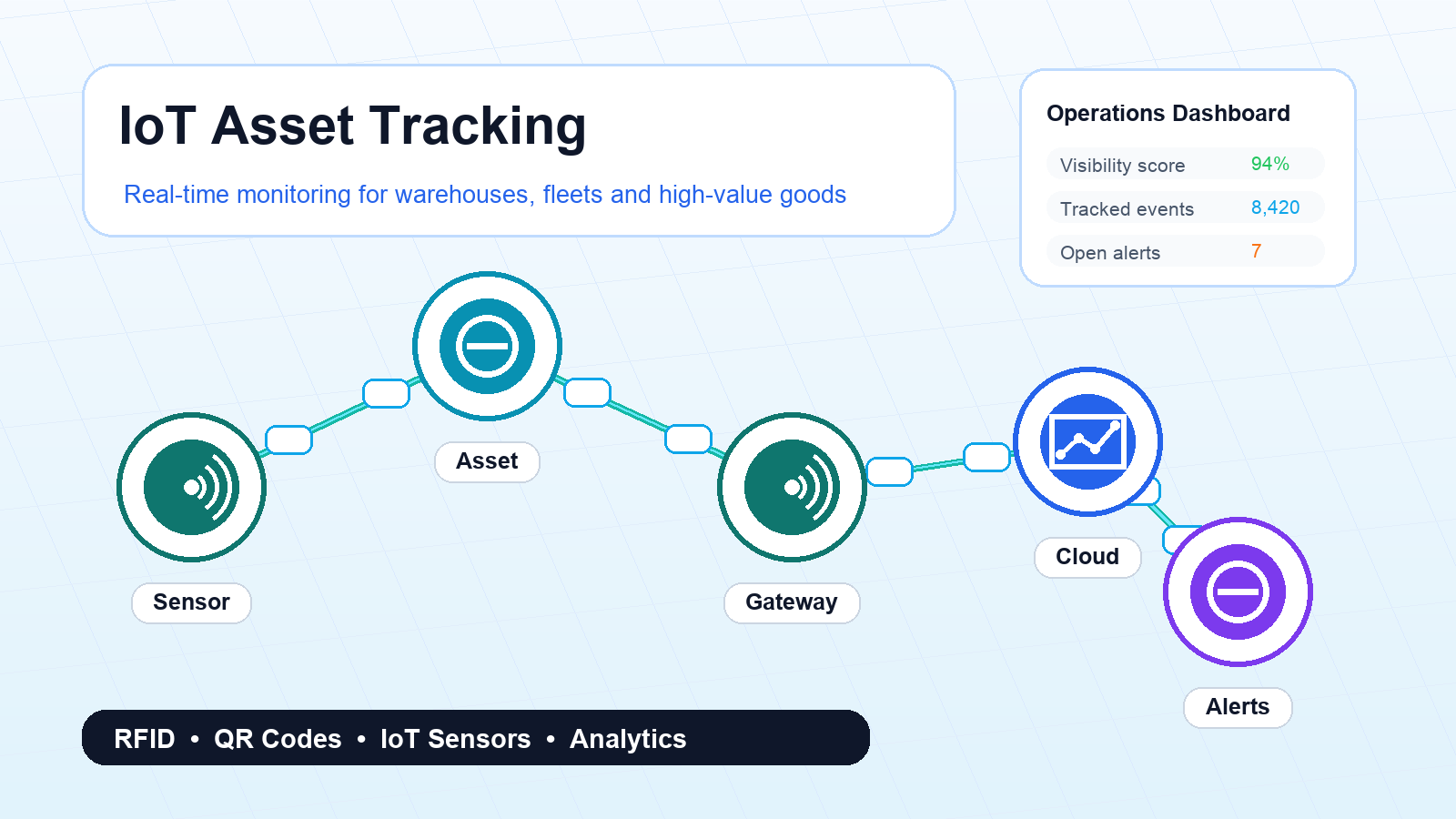
    IoT asset tracking addresses these problems by combining connected sensors, gateways, networks, and software. Instead of relying only on manual scans, teams can receive live or scheduled updates about location, condition, utilization, and exceptions.

    What IoT asset tracking means

    IoT asset tracking uses connected devices to monitor physical assets. The device may collect data such as GPS location, indoor location, temperature, humidity, vibration, movement, door open events, battery level, or usage status.

    The data is sent to a platform where teams can view dashboards, receive alerts, analyze trends, and connect asset events with business systems.

    Common assets tracked with IoT

    • Reusable transport items such as pallets, crates, bins, and containers
    • High-value equipment, tools, and machines
    • Medical devices and hospital equipment
    • Cold chain shipments for food, pharma, and healthcare
    • Vehicles, trailers, and mobile service assets
    • Construction equipment and field assets

    Why IoT is different from basic scanning

    Barcode, QR code, and RFID workflows usually depend on a scan event. That works well when employees or automated readers can capture each movement. IoT is useful when teams need status updates between scans.

    For example, a temperature sensor can report a cold chain breach during transit. A GPS device can show that a shipment has stopped unexpectedly. A vibration sensor can record mishandling. A utilization sensor can show whether an expensive asset is being used or sitting idle.

    Useful IoT tracking data

    • Location: GPS, cellular, Wi-Fi, BLE, UWB, or hybrid positioning.
    • Condition: Temperature, humidity, shock, tilt, vibration, and light exposure.
    • Movement: Motion, dwell time, route deviation, and unauthorized movement.
    • Utilization: Active usage time, idle time, run time, and maintenance indicators.
    • Device health: Battery level, signal strength, last seen time, and firmware status.

    Warehouse use cases

    In warehouses, IoT can help locate reusable assets, monitor storage conditions, and reduce time spent searching for equipment. Teams can track cages, forklifts, high-value inventory, temperature-controlled zones, and mobile tools.

    For many warehouses, the first benefit is simple: fewer searches and fewer manual checks. When employees know where assets are, operations move faster.

    Fleet and logistics use cases

    Fleet operations can use IoT to monitor vehicle location, trailer status, door events, temperature, route adherence, and delivery milestones. Logistics teams can receive alerts when shipments leave planned routes, stop too long, or experience condition breaches.

    This helps customer service teams give better updates and helps operations teams intervene before a delay becomes a failed delivery.

    High-value goods and cold chain

    IoT tracking is especially useful when the value or sensitivity of goods justifies the device cost. Pharmaceuticals, electronics, luxury goods, perishable food, medical samples, and critical spare parts often need stronger monitoring.

    For cold chain shipments, IoT can provide temperature evidence across the journey. That evidence supports quality checks, compliance, and faster decisions when an exception occurs.

    Network options

    IoT asset tracking can use different networks depending on the location and update frequency. Common options include cellular, NB-IoT, LoRaWAN, Bluetooth Low Energy, Wi-Fi, UWB, and satellite for remote routes.

    The network choice affects battery life, device cost, coverage, update frequency, and accuracy. A device that works well inside a warehouse may not work well for cross-country transport, so the environment matters.

    Implementation steps

    1. Identify assets that create the most cost or risk when they are missing or unmanaged.
    2. Define what data is needed: location, condition, utilization, or exception alerts.
    3. Select the device and network based on the operating environment.
    4. Run a pilot with a small asset group and clear success metrics.
    5. Connect alerts and reports to the people who can act on them.
    6. Scale only after battery performance, coverage, and data quality are proven.

    Mistakes to avoid

    • Tracking too many assets before proving the business case.
    • Choosing devices without testing real operating conditions.
    • Collecting data without defining who receives alerts and what action they should take.
    • Ignoring battery replacement and device maintenance.
    • Failing to integrate asset data with warehouse, transport, or maintenance systems.

    ROI drivers

    The return on IoT asset tracking usually comes from reduced loss, lower search time, better utilization, fewer shipment claims, improved compliance evidence, and faster exception response. The business case is strongest when the tracked asset or product is valuable, scarce, sensitive, or operationally critical.

    Final thoughts

    IoT asset tracking gives businesses a live view of assets that are hard to manage with manual scanning alone. The best projects start with a focused problem, such as missing containers, cold chain risk, expensive tools, or shipment exceptions.

    Once the first use case proves value, the same platform can support broader visibility across warehouses, fleets, and field operations.

    FAQs

    Does IoT asset tracking always require GPS?

    No. GPS is useful outdoors, but indoor tracking may use BLE, Wi-Fi, UWB, RFID, or gateway-based detection.

    How often should IoT devices send updates?

    It depends on the use case. High-risk shipments may need frequent updates, while reusable containers may only need milestone or exception-based updates.

    What is the main challenge in IoT tracking?

    The main challenge is matching device, network, battery life, and software workflow to the real operating environment.

  • AI in Supply Chain Traceability: Practical Use Cases for Manufacturers and Logistics Teams

    AI in Supply Chain Traceability: Practical Use Cases for Manufacturers and Logistics Teams

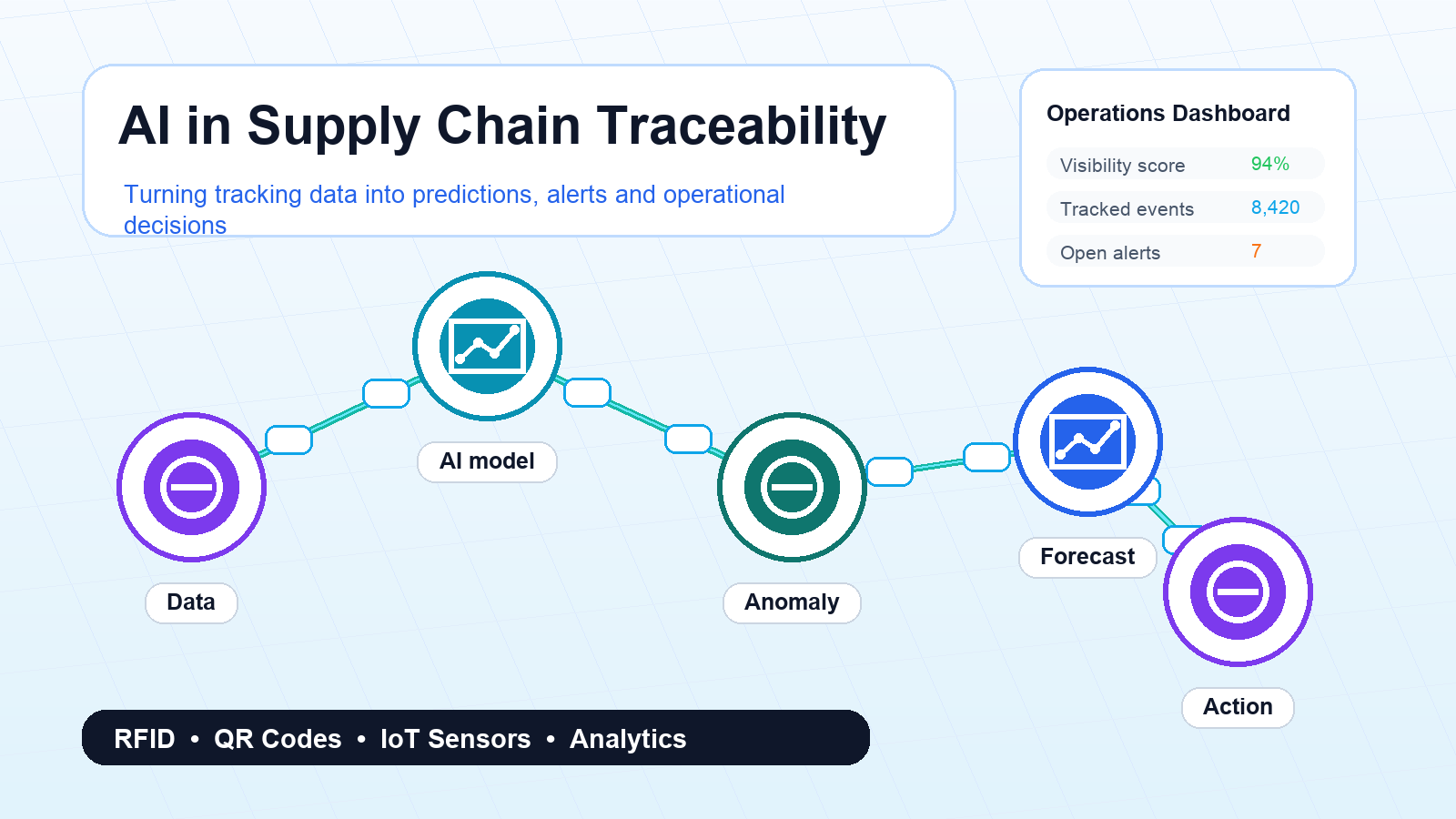
    AI is useful in supply chain traceability when it helps teams make better decisions from tracking data. It should not be treated as a magic layer on top of messy operations. The value comes when AI can detect patterns, flag exceptions, predict risk, or reduce manual review.

    Manufacturers and logistics teams already collect data from scans, RFID readers, sensors, ERP systems, warehouse systems, transport platforms, and customer updates. AI can help turn that data into practical actions.

    Where AI fits in traceability

    Traceability systems record what happened to a product, batch, asset, or shipment. AI can analyze those records and identify what is unusual, what may happen next, and where the process can improve.

    The strongest AI use cases usually depend on good operational data. If locations, item IDs, timestamps, and exception codes are incomplete, AI will struggle to produce reliable recommendations.

    Use case 1: anomaly detection

    Anomaly detection helps teams identify unusual patterns that may indicate a problem. Examples include a shipment stopping at an unexpected location, an item moving backward in the process, a batch taking longer than normal between stages, or a temperature reading drifting outside the usual range.

    Instead of asking users to monitor every dashboard, the system can highlight events that deserve attention.

    Use case 2: predictive delay alerts

    AI can estimate whether a shipment, production batch, or warehouse task is likely to miss its planned milestone. The model may use route history, carrier performance, current location, dwell time, weather, hub congestion, or scan timing.

    Predictive alerts are valuable because they create time to act. A team can reroute, notify the customer, change a production plan, or escalate with a logistics partner before the delay becomes unavoidable.

    Use case 3: computer vision for quality and identification

    Computer vision can support traceability by reading labels, detecting damage, checking package condition, confirming counts, or verifying whether the right item is present at the right stage.

    This can reduce manual inspection in repetitive workflows. It can also create visual evidence that supports quality checks and dispute resolution.

    Use case 4: smarter recall analysis

    During a recall, teams need to identify affected batches, locations, shipments, and customers quickly. AI can help analyze traceability records to narrow the likely impact, spot related movement patterns, and prioritize the highest-risk records for review.

    The system should not replace quality approval, but it can reduce the time spent searching through disconnected records.

    Use case 5: demand and inventory signals

    Traceability data can improve inventory planning when combined with sales, production, and movement history. AI can identify slow-moving stock, recurring stockouts, route-level demand changes, and locations where inventory accuracy is weak.

    This helps planners work with fresher signals instead of relying only on historical averages.

    Use case 6: automated exception routing

    Many supply chain exceptions are not complicated, but they need fast routing. A missed scan may go to the warehouse lead. A temperature breach may go to quality. A route deviation may go to transport operations. A high-value item movement may go to security.

    AI can help classify exceptions and suggest the next action based on past resolutions, priority, and business rules.

    Data needed before AI

    AI projects fail when the base traceability data is weak. Before investing heavily, teams should check the basics:

    • Consistent item, batch, shipment, and location IDs
    • Reliable timestamps and scan events
    • Clear exception codes and reason categories
    • Integration with ERP, WMS, TMS, or production systems
    • Enough historical data to identify normal and abnormal patterns

    How to start with a small AI project

    The best first AI project is narrow. Choose one problem where the outcome is easy to measure. For example, predict late shipments on one lane, detect abnormal dwell time in one warehouse, or classify temperature exceptions for one product group.

    1. Define the business problem and the decision AI should support.
    2. Collect the minimum data required for that decision.
    3. Build or configure a model that produces explainable outputs.
    4. Test recommendations against historical events.
    5. Run a controlled pilot with human review.
    6. Measure whether response time, accuracy, or cost improves.

    Risks to manage

    • Bad data: AI cannot fix missing or inconsistent traceability records by itself.
    • Black-box decisions: Operations teams need to understand why an alert was raised.
    • Alert fatigue: Too many low-quality alerts will make users ignore the system.
    • Poor adoption: AI must fit the workflow of the people who act on the recommendation.

    What success looks like

    A successful AI traceability project should produce clear operational results. Examples include fewer late deliveries, faster exception response, reduced manual inspection time, improved recall analysis, better inventory accuracy, or fewer false alarms.

    The technology matters, but the workflow matters more. If nobody acts on the insight, the insight has little value.

    Final thoughts

    AI can make traceability systems more useful by turning event data into warnings, predictions, and recommendations. The practical path is to start with clean data, a focused problem, and a measurable outcome.

    For most teams, the right question is not “How can we use AI?” It is “Which traceability decision is slow, expensive, or error-prone today, and can AI help improve it?”

    FAQs

    Can AI replace a traceability system?

    No. AI needs traceability data to work. It improves analysis and decision support but does not replace item identification, scanning, sensors, and process records.

    What is the easiest AI use case to start with?

    Anomaly detection or predictive delay alerts are often good starting points because they use data many companies already collect.

    Does AI require a large data science team?

    Not always. Many platforms include built-in analytics and alerting. Complex custom models may need data science support, but small pilots can start with focused rules and basic machine learning.

  • End-to-End Supply Chain Visibility: How to Reduce Delays, Loss, and Compliance Risk

    End-to-End Supply Chain Visibility: How to Reduce Delays, Loss, and Compliance Risk

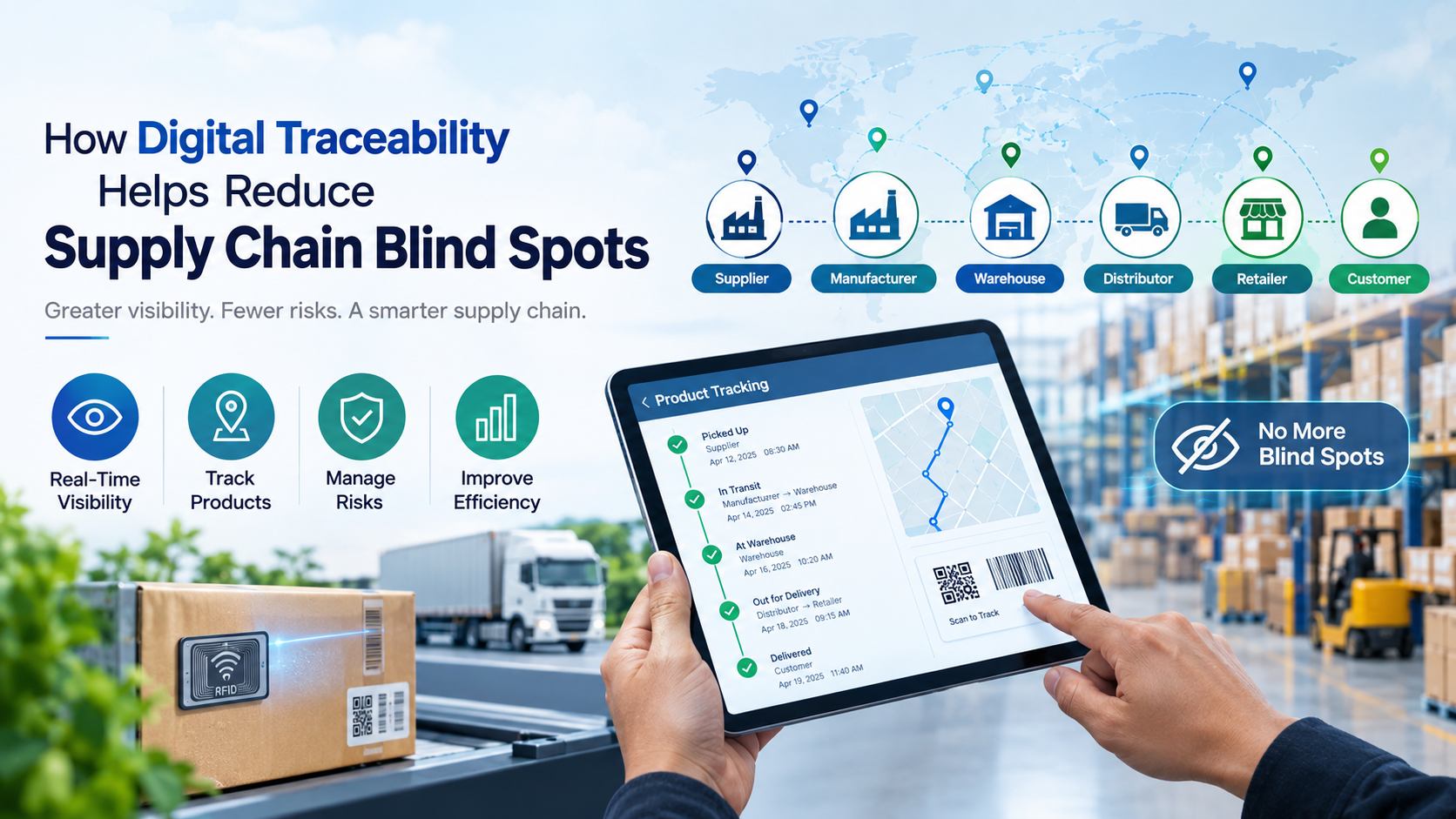
    Supply chain visibility sounds simple until a team tries to answer basic questions during a busy workday. Where is the shipment? Which batch is delayed? Which warehouse has the stock? Did the product stay within the required temperature range? Who handled the last movement?

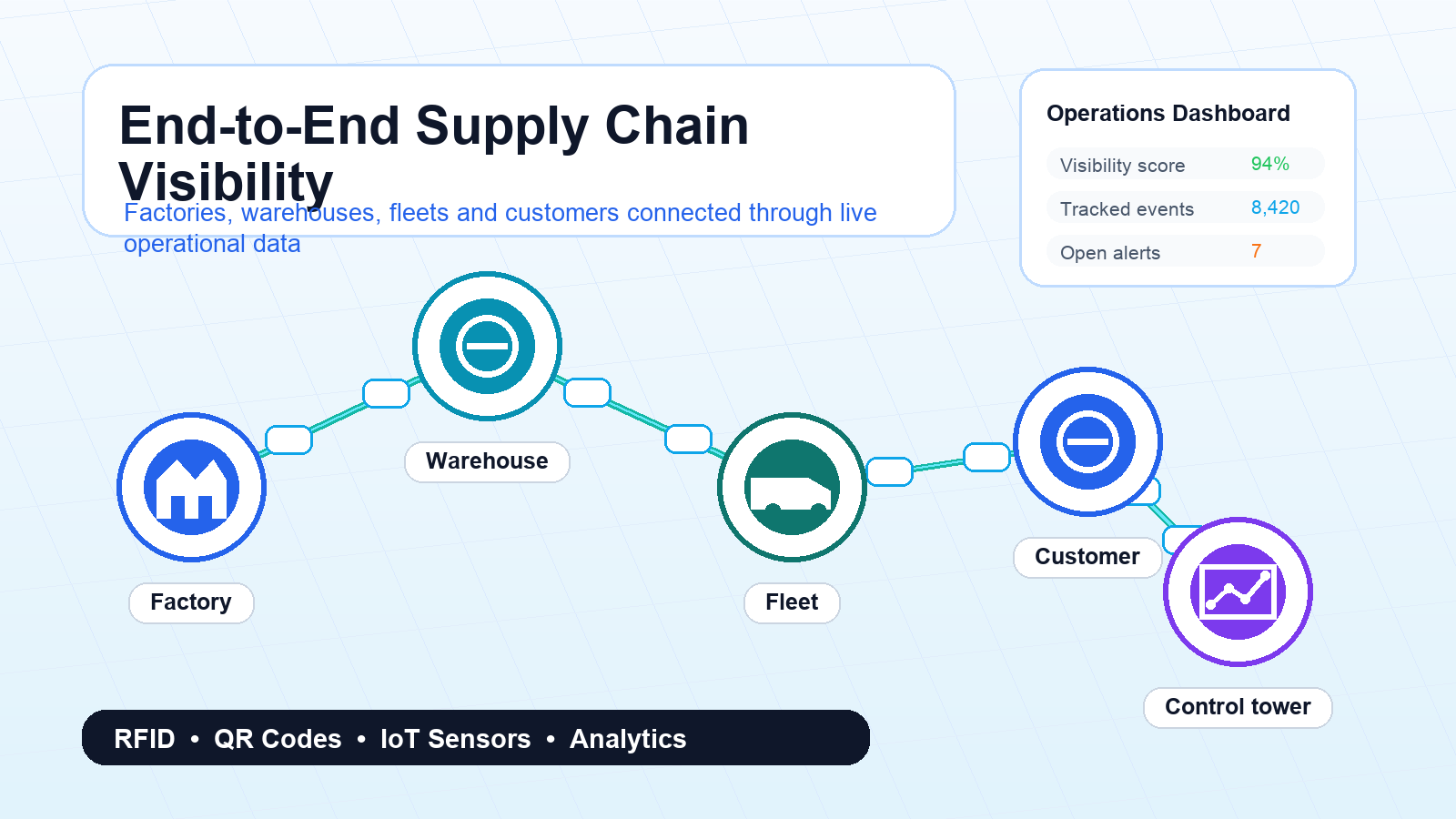
    When those answers live in different spreadsheets, emails, ERP screens, phone calls, and transport updates, delays become harder to control. End-to-end supply chain visibility solves that problem by giving teams a connected view of products, inventory, shipments, and exceptions from origin to destination.

    For manufacturers, distributors, retailers, and logistics teams, the goal is not to collect more data. The goal is to make operational decisions faster, with fewer blind spots.

    What end-to-end visibility means

    End-to-end visibility is the ability to see the movement and status of goods across the full supply chain. That includes raw materials, production, storage, dispatch, transport, delivery, returns, and in some cases the customer experience after delivery.

    A good visibility system connects events that usually sit in separate places. A production batch record, a warehouse scan, an RFID read, a truck location update, and a delivery confirmation should tell one continuous story.

    Where visibility usually breaks down

    Most companies already have some data. The problem is that the data is often late, incomplete, or difficult to trust.

    • Manual handovers: Teams depend on phone calls or handwritten records when goods move between locations.
    • System gaps: ERP, warehouse, transport, and customer service systems do not always share information cleanly.
    • Delayed updates: Shipment status changes after the issue has already affected the customer.
    • Weak item-level tracking: Teams can track a dispatch note but not the individual item, batch, pallet, or asset.
    • Poor exception handling: Delays, wrong scans, route changes, and missing items are noticed too late.

    What businesses should track

    The right tracking level depends on the process. Some businesses need item-level traceability. Others need batch, pallet, container, vehicle, or asset tracking.

    Common data points include product ID, batch number, serial number, location, timestamp, scan user, vehicle, shipment status, temperature, humidity, proof of delivery, and exception reason. The more regulated or high value the product is, the more important the data trail becomes.

    Technologies that support visibility

    Visibility does not come from one tool. It usually comes from a mix of identification, sensing, connectivity, and software.

    • QR codes and barcodes work well for low-cost scanning and product verification.
    • RFID helps when many items need to be scanned quickly without direct line of sight.
    • IoT sensors capture live condition data such as temperature, shock, humidity, or movement.
    • GPS and telematics provide vehicle and shipment location updates.
    • Control tower dashboards combine events, alerts, and reports into one operational view.

    How visibility reduces delays and loss

    Visibility helps teams spot problems while there is still time to act. If a shipment is stuck at a hub, the transport team can escalate before the delivery date is missed. If inventory is sitting in the wrong bin, the warehouse team can correct it before production stops. If a temperature sensor reports a breach, quality teams can isolate the affected batch before it reaches customers.

    The biggest improvement often comes from exception workflows. A dashboard that only shows data is useful. A system that alerts the right person, records the action taken, and tracks the resolution is far more valuable.

    Compliance benefits

    Compliance teams need evidence. They need to show what happened, when it happened, who handled it, and whether the process followed the required standard. A visibility platform creates that audit trail automatically if scanning and event capture are designed correctly.

    This is especially useful in pharmaceuticals, food, healthcare, automotive, and electronics, where recalls, warranties, quality checks, and chain-of-custody records matter.

    How to start without overcomplicating it

    The best starting point is one high-friction process. Pick a product line, warehouse flow, asset category, route, or compliance requirement where the business impact is easy to measure.

    1. Map the current movement of goods and information.
    2. Identify the blind spots that create delays, loss, or manual follow-up.
    3. Choose the simplest tracking technology that solves the problem.
    4. Run a pilot with clear metrics such as inventory accuracy, dispatch errors, delay alerts, or recall lookup time.
    5. Scale only after the workflow, data quality, and user adoption are stable.

    Metrics to watch

    Useful visibility metrics include on-time dispatch, on-time delivery, inventory accuracy, scan compliance, exception response time, lost item rate, return processing time, and audit preparation time. These numbers show whether visibility is improving operations or just adding another dashboard.

    Final thoughts

    End-to-end supply chain visibility gives teams a clearer view of what is moving, where it is moving, and what needs attention. The companies that benefit most are the ones that treat visibility as an operating system for daily decisions, not a reporting layer that people check after something goes wrong.

    Start small, measure the result, and build toward a connected supply chain where problems are visible early enough to fix.

    FAQs

    What is end-to-end supply chain visibility?

    It is the ability to track products, assets, inventory, and shipments across the full supply chain, from origin to delivery.

    Does visibility require RFID?

    No. RFID is useful for many use cases, but QR codes, barcodes, GPS, IoT sensors, and system integrations can also support visibility.

    What is the best first visibility project?

    Start with one painful process, such as shipment exceptions, warehouse inventory mismatch, asset loss, or compliance reporting.

  • RFID vs Barcode vs QR Code: Choosing the Right Tracking Technology for Your Business

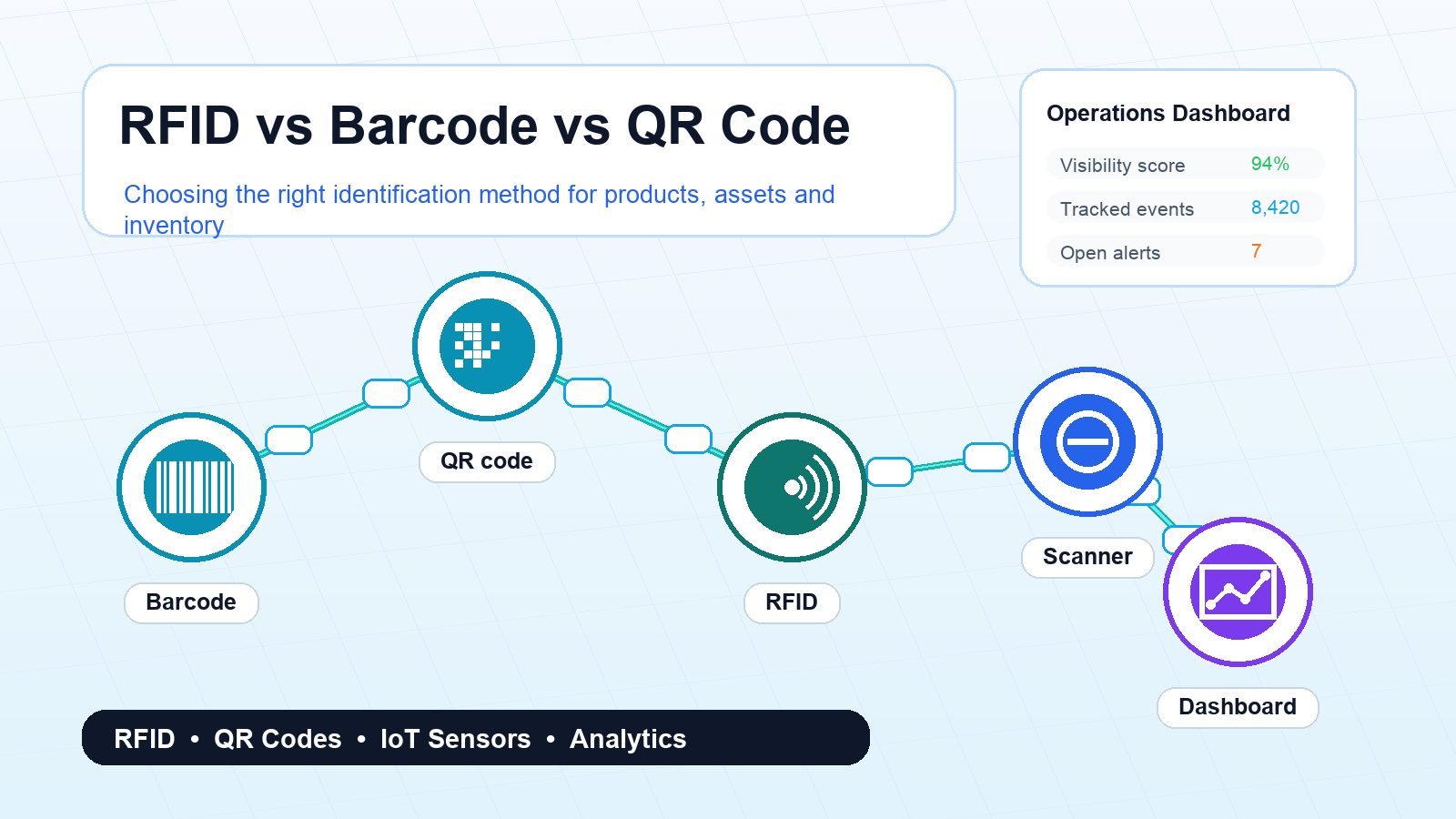
    RFID vs Barcode vs QR Code: Choosing the Right Tracking Technology for Your Business

    RFID, barcodes, and QR codes all help businesses identify and track items. The right choice depends on the process, the scanning environment, the level of automation required, and the cost the business can support.

    A barcode may be perfect for simple warehouse picking. A QR code may be better for customer-facing product verification. RFID may be the stronger option when hundreds of items need to be read quickly without direct line of sight.

    This guide compares the three technologies in practical terms so teams can choose the right tracking method instead of buying technology that does not fit the operation.

    Quick comparison

    • Barcode: Lowest cost, widely adopted, requires line of sight, best for simple scanning workflows.
    • QR code: Low cost, stores more data than a traditional barcode, can be scanned by smartphones.
    • RFID: Higher tag and infrastructure cost, fast reads, works without line of sight, supports automation.

    How barcode tracking works

    A barcode is a printed pattern that represents data. A scanner reads the pattern and sends the item ID to a software system. Barcodes are common in retail, warehouses, manufacturing, logistics, healthcare, and documents.

    The main advantage is cost. Labels are cheap to print, scanners are easy to deploy, and most employees already understand the workflow. The limitation is that each label usually needs to be visible and scanned one at a time.

    When barcodes are the right choice

    • Low-cost item identification
    • Warehouse picking and packing
    • Shipping labels and cartons
    • Retail checkout
    • Basic inventory movement records

    Barcodes are still useful because they are simple. If the process only needs occasional scanning and the label is easy to access, a barcode may be enough.

    How QR code tracking works

    A QR code is a two-dimensional code that can store more information than a standard barcode. It can hold URLs, serial numbers, product IDs, batch details, and verification links. Most smartphones can scan QR codes without a special device.

    That makes QR codes useful for both internal operations and customer-facing use cases. A business can use QR codes for inventory tracking, warranty registration, product authenticity checks, installation guides, or service records.

    When QR codes are the right choice

    • Product authentication and anti-counterfeit workflows
    • Consumer verification through mobile phones
    • Field service and maintenance records
    • Batch traceability on packaging
    • Low-cost digital product passports

    How RFID tracking works

    RFID uses radio signals to identify tags. The tag may be attached to a product, pallet, asset, container, uniform, tool, or vehicle. An RFID reader captures the tag ID and sends it to the tracking software.

    The major benefit is speed. RFID can read many tags quickly, and the tag does not always need to be visible. That is useful when items are inside cartons, moving through a gate, stacked on pallets, or handled in large volumes.

    When RFID is the right choice

    • High-volume warehouse operations
    • Reusable transport item tracking
    • Asset tracking in factories, hospitals, and campuses
    • Retail inventory cycle counts
    • Manufacturing work-in-progress tracking

    RFID is not automatically better than barcodes. It is better when the value of faster, more automated scanning is higher than the added cost of tags, readers, testing, and process design.

    Cost considerations

    Barcodes and QR codes are inexpensive because the label can be printed on standard packaging or stickers. RFID requires tags and readers, and some environments need testing because metal, liquids, distance, and orientation can affect read performance.

    The business case for RFID is strongest when labor savings, inventory accuracy, loss reduction, or throughput improvement can justify the investment.

    Accuracy and data quality

    All three technologies can fail if the process is weak. A damaged barcode, badly placed QR code, or poorly tuned RFID reader can create inaccurate records. The tracking system should include scan validation, duplicate handling, exception alerts, and user training.

    Can businesses use more than one?

    Yes. Many operations use a hybrid model. A product may carry a QR code for customers and an RFID tag for warehouse automation. A carton may have a barcode for logistics partners and an RFID label for internal movement. The best design follows the journey of the item and the needs of each stakeholder.

    Selection checklist

    • Do items need to be scanned one by one or in bulk?
    • Is line of sight available?
    • Is the environment harsh, wet, metallic, or high-speed?
    • Who scans the item: employee, customer, driver, or automated reader?
    • What is the acceptable tag or label cost?
    • Does the process need real-time updates or milestone scans?

    Final recommendation

    Use barcodes when the process is simple and cost matters most. Use QR codes when mobile scanning or customer verification is important. Use RFID when speed, automation, and bulk reading can create measurable value.

    The strongest tracking systems are designed around the business workflow first. Technology should support that workflow, not force the team to change how the operation works without a clear reason.

    FAQs

    Is RFID replacing barcodes?

    No. RFID is growing, but barcodes remain practical for many low-cost scanning workflows.

    Can a QR code be used for supply chain traceability?

    Yes. QR codes can carry product or batch identifiers and link to digital records, verification pages, or service workflows.

    Which technology is best for warehouses?

    Barcodes work well for basic operations. RFID is better when the warehouse needs faster cycle counts, bulk reads, or automated movement capture.

  • Track and Trace Solutions: A Practical Guide to Supply Chain Visibility in 2026

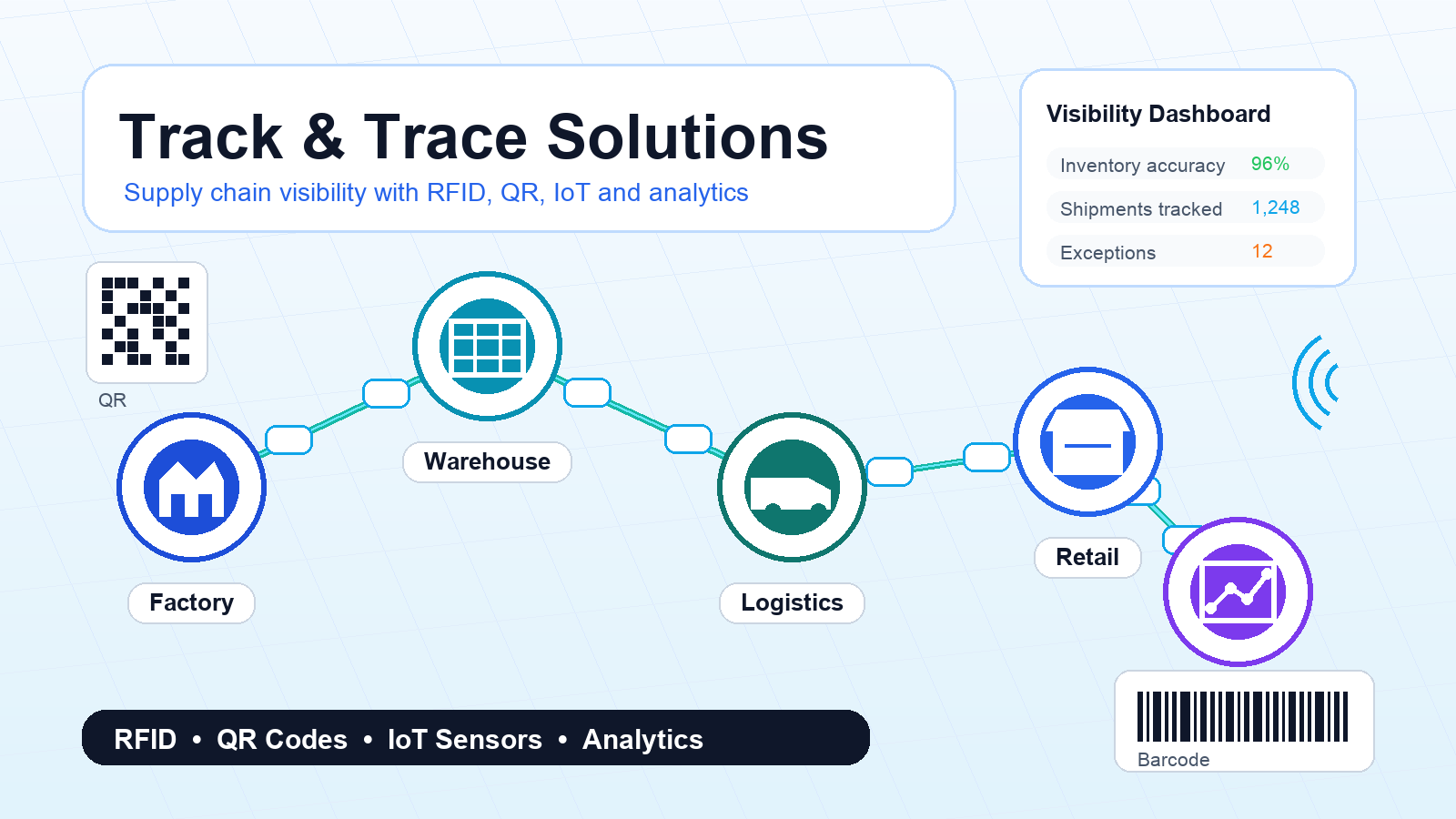
    Track and Trace Solutions: A Practical Guide to Supply Chain Visibility in 2026

    Track and trace solutions help businesses answer a simple but critical question: where is every product, component, shipment, or asset right now, and what happened to it before it reached that point?

    For manufacturers, distributors, logistics teams, healthcare providers, and retailers, that visibility is no longer optional. Customers expect faster delivery. Regulators expect better records. Operations teams need fewer blind spots. And leadership wants proof that inventory, assets, and products are moving through the supply chain without unnecessary delays, loss, or compliance risk.

    This guide explains what track and trace means, the technologies behind it, the business benefits, and how to plan a practical rollout.

    What Are Track and Trace Solutions?

    Track and trace solutions are systems that identify, monitor, and record the movement of items across the supply chain. They combine identification technologies, data capture devices, software, and analytics to create a reliable history of each item or shipment.

    In simple terms:

    • Tracking shows the current location and status of an item.
    • Tracing shows the historical journey of that item from origin to destination.

    Together, they create end-to-end supply chain visibility. A business can see when a product was manufactured, where it was stored, when it was shipped, which route it followed, who handled it, and whether any exceptions occurred along the way.

    Why Supply Chain Visibility Matters in 2026

    Modern supply chains are fast, connected, and vulnerable to disruption. A single delay, stock mismatch, quality issue, or missing shipment can affect production schedules, customer commitments, and brand trust.

    Track and trace systems help businesses move from reactive problem-solving to proactive control. Instead of discovering issues after a customer complaint or audit, teams can detect exceptions earlier and respond faster.

    Key reasons companies invest in track and trace

    • Regulatory compliance: Industries such as pharmaceuticals, food, healthcare, and manufacturing require accurate product history and movement records.
    • Inventory accuracy: Real-time visibility reduces stock discrepancies, overstocking, and lost inventory.
    • Faster recalls: Businesses can identify affected batches or shipments quickly instead of recalling more products than necessary.
    • Customer transparency: Buyers increasingly expect reliable delivery updates and product authenticity.
    • Operational efficiency: Automated data capture reduces manual entry, paperwork, and human error.
    • Risk reduction: Teams can detect theft, diversion, temperature excursions, route delays, and process gaps.

    Core Technologies Used in Track and Trace

    A track and trace solution is not a single technology. It is usually a combination of tools selected according to the use case, cost, environment, and accuracy requirement.

    1. Barcode and QR Code Tracking

    Barcodes and QR codes are widely used because they are affordable, easy to print, and simple to scan. They work well for item identification, warehouse operations, shipping labels, and customer-facing product verification.

    QR codes are especially useful when more data needs to be stored or when consumers need to verify product authenticity using a smartphone.

    2. RFID Tracking

    Radio Frequency Identification, or RFID, allows items to be scanned without direct line of sight. This is valuable in warehouses, manufacturing plants, retail inventory, reusable containers, and asset tracking.

    RFID can reduce scanning time significantly when many items need to be identified at once. It is often selected when speed and automation matter more than the lowest possible tag cost.

    3. IoT Sensors

    IoT sensors collect real-time data such as location, temperature, humidity, vibration, shock, and movement. They are useful for cold chain logistics, high-value shipments, fleet tracking, and sensitive products.

    For example, a pharmaceutical or food shipment can be monitored continuously to confirm whether temperature stayed within the acceptable range.

    4. GPS and Real-Time Location Systems

    GPS is commonly used for vehicles and outdoor shipment tracking. Real-Time Location Systems, or RTLS, are used for more precise indoor tracking in hospitals, factories, warehouses, and large campuses.

    Depending on the required accuracy, RTLS may use BLE, Wi-Fi, UWB, infrared, or active RFID.

    5. Cloud Software and Analytics

    The software layer is where data becomes useful. A strong platform brings together scanning events, sensor data, shipment milestones, inventory records, user activity, and exception alerts.

    Dashboards, reports, alerts, and integrations help operations teams act on the data instead of simply collecting it.

    How Track and Trace Works in a Real Supply Chain

    A typical track and trace workflow includes the following steps:

    1. Assign a unique identity: Each product, batch, pallet, asset, or shipment receives a barcode, QR code, RFID tag, or digital ID.
    2. Capture events: Scanners, RFID readers, mobile apps, IoT devices, or system integrations capture movement and status updates.
    3. Store the data: Events are recorded in a central software platform with timestamps, locations, users, and contextual details.
    4. Monitor exceptions: The system flags issues such as missed scans, delays, wrong destinations, temperature breaches, or unexpected route changes.
    5. Analyze and improve: Teams review trends to reduce bottlenecks, improve inventory accuracy, and strengthen compliance.

    Business Benefits of Track and Trace Solutions

    Better inventory control

    When every movement is recorded, teams can reduce stock mismatch between physical inventory and system inventory. This helps avoid unnecessary purchases, production delays, and customer service issues.

    Faster decision-making

    Real-time data helps managers respond quickly. If a shipment is delayed or an item is missing from the expected location, the team can act before the issue becomes expensive.

    Improved compliance readiness

    Audit trails are easier to produce when every important event is already captured digitally. This is especially useful in regulated industries where batch history, chain of custody, and process records matter.

    Reduced manual work

    Manual spreadsheets and paper-based logs often create errors and delays. Automated scanning and digital workflows improve accuracy while freeing employees for higher-value tasks.

    Higher customer trust

    When businesses can verify product authenticity, provide better delivery visibility, and handle recalls quickly, customers gain more confidence in the brand.

    Industries That Benefit Most

    Track and trace can support almost any business that moves goods or manages physical assets. Common use cases include:

    • Manufacturing: Work-in-progress tracking, component traceability, quality control, and finished goods movement.
    • Pharmaceuticals: Serialization, batch tracking, cold chain monitoring, anti-counterfeit protection, and compliance reporting.
    • Food and beverage: Ingredient traceability, production batch visibility, expiry tracking, and faster recalls.
    • Logistics and warehousing: Shipment visibility, pallet tracking, route monitoring, and proof of delivery.
    • Healthcare: Medical equipment tracking, RTLS asset visibility, inventory control, and patient safety workflows.
    • Retail: Inventory accuracy, product authentication, loss prevention, and omnichannel fulfilment.

    How to Choose the Right Track and Trace Solution

    The best solution depends on the business process, not just the technology. Before selecting a platform or device, clarify the problem you want to solve.

    Questions to ask before implementation

    • What needs to be tracked: item, batch, pallet, vehicle, asset, or shipment?
    • Where does tracking need to happen: factory, warehouse, vehicle, store, field, or customer location?
    • How accurate does location data need to be?
    • Is real-time monitoring required, or are milestone scans enough?
    • What systems need to integrate with the platform: ERP, WMS, TMS, CRM, or e-commerce?
    • Which compliance or audit reports are required?
    • What is the acceptable cost per tag, sensor, scan, or asset?

    Implementation Roadmap

    A practical rollout should start small and scale after value is proven.

    Step 1: Map the current process

    Document how products, assets, and information move today. Identify blind spots, manual steps, repeated errors, and high-risk points.

    Step 2: Define measurable goals

    Examples include reducing missing inventory by 30%, improving dispatch accuracy, reducing recall investigation time, or increasing scan compliance.

    Step 3: Select the right identification method

    Use barcodes or QR codes for low-cost scanning, RFID for speed and automation, IoT sensors for condition monitoring, and GPS or RTLS for location visibility.

    Step 4: Pilot one focused use case

    Start with one warehouse, one product line, one fleet route, or one asset category. A focused pilot is easier to measure and refine.

    Step 5: Integrate with business systems

    Track and trace data becomes more valuable when it connects with ERP, warehouse, transport, or customer service systems.

    Step 6: Scale with governance

    Standardize data formats, user roles, scanning rules, exception workflows, and reporting dashboards before expanding across locations.

    Common Mistakes to Avoid

    • Starting with technology instead of business goals: RFID, QR, IoT, and RTLS all have different strengths. The process should guide the tool.
    • Ignoring data quality: Poor master data, inconsistent item codes, or missing location records can weaken the entire system.
    • Skipping user training: Even the best software fails if teams do not scan, tag, or update records correctly.
    • Overcomplicating the first rollout: A narrow, measurable pilot is usually better than a complex multi-location launch.
    • Not planning integrations: Track and trace should support existing operations, not become another isolated data system.

    Future of Track and Trace

    Track and trace is moving beyond basic shipment visibility. AI, predictive analytics, computer vision, digital twins, and automated exception handling are making systems more intelligent.

    Instead of simply showing where an item is, modern platforms can help predict delays, recommend corrective action, detect unusual movement patterns, and improve planning decisions.

    For businesses with complex operations, this shift can turn supply chain data into a competitive advantage.

    Final Thoughts

    Track and trace solutions give businesses the visibility needed to manage products, assets, shipments, and compliance with more confidence. The right system can improve inventory accuracy, reduce risk, speed up audits, strengthen customer trust, and make supply chain operations more resilient.

    The best approach is to start with a focused business problem, select the right technology mix, run a measurable pilot, and then scale the solution across the supply chain.

    FAQs

    What is the difference between tracking and tracing?

    Tracking shows the current location or status of an item. Tracing shows the historical journey of that item, including where it came from, where it moved, and what happened along the way.

    Which is better for track and trace: RFID or barcode?

    Barcodes and QR codes are more affordable and work well for simple scanning. RFID is better when many items need to be scanned quickly or without line of sight. Many businesses use both depending on the process.

    Can track and trace help with product recalls?

    Yes. A good traceability system helps identify affected batches, shipments, locations, and customers faster, reducing recall time and limiting unnecessary disruption.

    Is track and trace only for large companies?

    No. Smaller businesses can start with QR codes, barcode scanning, or a focused inventory visibility workflow and expand as operations grow.

    What data should a track and trace system capture?

    Common data includes item ID, batch number, location, timestamp, user, status, shipment details, sensor readings, and exception events.

  • Blockchain in Supply Chain Traceability: Where It Works and Where It Does Not

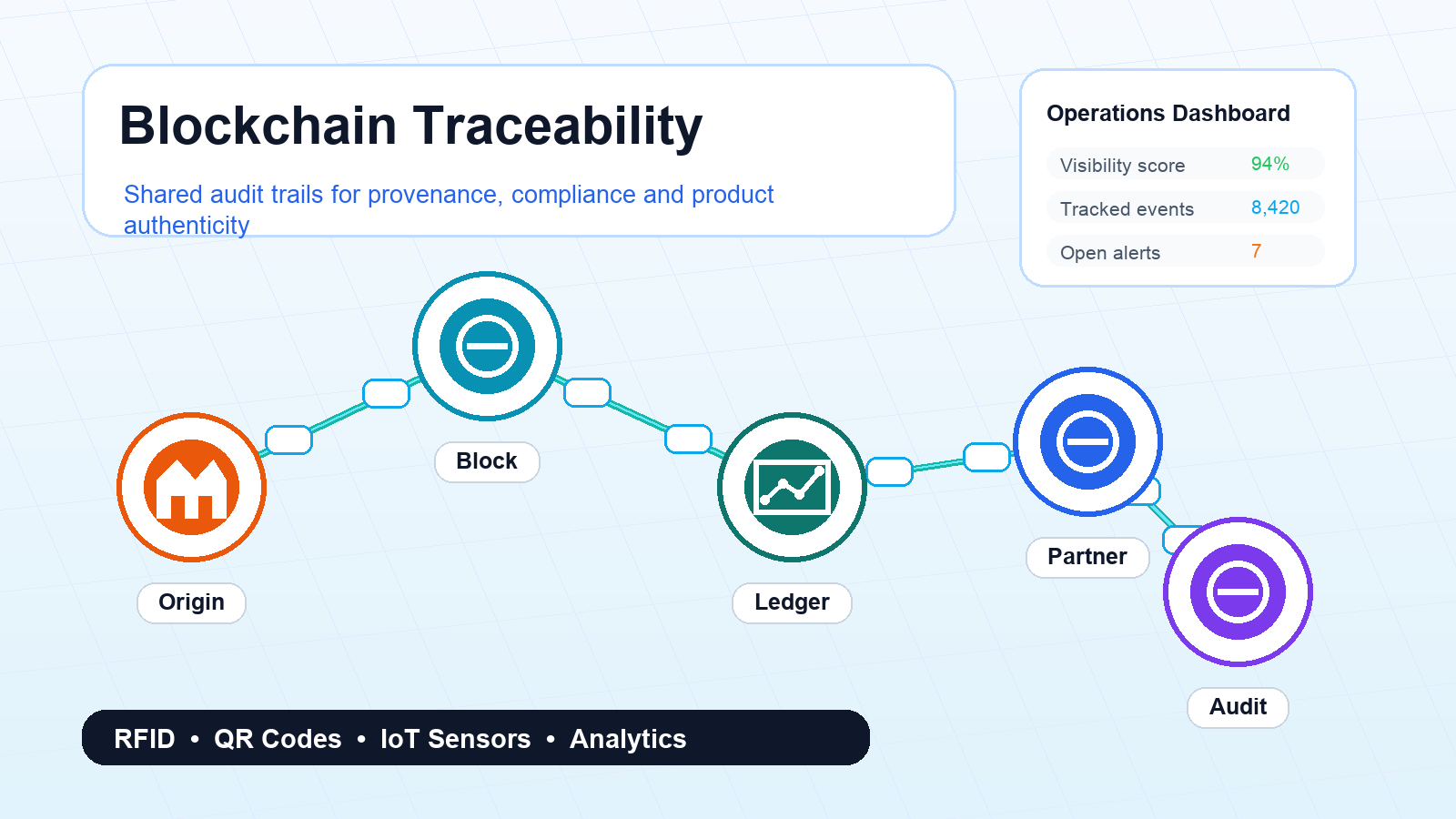
    Blockchain in Supply Chain Traceability: Where It Works and Where It Does Not

    Blockchain has been discussed in supply chain traceability for years. Some claims were exaggerated, but the technology still has useful applications when multiple parties need a shared, tamper-resistant record of events.

    The practical question is not whether blockchain is good or bad. The question is whether it solves a specific trust, audit, or multi-party data sharing problem better than a conventional database.

    What blockchain adds to traceability

    A blockchain is a shared ledger where records are linked in a way that makes unauthorized changes difficult. In supply chain traceability, it can record events such as production, certification, shipment, custody transfer, inspection, and delivery.

    The main value is shared trust. When suppliers, manufacturers, logistics partners, auditors, distributors, and customers need to verify a common record, blockchain can reduce disputes about whether a record was changed later.

    Where blockchain can work well

    • Product provenance: Showing where a product or raw material came from.
    • Certification records: Recording compliance documents, inspection results, or sustainability claims.
    • Anti-counterfeit workflows: Linking a physical product to a digital identity that can be verified.
    • Chain of custody: Recording custody transfer between multiple organizations.
    • Trade documentation: Sharing shipment, customs, and finance-related records between parties.

    Where blockchain is often unnecessary

    If one company controls the full process and only needs internal tracking, a normal database may be simpler and cheaper. Blockchain does not automatically improve inventory accuracy, warehouse scanning, shipment tracking, or sensor data collection.

    It also does not make false data true. If a user records the wrong batch number or a fake certificate is uploaded, the ledger may preserve that bad data very well. The system still needs strong identity checks, process controls, and validation.

    The physical-digital link problem

    The hardest part of blockchain traceability is connecting the physical item to the digital record. A ledger can store a product ID, but the business still needs a reliable way to prove that the product being scanned is the same product represented in the record.

    This is where QR codes, RFID, serialization, tamper-evident labels, IoT sensors, and inspection processes matter. Blockchain is only one part of the traceability system.

    Useful architecture

    A practical blockchain traceability setup usually includes:

    • Unique product, batch, or shipment identities
    • Scanning or sensor systems that capture events
    • Business rules that validate who can submit each event
    • A ledger for selected records that need shared verification
    • Dashboards, APIs, and reports for daily operations

    Not every event needs to go on-chain. Many systems store detailed operational data off-chain and record hashes or key milestones on-chain for verification.

    Industries where blockchain may help

    Blockchain can be relevant in industries where trust across organizations is a major issue. Examples include food provenance, pharmaceuticals, luxury goods, electronics, diamonds, agriculture, cross-border trade, and sustainability reporting.

    In these cases, the ledger can help prove claims about origin, handling, certification, or custody. The value is strongest when partners agree to use the same record and when verification matters to regulators, buyers, or customers.

    Implementation checklist

    1. Define the trust problem. Do not start with the technology.
    2. Identify which parties need to write, read, or verify records.
    3. Decide which events deserve shared ledger treatment.
    4. Design the physical-to-digital identity method.
    5. Set rules for data validation, access, privacy, and correction.
    6. Start with one product line or partner network before scaling.

    Data privacy and commercial sensitivity

    Supply chain partners may not want every participant to see every detail. Pricing, supplier relationships, volumes, and customer information can be sensitive. Any blockchain design must handle permissions, privacy, and data minimization.

    In many cases, permissioned networks are more practical than public ledgers because they allow controlled participation and clearer governance.

    How to judge ROI

    Blockchain ROI usually comes from reduced disputes, faster audits, stronger product authenticity, better certification trust, and improved partner collaboration. If those benefits are not important, the added complexity may not be worth it.

    A blockchain project should compete against simpler alternatives. If a conventional database, secure API, and good audit log solve the problem, use that.

    Final thoughts

    Blockchain can support supply chain traceability when multiple parties need a shared record they can trust. It is less useful when the problem is basic scanning, inventory accuracy, or internal reporting.

    The strongest projects combine blockchain with good identification, clean data, clear governance, and a real business reason for shared verification.

    FAQs

    Does blockchain guarantee product authenticity?

    No. It can help verify records, but authenticity also depends on secure labeling, serialization, inspections, and controls that connect the physical product to the digital record.

    Is blockchain required for traceability?

    No. Many traceability systems work well with standard databases, APIs, RFID, QR codes, and IoT sensors.

    When should a company consider blockchain?

    Consider it when several organizations need to share and verify records, and when trust, auditability, or provenance is a major business requirement.