Blockchain has been discussed in supply chain traceability for years. Some claims were exaggerated, but the technology still has useful applications when multiple parties need a shared, tamper-resistant record of events.
The practical question is not whether blockchain is good or bad. The question is whether it solves a specific trust, audit, or multi-party data sharing problem better than a conventional database.
What blockchain adds to traceability
A blockchain is a shared ledger where records are linked in a way that makes unauthorized changes difficult. In supply chain traceability, it can record events such as production, certification, shipment, custody transfer, inspection, and delivery.
The main value is shared trust. When suppliers, manufacturers, logistics partners, auditors, distributors, and customers need to verify a common record, blockchain can reduce disputes about whether a record was changed later.
Where blockchain can work well
- Product provenance: Showing where a product or raw material came from.
- Certification records: Recording compliance documents, inspection results, or sustainability claims.
- Anti-counterfeit workflows: Linking a physical product to a digital identity that can be verified.
- Chain of custody: Recording custody transfer between multiple organizations.
- Trade documentation: Sharing shipment, customs, and finance-related records between parties.
Where blockchain is often unnecessary
If one company controls the full process and only needs internal tracking, a normal database may be simpler and cheaper. Blockchain does not automatically improve inventory accuracy, warehouse scanning, shipment tracking, or sensor data collection.
It also does not make false data true. If a user records the wrong batch number or a fake certificate is uploaded, the ledger may preserve that bad data very well. The system still needs strong identity checks, process controls, and validation.
The physical-digital link problem
The hardest part of blockchain traceability is connecting the physical item to the digital record. A ledger can store a product ID, but the business still needs a reliable way to prove that the product being scanned is the same product represented in the record.
This is where QR codes, RFID, serialization, tamper-evident labels, IoT sensors, and inspection processes matter. Blockchain is only one part of the traceability system.
Useful architecture
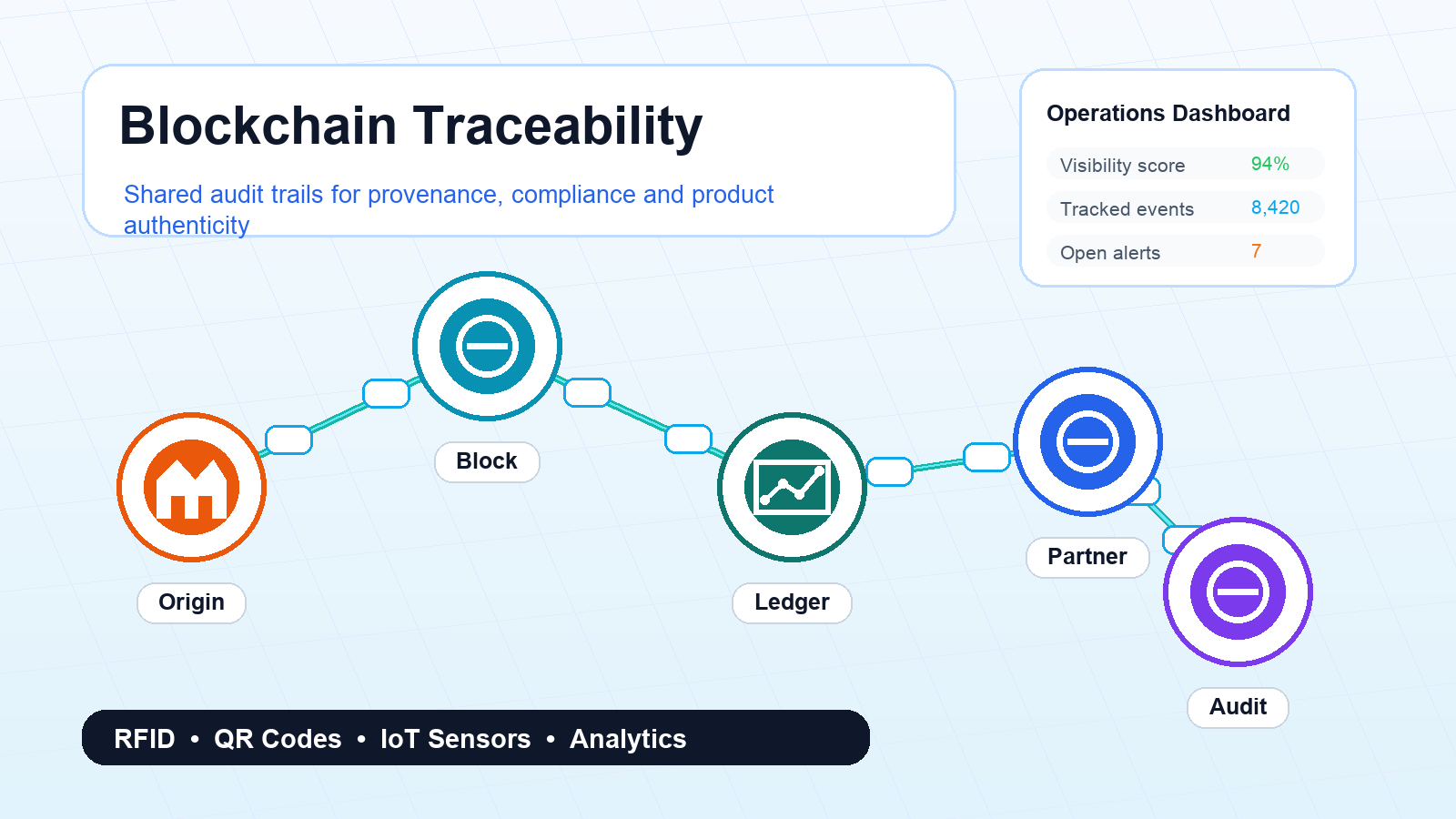
A practical blockchain traceability setup usually includes:
- Unique product, batch, or shipment identities
- Scanning or sensor systems that capture events
- Business rules that validate who can submit each event
- A ledger for selected records that need shared verification
- Dashboards, APIs, and reports for daily operations
Not every event needs to go on-chain. Many systems store detailed operational data off-chain and record hashes or key milestones on-chain for verification.
Industries where blockchain may help
Blockchain can be relevant in industries where trust across organizations is a major issue. Examples include food provenance, pharmaceuticals, luxury goods, electronics, diamonds, agriculture, cross-border trade, and sustainability reporting.
In these cases, the ledger can help prove claims about origin, handling, certification, or custody. The value is strongest when partners agree to use the same record and when verification matters to regulators, buyers, or customers.
Implementation checklist
- Define the trust problem. Do not start with the technology.
- Identify which parties need to write, read, or verify records.
- Decide which events deserve shared ledger treatment.
- Design the physical-to-digital identity method.
- Set rules for data validation, access, privacy, and correction.
- Start with one product line or partner network before scaling.
Data privacy and commercial sensitivity
Supply chain partners may not want every participant to see every detail. Pricing, supplier relationships, volumes, and customer information can be sensitive. Any blockchain design must handle permissions, privacy, and data minimization.
In many cases, permissioned networks are more practical than public ledgers because they allow controlled participation and clearer governance.
How to judge ROI
Blockchain ROI usually comes from reduced disputes, faster audits, stronger product authenticity, better certification trust, and improved partner collaboration. If those benefits are not important, the added complexity may not be worth it.
A blockchain project should compete against simpler alternatives. If a conventional database, secure API, and good audit log solve the problem, use that.
Final thoughts
Blockchain can support supply chain traceability when multiple parties need a shared record they can trust. It is less useful when the problem is basic scanning, inventory accuracy, or internal reporting.
The strongest projects combine blockchain with good identification, clean data, clear governance, and a real business reason for shared verification.
FAQs
Does blockchain guarantee product authenticity?
No. It can help verify records, but authenticity also depends on secure labeling, serialization, inspections, and controls that connect the physical product to the digital record.
Is blockchain required for traceability?
No. Many traceability systems work well with standard databases, APIs, RFID, QR codes, and IoT sensors.
When should a company consider blockchain?
Consider it when several organizations need to share and verify records, and when trust, auditability, or provenance is a major business requirement.