Centralized vs Distributed Traceability Systems: Which Is Better?
Modern supply chains involve manufacturers, suppliers, distributors, warehouses, retailers, and customers. With so many participants involved, businesses need accurate and reliable ways to track products, materials, and information throughout the supply chain.
This is where traceability systems become important. They help businesses record where products come from, where they are currently located, and what happens to them at different stages.
Two common approaches are centralized and distributed traceability systems. While both are designed to improve visibility and data management, they work differently.
In this article, we will explain the difference between centralized and distributed traceability systems, their advantages and limitations, use cases, and how businesses can choose the right approach.
What Is a Traceability System?
A traceability system is a technology-based solution that helps organizations track products, materials, assets, and related information throughout their lifecycle.
It can collect information at different stages, including manufacturing, packaging, transportation, warehousing, distribution, and delivery.
Businesses can use technologies such as RFID, barcodes, QR codes, IoT sensors, cloud platforms, and databases to collect and manage traceability data.
How Traceability Systems Work
A typical traceability system collects data whenever a product or asset moves through a supply chain.
For example, a product may be:
- Manufactured at a production facility.
- Assigned a unique identification number.
- Stored in a warehouse.
- Transported to a distributor.
- Delivered to a retailer.
- Purchased by a customer.
The system records important information at each stage, creating a traceable history of the product.
Why Traceability Matters
Effective traceability can help businesses improve:
- Supply chain visibility
- Product quality
- Inventory management
- Regulatory compliance
- Product recalls
- Operational efficiency
- Customer confidence
- Data-driven decision-making
What Is a Centralized Traceability System?
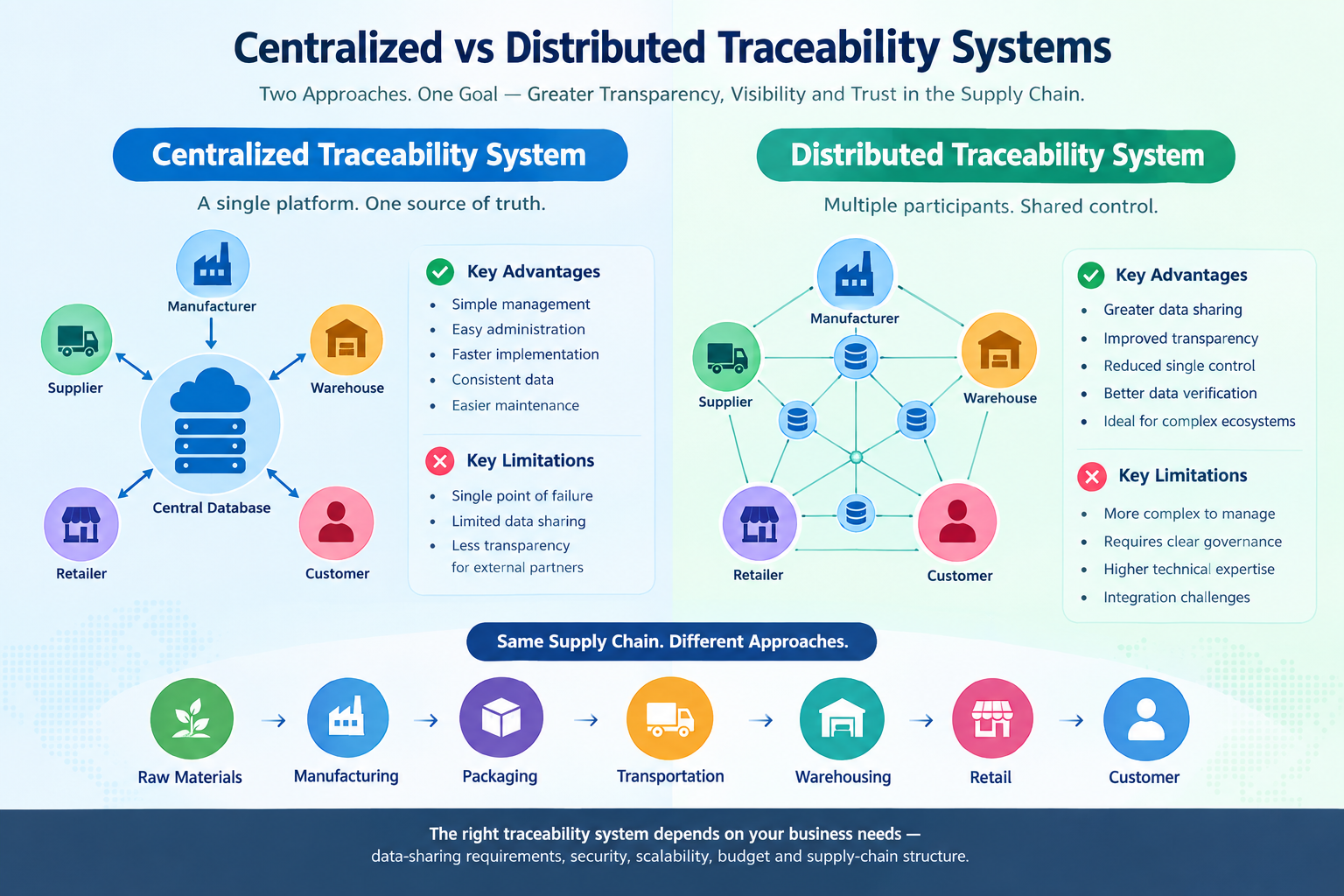
A centralized traceability system stores and manages data through a central database or platform. A central organization or system administrator generally controls access, data management, and system operations.
For example, a manufacturer may use one central cloud-based platform to collect information from its suppliers, warehouses, production facilities, and distribution partners.
How Centralized Traceability Works
In a centralized model, different users and devices send information to a central system.
The central platform processes and stores the data. Authorized users can then access the information based on their permissions.
This approach provides businesses with a single source of information for managing traceability data.
Advantages of Centralized Traceability
A centralized system can provide several benefits:
- Simpler management: Data is managed from one central platform.
- Easy administration: Organizations can control user access and permissions.
- Faster implementation: Centralized systems can be easier to deploy within a single organization.
- Consistent data management: Information follows centralized rules and processes.
- Easier maintenance: Updates and system changes can be managed centrally.
Limitations of Centralized Traceability
Despite these advantages, centralized systems also have some limitations.
A central database can become a critical point of failure. If the central platform experiences downtime, users may have difficulty accessing traceability information.
There can also be challenges when multiple independent organizations need to share and verify data because control remains with the central authority.
What Is a Distributed Traceability System?
A distributed traceability system stores or manages information across multiple connected participants or nodes rather than depending entirely on one central authority.
The goal is to allow different parties in a supply chain to participate in data sharing while maintaining greater distribution of control.
Distributed approaches can use technologies such as distributed databases, blockchain, and other decentralized architectures.
How Distributed Traceability Works
In a distributed model, different participants can contribute or access relevant information according to predefined rules.
For example, a manufacturer can record production information, a logistics company can record transportation data, and a retailer can record receiving information.
Depending on the technology used, participants may be able to verify information without depending entirely on a single organization to maintain the complete record.
Advantages of Distributed Traceability
Distributed traceability can offer several benefits:
- Greater data sharing: Multiple participants can contribute information.
- Improved transparency: Authorized participants can have better visibility into shared records.
- Reduced dependence on one central authority: Data management can be distributed across participants.
- Better data verification: Some distributed architectures can help participants verify records.
- Useful for complex ecosystems: It can be suitable when many independent organizations need to collaborate.
Limitations of Distributed Traceability
Distributed systems can also be more complex to design and manage.
Organizations may need to establish clear rules about data ownership, access, governance, and interoperability.
Implementation can also require more technical expertise, especially when blockchain or other advanced distributed technologies are involved.
Centralized vs Distributed Traceability Systems: Key Differences
Although both approaches support traceability, they differ in how information is stored, controlled, shared, and managed.
Data Management
A centralized system generally stores information in a central database.
A distributed system spreads data management across multiple connected participants or nodes.
Control
Centralized systems normally have a central organization or administrator responsible for managing the platform.
Distributed systems can distribute control among multiple participants depending on the architecture.
Data Sharing
Centralized systems can make internal data sharing straightforward because information is managed through one platform.
Distributed systems can be useful when multiple independent organizations need to exchange and verify information.
Security
Centralized systems can use strong access controls, authentication, encryption, and monitoring. However, the central infrastructure becomes an important security target.
Distributed systems can reduce reliance on one central point, but security still depends heavily on the technology, governance, permissions, and implementation.
Scalability
Centralized platforms can scale effectively when designed with modern cloud infrastructure.
Distributed systems can also scale across participants, but adding more organizations can introduce additional governance and interoperability requirements.
Cost and Maintenance
Centralized solutions can be easier and less expensive to maintain when one organization controls the entire system.
Distributed solutions may require additional infrastructure, integration, governance, and technical expertise.
Centralized vs Distributed Traceability: Comparison Table
| Factor | Centralized Traceability | Distributed Traceability |
|---|---|---|
| Data management | Central database/platform | Distributed across participants or nodes |
| Control | Central authority | Shared or distributed |
| Data sharing | Usually controlled by central platform | Designed for multi-party participation |
| Implementation | Generally simpler | Can be more complex |
| Maintenance | Centrally managed | Requires distributed governance |
| Transparency | Depends on access permissions | Can provide shared visibility |
| Security | Centralized security controls | Distributed security mechanisms |
| Best suited for | Organizations with centralized operations | Complex multi-party ecosystems |
When Should You Choose a Centralized Traceability System?
A centralized system can be a good choice when one organization needs strong control over its data and operations.
Best Use Cases
It may work well for:
- Internal manufacturing operations
- Warehouse management
- Enterprise inventory tracking
- Retail operations
- Asset management
- Organizations with centralized control
For example, a manufacturer operating multiple warehouses may prefer a centralized platform that connects production, inventory, and distribution data in one place.
Industries That Can Benefit
Centralized traceability can be useful in industries such as:
- Manufacturing
- Retail
- Healthcare
- Logistics
- Automotive
- Food and beverage
- Pharmaceuticals
When Should You Choose a Distributed Traceability System?
A distributed approach can be valuable when several independent organizations need to share information across a supply chain.
Best Use Cases
Distributed traceability can be considered for:
- Global supply chains
- Multi-party logistics networks
- Product provenance
- Cross-company traceability
- Complex supplier networks
- Industries requiring shared data verification
For example, a food supply chain may involve farmers, processors, distributors, retailers, and regulators. A distributed approach can help different participants share relevant information across the product journey.
Industries That Can Benefit
Potential applications include:
- Food and agriculture
- Pharmaceuticals
- Manufacturing
- Logistics
- Automotive
- Consumer goods
- Supply chain management
Can Centralized and Distributed Systems Work Together?
Yes. Businesses do not always have to choose between completely centralized or completely distributed architectures.
A hybrid traceability system can combine centralized and distributed technologies.
Hybrid Traceability Architecture
For example, an organization can maintain its operational data in a centralized cloud platform while using a distributed technology layer to share selected information with external supply chain partners.
This can provide centralized operational control while supporting broader data sharing.
Benefits of a Hybrid Approach
A hybrid model can help organizations achieve:
- Centralized operational management
- Controlled data sharing
- Better interoperability
- Improved supply chain visibility
- Flexible system architecture
- Support for different technology environments
How to Choose the Right Traceability System
The right approach depends on the organization’s business model, supply chain structure, technology requirements, and data-sharing needs.
Consider Your Supply Chain Size
A company with a relatively controlled supply chain may find a centralized system easier to manage.
A large ecosystem involving many independent partners may require a more distributed approach.
Evaluate Data Sharing Requirements
Ask how many organizations need access to traceability information and how much data they need to share.
If most information remains within one organization, centralized architecture may be sufficient.
Consider Security and Compliance
Businesses should evaluate data protection, access control, industry regulations, audit requirements, and data ownership before selecting an architecture.
Evaluate Cost and Scalability
Consider both initial implementation costs and long-term maintenance.
The system should be able to grow as the organization adds products, locations, users, suppliers, and customers.
Future of Traceability Systems
Traceability is becoming increasingly connected with technologies such as IoT, artificial intelligence, cloud computing, RFID, and blockchain.
IoT and Real-Time Tracking
IoT sensors can collect information about location, temperature, humidity, movement, and other conditions.
This can provide businesses with more real-time visibility into products and assets.
AI-Powered Traceability
Artificial intelligence can help analyze large volumes of traceability data and identify patterns, anomalies, delays, and potential risks.
Blockchain and Distributed Data
Blockchain can support certain distributed traceability applications by creating shared records that participants can verify according to the network’s rules.
However, blockchain is not automatically the best solution for every traceability requirement.
Cloud-Based Traceability
Cloud platforms make it easier for businesses to connect locations, devices, applications, and supply chain partners through centralized infrastructure.
Conclusion
Both centralized and distributed traceability systems can help organizations improve supply chain visibility and product tracking. However, they address different business requirements.
A centralized traceability system can be easier to manage and may be suitable for organizations that need centralized control. A distributed traceability system can be valuable for complex supply chains where multiple independent participants need to share information.
Before choosing a solution, businesses should evaluate their supply chain structure, data-sharing requirements, security needs, scalability, budget, and compliance requirements.
The best traceability architecture is not necessarily the most advanced one. It is the one that fits the organization’s actual operational and business needs.
Frequently Asked Questions
Q1. What is a centralized traceability system?
A centralized traceability system manages traceability information through a central database or platform controlled by a central organization.
Q2. What is a distributed traceability system?
A distributed traceability system manages information across multiple connected participants or nodes, allowing data and control to be distributed depending on the architecture.
Q3. What is the difference between centralized and distributed traceability?
The main difference is how data and control are managed. Centralized systems depend primarily on a central platform, while distributed systems spread data management or control across multiple participants.
Q4. Which traceability system is more secure?
Neither architecture is automatically more secure. Security depends on system design, authentication, encryption, access controls, governance, monitoring, and implementation quality.
Q5. Which traceability system is better for supply chains?
There is no single answer. Centralized systems can be effective when one organization needs strong control, while distributed systems can be useful when multiple independent organizations need to share and verify information.
Q6. Can a business use both centralized and distributed traceability?
Yes. A hybrid architecture can combine centralized operational systems with distributed technologies for selected data-sharing or verification requirements.