Supply chain visibility sounds simple until a team tries to answer basic questions during a busy workday. Where is the shipment? Which batch is delayed? Which warehouse has the stock? Did the product stay within the required temperature range? Who handled the last movement?
When those answers live in different spreadsheets, emails, ERP screens, phone calls, and transport updates, delays become harder to control. End-to-end supply chain visibility solves that problem by giving teams a connected view of products, inventory, shipments, and exceptions from origin to destination.
For manufacturers, distributors, retailers, and logistics teams, the goal is not to collect more data. The goal is to make operational decisions faster, with fewer blind spots.
What end-to-end visibility means
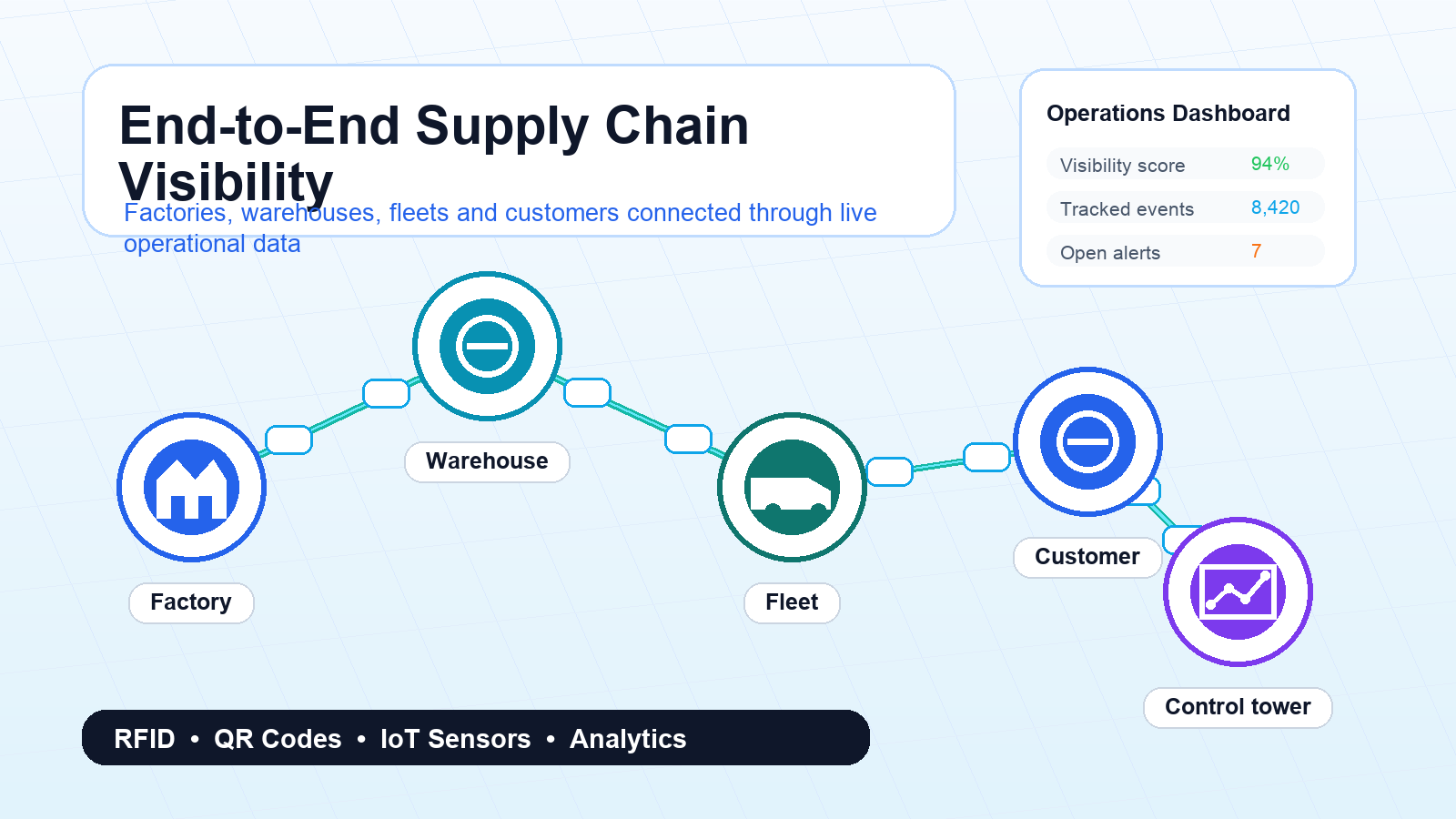
End-to-end visibility is the ability to see the movement and status of goods across the full supply chain. That includes raw materials, production, storage, dispatch, transport, delivery, returns, and in some cases the customer experience after delivery.
A good visibility system connects events that usually sit in separate places. A production batch record, a warehouse scan, an RFID read, a truck location update, and a delivery confirmation should tell one continuous story.
Where visibility usually breaks down
Most companies already have some data. The problem is that the data is often late, incomplete, or difficult to trust.
- Manual handovers: Teams depend on phone calls or handwritten records when goods move between locations.
- System gaps: ERP, warehouse, transport, and customer service systems do not always share information cleanly.
- Delayed updates: Shipment status changes after the issue has already affected the customer.
- Weak item-level tracking: Teams can track a dispatch note but not the individual item, batch, pallet, or asset.
- Poor exception handling: Delays, wrong scans, route changes, and missing items are noticed too late.
What businesses should track
The right tracking level depends on the process. Some businesses need item-level traceability. Others need batch, pallet, container, vehicle, or asset tracking.
Common data points include product ID, batch number, serial number, location, timestamp, scan user, vehicle, shipment status, temperature, humidity, proof of delivery, and exception reason. The more regulated or high value the product is, the more important the data trail becomes.
Technologies that support visibility
Visibility does not come from one tool. It usually comes from a mix of identification, sensing, connectivity, and software.
- QR codes and barcodes work well for low-cost scanning and product verification.
- RFID helps when many items need to be scanned quickly without direct line of sight.
- IoT sensors capture live condition data such as temperature, shock, humidity, or movement.
- GPS and telematics provide vehicle and shipment location updates.
- Control tower dashboards combine events, alerts, and reports into one operational view.
How visibility reduces delays and loss
Visibility helps teams spot problems while there is still time to act. If a shipment is stuck at a hub, the transport team can escalate before the delivery date is missed. If inventory is sitting in the wrong bin, the warehouse team can correct it before production stops.
The biggest improvement often comes from exception workflows. A dashboard that only shows data is useful. A system that alerts the right person, records the action taken, and tracks the resolution is far more valuable.
Compliance benefits
Compliance teams need evidence. They need to show what happened, when it happened, who handled it, and whether the process followed the required standard. A visibility platform creates that audit trail automatically if scanning and event capture are designed correctly.
This is especially useful in pharmaceuticals, food, healthcare, automotive, and electronics, where recalls, warranties, quality checks, and chain-of-custody records matter.
How to start without overcomplicating it
The best starting point is one high-friction process. Pick a product line, warehouse flow, asset category, route, or compliance requirement where the business impact is easy to measure.
- Map the current movement of goods and information.
- Identify the blind spots that create delays, loss, or manual follow-up.
- Choose the simplest tracking technology that solves the problem.
- Run a pilot with clear metrics such as inventory accuracy, dispatch errors, delay alerts, or recall lookup time.
- Scale only after the workflow, data quality, and user adoption are stable.
Metrics to watch
Useful visibility metrics include on-time dispatch, on-time delivery, inventory accuracy, scan compliance, exception response time, lost item rate, return processing time, and audit preparation time. These numbers show whether visibility is improving operations or just adding another dashboard.
Final thoughts
End-to-end supply chain visibility gives teams a clearer view of what is moving, where it is moving, and what needs attention. The companies that benefit most are the ones that treat visibility as an operating system for daily decisions, not a reporting layer that people check after something goes wrong.
Start small, measure the result, and build toward a connected supply chain where problems are visible early enough to fix.
FAQs
What is end-to-end supply chain visibility?
It is the ability to track products, assets, inventory, and shipments across the full supply chain, from origin to delivery.
Does visibility require RFID?
No. RFID is useful for many use cases, but QR codes, barcodes, GPS, IoT sensors, and system integrations can also support visibility.
What is the best first visibility project?
Start with one painful process, such as shipment exceptions, warehouse inventory mismatch, asset loss, or compliance reporting.