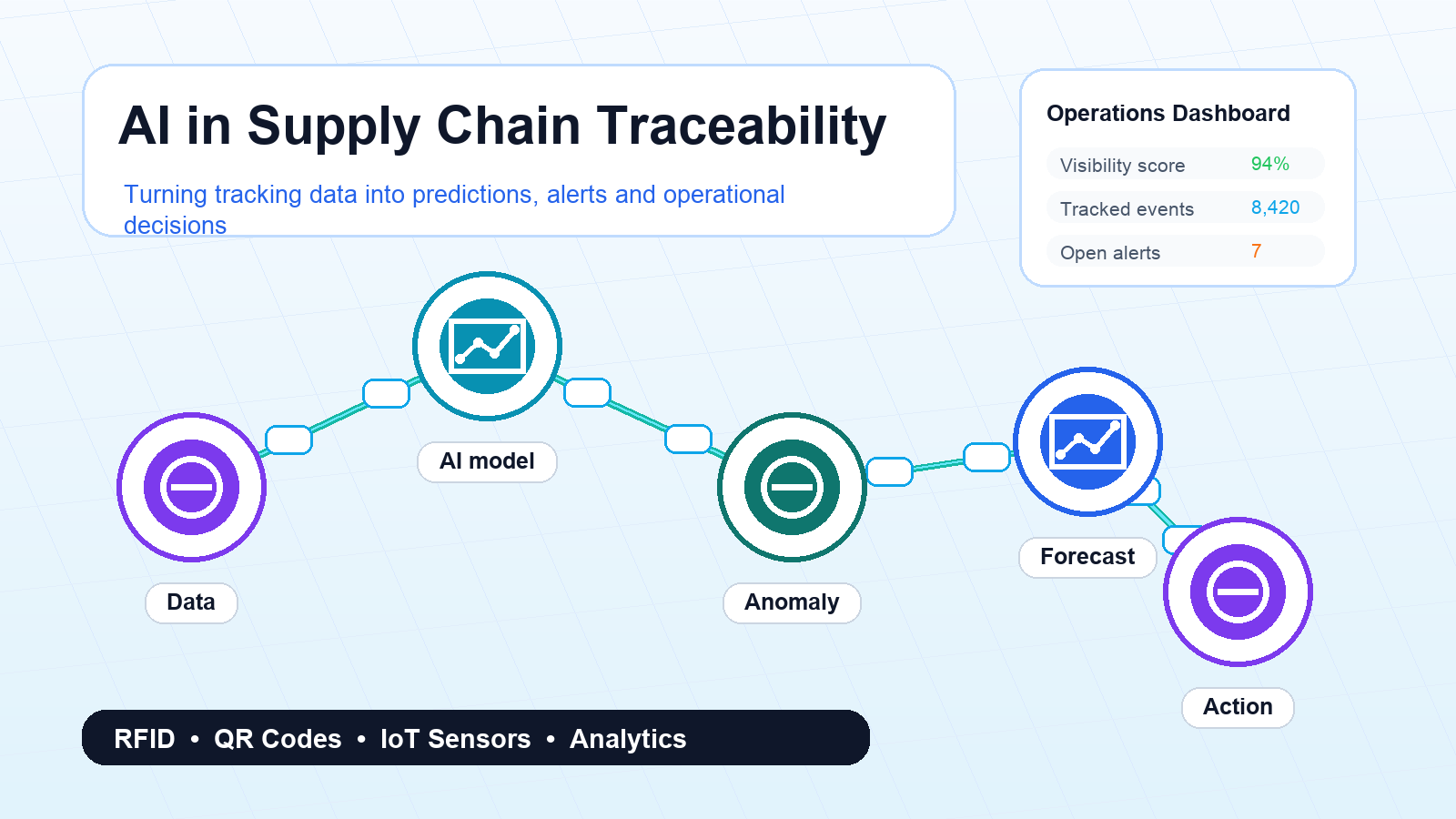
AI is useful in supply chain traceability when it helps teams make better decisions from tracking data. It should not be treated as a magic layer on top of messy operations. The value comes when AI can detect patterns, flag exceptions, predict risk, or reduce manual review.
Manufacturers and logistics teams already collect data from scans, RFID readers, sensors, ERP systems, warehouse systems, transport platforms, and customer updates. AI can help turn that data into practical actions.
Where AI fits in traceability
Traceability systems record what happened to a product, batch, asset, or shipment. AI can analyze those records and identify what is unusual, what may happen next, and where the process can improve.
The strongest AI use cases usually depend on good operational data. If locations, item IDs, timestamps, and exception codes are incomplete, AI will struggle to produce reliable recommendations.
Use case 1: anomaly detection
Anomaly detection helps teams identify unusual patterns that may indicate a problem. Examples include a shipment stopping at an unexpected location, an item moving backward in the process, a batch taking longer than normal between stages, or a temperature reading drifting outside the usual range.
Instead of asking users to monitor every dashboard, the system can highlight events that deserve attention.
Use case 2: predictive delay alerts
AI can estimate whether a shipment, production batch, or warehouse task is likely to miss its planned milestone. The model may use route history, carrier performance, current location, dwell time, weather, hub congestion, or scan timing.
Predictive alerts are valuable because they create time to act. A team can reroute, notify the customer, change a production plan, or escalate with a logistics partner before the delay becomes unavoidable.
Use case 3: computer vision for quality and identification
Computer vision can support traceability by reading labels, detecting damage, checking package condition, confirming counts, or verifying whether the right item is present at the right stage.
This can reduce manual inspection in repetitive workflows. It can also create visual evidence that supports quality checks and dispute resolution.
Use case 4: smarter recall analysis
During a recall, teams need to identify affected batches, locations, shipments, and customers quickly. AI can help analyze traceability records to narrow the likely impact, spot related movement patterns, and prioritize the highest-risk records for review.
The system should not replace quality approval, but it can reduce the time spent searching through disconnected records.
Use case 5: demand and inventory signals
Traceability data can improve inventory planning when combined with sales, production, and movement history. AI can identify slow-moving stock, recurring stockouts, route-level demand changes, and locations where inventory accuracy is weak.
This helps planners work with fresher signals instead of relying only on historical averages.
Use case 6: automated exception routing
Many supply chain exceptions are not complicated, but they need fast routing. A missed scan may go to the warehouse lead. A temperature breach may go to quality. A route deviation may go to transport operations. A high-value item movement may go to security.
AI can help classify exceptions and suggest the next action based on past resolutions, priority, and business rules.
Data needed before AI
AI projects fail when the base traceability data is weak. Before investing heavily, teams should check the basics:
- Consistent item, batch, shipment, and location IDs
- Reliable timestamps and scan events
- Clear exception codes and reason categories
- Integration with ERP, WMS, TMS, or production systems
- Enough historical data to identify normal and abnormal patterns
How to start with a small AI project
The best first AI project is narrow. Choose one problem where the outcome is easy to measure. For example, predict late shipments on one lane, detect abnormal dwell time in one warehouse, or classify temperature exceptions for one product group.
- Define the business problem and the decision AI should support.
- Collect the minimum data required for that decision.
- Build or configure a model that produces explainable outputs.
- Test recommendations against historical events.
- Run a controlled pilot with human review.
- Measure whether response time, accuracy, or cost improves.
Risks to manage
- Bad data: AI cannot fix missing or inconsistent traceability records by itself.
- Black-box decisions: Operations teams need to understand why an alert was raised.
- Alert fatigue: Too many low-quality alerts will make users ignore the system.
- Poor adoption: AI must fit the workflow of the people who act on the recommendation.
What success looks like
A successful AI traceability project should produce clear operational results. Examples include fewer late deliveries, faster exception response, reduced manual inspection time, improved recall analysis, better inventory accuracy, or fewer false alarms.
The technology matters, but the workflow matters more. If nobody acts on the insight, the insight has little value.
Final thoughts
AI can make traceability systems more useful by turning event data into warnings, predictions, and recommendations. The practical path is to start with clean data, a focused problem, and a measurable outcome.
For most teams, the right question is not “How can we use AI?” It is “Which traceability decision is slow, expensive, or error-prone today, and can AI help improve it?”
FAQs
Can AI replace a traceability system?
No. AI needs traceability data to work. It improves analysis and decision support but does not replace item identification, scanning, sensors, and process records.
What is the easiest AI use case to start with?
Anomaly detection or predictive delay alerts are often good starting points because they use data many companies already collect.
Does AI require a large data science team?
Not always. Many platforms include built-in analytics and alerting. Complex custom models may need data science support, but small pilots can start with focused rules and basic machine learning.