Track and trace solutions help businesses answer a simple but critical question: where is every product, component, shipment, or asset right now, and what happened to it before it reached that point?
For manufacturers, distributors, logistics teams, healthcare providers, and retailers, that visibility is no longer optional. Customers expect faster delivery. Regulators expect better records. Operations teams need fewer blind spots. And leadership wants proof that inventory, assets, and products are moving through the supply chain without unnecessary delays, loss, or compliance risk.
This guide explains what track and trace means, the technologies behind it, the business benefits, and how to plan a practical rollout.
What Are Track and Trace Solutions?
Track and trace solutions are systems that identify, monitor, and record the movement of items across the supply chain. They combine identification technologies, data capture devices, software, and analytics to create a reliable history of each item or shipment.
In simple terms:
- Tracking shows the current location and status of an item.
- Tracing shows the historical journey of that item from origin to destination.
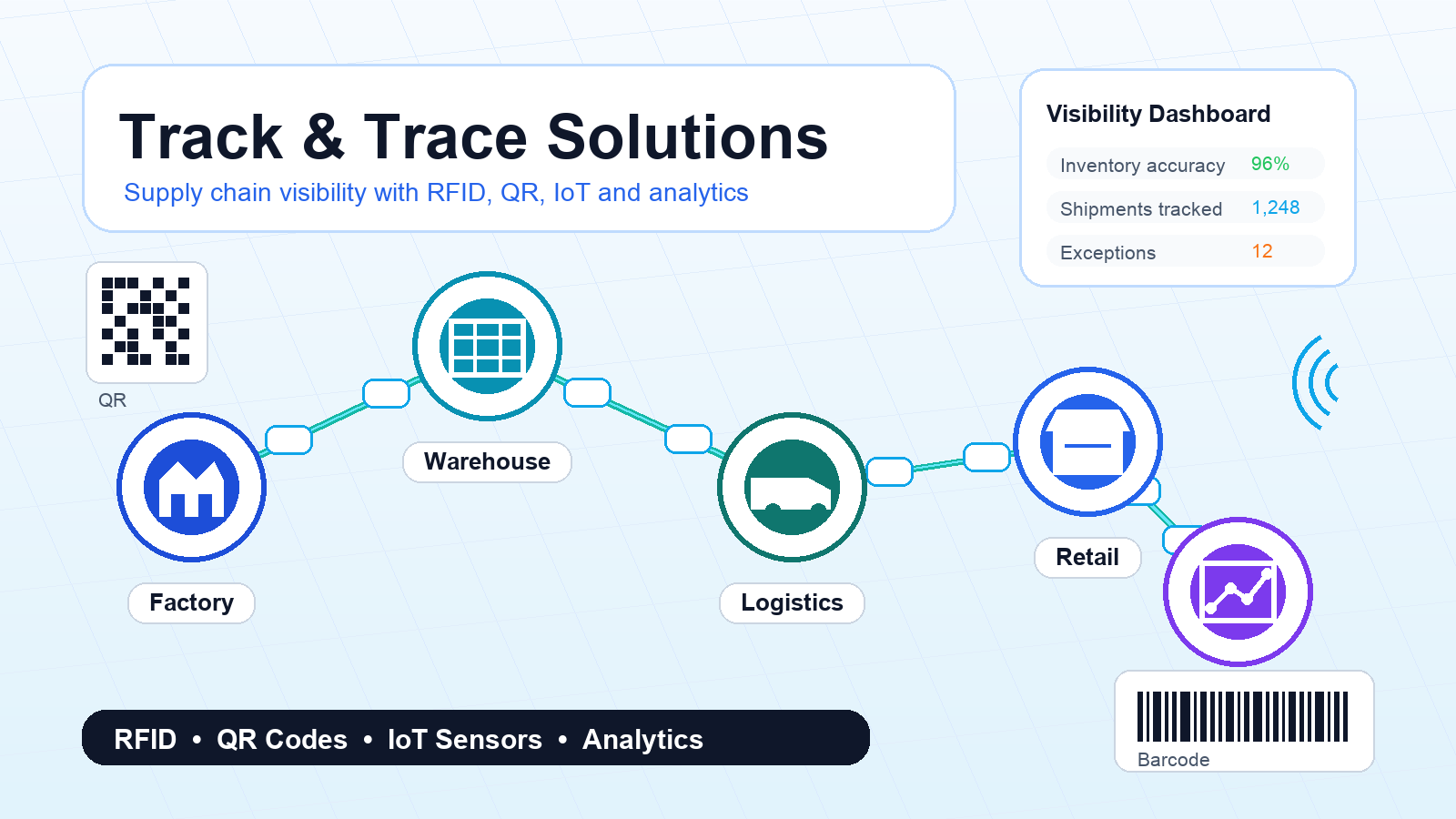
Together, they create end-to-end supply chain visibility. A business can see when a product was manufactured, where it was stored, when it was shipped, which route it followed, who handled it, and whether any exceptions occurred along the way.
Why Supply Chain Visibility Matters in 2026
Modern supply chains are fast, connected, and vulnerable to disruption. A single delay, stock mismatch, quality issue, or missing shipment can affect production schedules, customer commitments, and brand trust.
Track and trace systems help businesses move from reactive problem-solving to proactive control. Instead of discovering issues after a customer complaint or audit, teams can detect exceptions earlier and respond faster.
Key reasons companies invest in track and trace
- Regulatory compliance: Industries such as pharmaceuticals, food, healthcare, and manufacturing require accurate product history and movement records.
- Inventory accuracy: Real-time visibility reduces stock discrepancies, overstocking, and lost inventory.
- Faster recalls: Businesses can identify affected batches or shipments quickly instead of recalling more products than necessary.
- Customer transparency: Buyers increasingly expect reliable delivery updates and product authenticity.
- Operational efficiency: Automated data capture reduces manual entry, paperwork, and human error.
- Risk reduction: Teams can detect theft, diversion, temperature excursions, route delays, and process gaps.
Core Technologies Used in Track and Trace
A track and trace solution is not a single technology. It is usually a combination of tools selected according to the use case, cost, environment, and accuracy requirement.
1. Barcode and QR Code Tracking
Barcodes and QR codes are widely used because they are affordable, easy to print, and simple to scan. They work well for item identification, warehouse operations, shipping labels, and customer-facing product verification.
QR codes are especially useful when more data needs to be stored or when consumers need to verify product authenticity using a smartphone.
2. RFID Tracking
Radio Frequency Identification, or RFID, allows items to be scanned without direct line of sight. This is valuable in warehouses, manufacturing plants, retail inventory, reusable containers, and asset tracking.
RFID can reduce scanning time significantly when many items need to be identified at once. It is often selected when speed and automation matter more than the lowest possible tag cost.
3. IoT Sensors
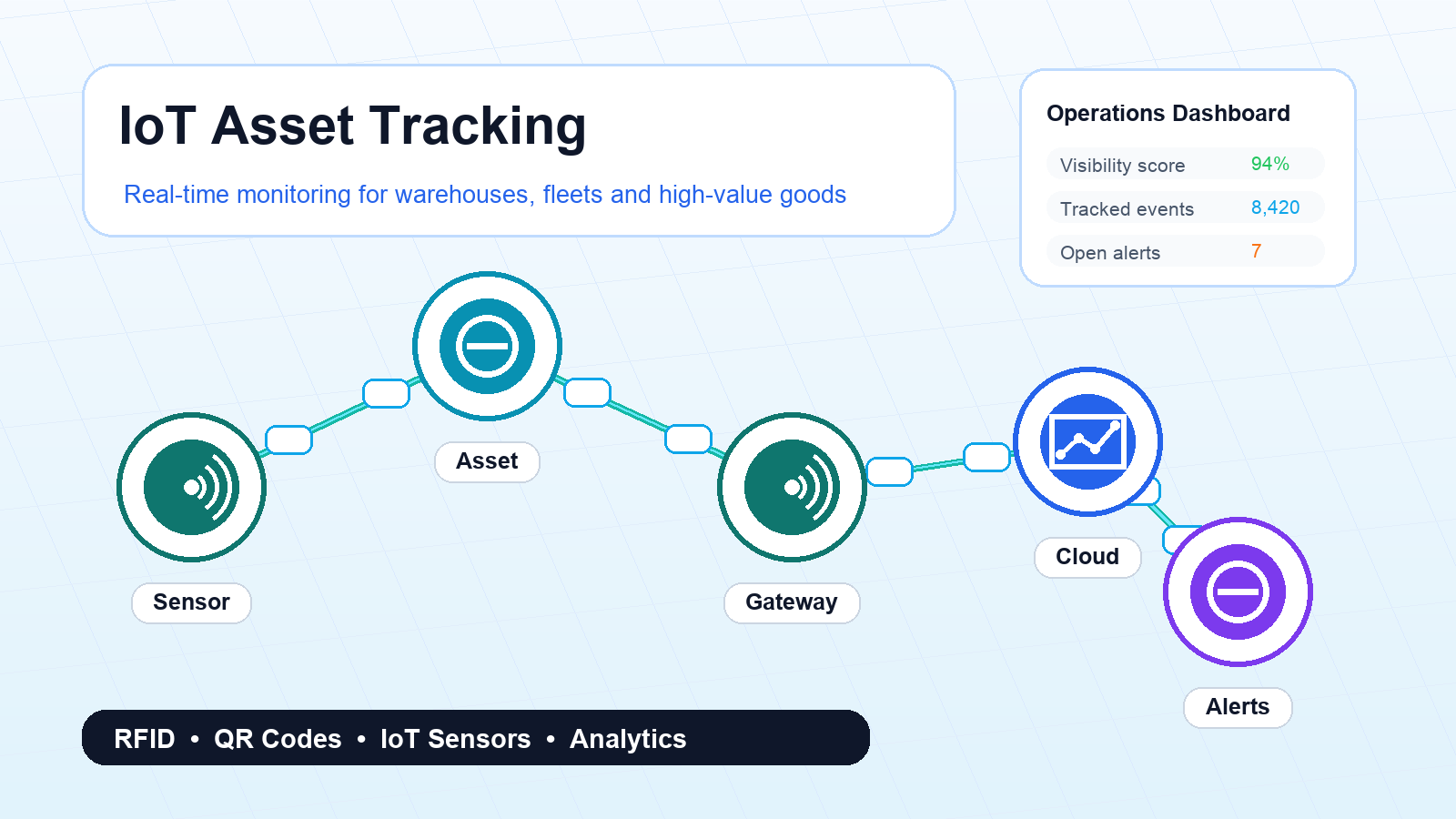
IoT sensors collect real-time data such as location, temperature, humidity, vibration, shock, and movement. They are useful for cold chain logistics, high-value shipments, fleet tracking, and sensitive products.
For example, a pharmaceutical or food shipment can be monitored continuously to confirm whether temperature stayed within the acceptable range.
4. GPS and Real-Time Location Systems
GPS is commonly used for vehicles and outdoor shipment tracking. Real-Time Location Systems, or RTLS, are used for more precise indoor tracking in hospitals, factories, warehouses, and large campuses.
Depending on the required accuracy, RTLS may use BLE, Wi-Fi, UWB, infrared, or active RFID.
5. Cloud Software and Analytics
The software layer is where data becomes useful. A strong platform brings together scanning events, sensor data, shipment milestones, inventory records, user activity, and exception alerts.
Dashboards, reports, alerts, and integrations help operations teams act on the data instead of simply collecting it.
How Track and Trace Works in a Real Supply Chain
A typical track and trace workflow includes the following steps:
- Assign a unique identity: Each product, batch, pallet, asset, or shipment receives a barcode, QR code, RFID tag, or digital ID.
- Capture events: Scanners, RFID readers, mobile apps, IoT devices, or system integrations capture movement and status updates.
- Store the data: Events are recorded in a central software platform with timestamps, locations, users, and contextual details.
- Monitor exceptions: The system flags issues such as missed scans, delays, wrong destinations, temperature breaches, or unexpected route changes.
- Analyze and improve: Teams review trends to reduce bottlenecks, improve inventory accuracy, and strengthen compliance.
Business Benefits of Track and Trace Solutions
Better inventory control
When every movement is recorded, teams can reduce stock mismatch between physical inventory and system inventory. This helps avoid unnecessary purchases, production delays, and customer service issues.
Faster decision-making
Real-time data helps managers respond quickly. If a shipment is delayed or an item is missing from the expected location, the team can act before the issue becomes expensive.
Improved compliance readiness
Audit trails are easier to produce when every important event is already captured digitally. This is especially useful in regulated industries where batch history, chain of custody, and process records matter.
Reduced manual work
Manual spreadsheets and paper-based logs often create errors and delays. Automated scanning and digital workflows improve accuracy while freeing employees for higher-value tasks.
Higher customer trust
When businesses can verify product authenticity, provide better delivery visibility, and handle recalls quickly, customers gain more confidence in the brand.
Industries That Benefit Most
Track and trace can support almost any business that moves goods or manages physical assets. Common use cases include:
- Manufacturing: Work-in-progress tracking, component traceability, quality control, and finished goods movement.
- Pharmaceuticals: Serialization, batch tracking, cold chain monitoring, anti-counterfeit protection, and compliance reporting.
- Food and beverage: Ingredient traceability, production batch visibility, expiry tracking, and faster recalls.
- Logistics and warehousing: Shipment visibility, pallet tracking, route monitoring, and proof of delivery.
- Healthcare: Medical equipment tracking, RTLS asset visibility, inventory control, and patient safety workflows.
- Retail: Inventory accuracy, product authentication, loss prevention, and omnichannel fulfilment.
How to Choose the Right Track and Trace Solution
The best solution depends on the business process, not just the technology. Before selecting a platform or device, clarify the problem you want to solve.
Questions to ask before implementation
- What needs to be tracked: item, batch, pallet, vehicle, asset, or shipment?
- Where does tracking need to happen: factory, warehouse, vehicle, store, field, or customer location?
- How accurate does location data need to be?
- Is real-time monitoring required, or are milestone scans enough?
- What systems need to integrate with the platform: ERP, WMS, TMS, CRM, or e-commerce?
- Which compliance or audit reports are required?
- What is the acceptable cost per tag, sensor, scan, or asset?
Implementation Roadmap
A practical rollout should start small and scale after value is proven.
Step 1: Map the current process
Document how products, assets, and information move today. Identify blind spots, manual steps, repeated errors, and high-risk points.
Step 2: Define measurable goals
Examples include reducing missing inventory by 30%, improving dispatch accuracy, reducing recall investigation time, or increasing scan compliance.
Step 3: Select the right identification method
Use barcodes or QR codes for low-cost scanning, RFID for speed and automation, IoT sensors for condition monitoring, and GPS or RTLS for location visibility.
Step 4: Pilot one focused use case
Start with one warehouse, one product line, one fleet route, or one asset category. A focused pilot is easier to measure and refine.
Step 5: Integrate with business systems
Track and trace data becomes more valuable when it connects with ERP, warehouse, transport, or customer service systems.
Step 6: Scale with governance
Standardize data formats, user roles, scanning rules, exception workflows, and reporting dashboards before expanding across locations.
Common Mistakes to Avoid
- Starting with technology instead of business goals: RFID, QR, IoT, and RTLS all have different strengths. The process should guide the tool.
- Ignoring data quality: Poor master data, inconsistent item codes, or missing location records can weaken the entire system.
- Skipping user training: Even the best software fails if teams do not scan, tag, or update records correctly.
- Overcomplicating the first rollout: A narrow, measurable pilot is usually better than a complex multi-location launch.
- Not planning integrations: Track and trace should support existing operations, not become another isolated data system.
Future of Track and Trace
Track and trace is moving beyond basic shipment visibility. AI, predictive analytics, computer vision, digital twins, and automated exception handling are making systems more intelligent.
Instead of simply showing where an item is, modern platforms can help predict delays, recommend corrective action, detect unusual movement patterns, and improve planning decisions.
For businesses with complex operations, this shift can turn supply chain data into a competitive advantage.
Final Thoughts
Track and trace solutions give businesses the visibility needed to manage products, assets, shipments, and compliance with more confidence. The right system can improve inventory accuracy, reduce risk, speed up audits, strengthen customer trust, and make supply chain operations more resilient.
The best approach is to start with a focused business problem, select the right technology mix, run a measurable pilot, and then scale the solution across the supply chain.
FAQs
What is the difference between tracking and tracing?
Tracking shows the current location or status of an item. Tracing shows the historical journey of that item, including where it came from, where it moved, and what happened along the way.
Which is better for track and trace: RFID or barcode?
Barcodes and QR codes are more affordable and work well for simple scanning. RFID is better when many items need to be scanned quickly or without line of sight. Many businesses use both depending on the process.
Can track and trace help with product recalls?
Yes. A good traceability system helps identify affected batches, shipments, locations, and customers faster, reducing recall time and limiting unnecessary disruption.
Is track and trace only for large companies?
No. Smaller businesses can start with QR codes, barcode scanning, or a focused inventory visibility workflow and expand as operations grow.
What data should a track and trace system capture?
Common data includes item ID, batch number, location, timestamp, user, status, shipment details, sensor readings, and exception events.