
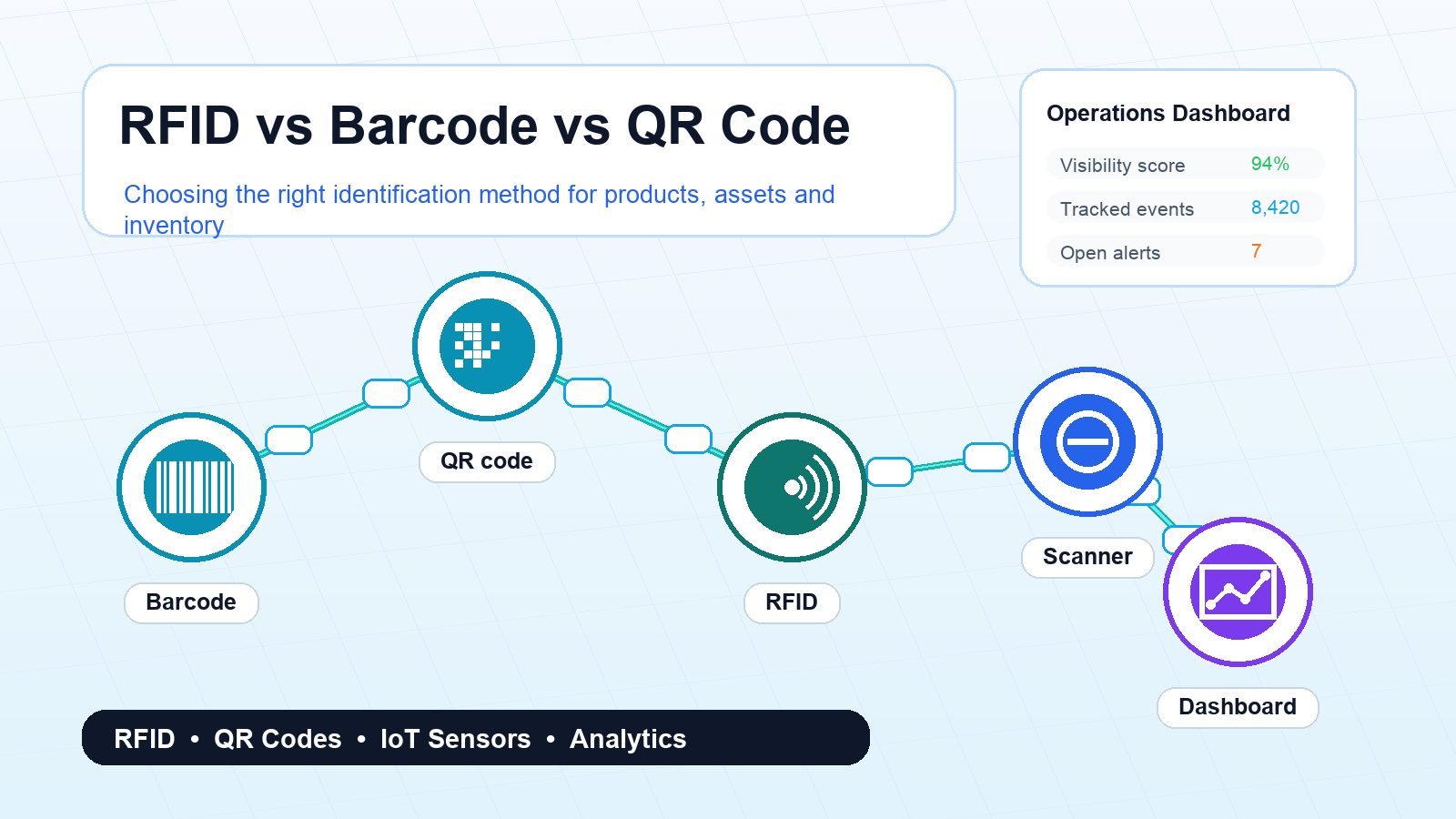
RFID, barcodes, and QR codes all help businesses identify and track items. The right choice depends on the process, the scanning environment, the level of automation required, and the cost the business can support.
A barcode may be perfect for simple warehouse picking. A QR code may be better for customer-facing product verification. RFID may be the stronger option when hundreds of items need to be read quickly without direct line of sight.
This guide compares the three technologies in practical terms so teams can choose the right tracking method instead of buying technology that does not fit the operation.
Quick comparison
- Barcode: Lowest cost, widely adopted, requires line of sight, best for simple scanning workflows.
- QR code: Low cost, stores more data than a traditional barcode, can be scanned by smartphones.
- RFID: Higher tag and infrastructure cost, fast reads, works without line of sight, supports automation.
How barcode tracking works
A barcode is a printed pattern that represents data. A scanner reads the pattern and sends the item ID to a software system. Barcodes are common in retail, warehouses, manufacturing, logistics, healthcare, and documents.
The main advantage is cost. Labels are cheap to print, scanners are easy to deploy, and most employees already understand the workflow. The limitation is that each label usually needs to be visible and scanned one at a time.
When barcodes are the right choice
- Low-cost item identification
- Warehouse picking and packing
- Shipping labels and cartons
- Retail checkout
- Basic inventory movement records
Barcodes are still useful because they are simple. If the process only needs occasional scanning and the label is easy to access, a barcode may be enough.
How QR code tracking works
A QR code is a two-dimensional code that can store more information than a standard barcode. It can hold URLs, serial numbers, product IDs, batch details, and verification links. Most smartphones can scan QR codes without a special device.
That makes QR codes useful for both internal operations and customer-facing use cases. A business can use QR codes for inventory tracking, warranty registration, product authenticity checks, installation guides, or service records.
When QR codes are the right choice
- Product authentication and anti-counterfeit workflows
- Consumer verification through mobile phones
- Field service and maintenance records
- Batch traceability on packaging
- Low-cost digital product passports
How RFID tracking works
RFID uses radio signals to identify tags. The tag may be attached to a product, pallet, asset, container, uniform, tool, or vehicle. An RFID reader captures the tag ID and sends it to the tracking software.
The major benefit is speed. RFID can read many tags quickly, and the tag does not always need to be visible. That is useful when items are inside cartons, moving through a gate, stacked on pallets, or handled in large volumes.
When RFID is the right choice
- High-volume warehouse operations
- Reusable transport item tracking
- Asset tracking in factories, hospitals, and campuses
- Retail inventory cycle counts
- Manufacturing work-in-progress tracking
RFID is not automatically better than barcodes. It is better when the value of faster, more automated scanning is higher than the added cost of tags, readers, testing, and process design.
Cost considerations
Barcodes and QR codes are inexpensive because the label can be printed on standard packaging or stickers. RFID requires tags and readers, and some environments need testing because metal, liquids, distance, and orientation can affect read performance.
The business case for RFID is strongest when labor savings, inventory accuracy, loss reduction, or throughput improvement can justify the investment.
Accuracy and data quality
All three technologies can fail if the process is weak. A damaged barcode, badly placed QR code, or poorly tuned RFID reader can create inaccurate records. The tracking system should include scan validation, duplicate handling, exception alerts, and user training.
Can businesses use more than one?
Yes. Many operations use a hybrid model. A product may carry a QR code for customers and an RFID tag for warehouse automation. A carton may have a barcode for logistics partners and an RFID label for internal movement. The best design follows the journey of the item and the needs of each stakeholder.
Selection checklist
- Do items need to be scanned one by one or in bulk?
- Is line of sight available?
- Is the environment harsh, wet, metallic, or high-speed?
- Who scans the item: employee, customer, driver, or automated reader?
- What is the acceptable tag or label cost?
- Does the process need real-time updates or milestone scans?
Final recommendation
Use barcodes when the process is simple and cost matters most. Use QR codes when mobile scanning or customer verification is important.
The strongest tracking systems are designed around the business workflow first. Technology should support that workflow, not force the team to change how the operation works without a clear reason.
FAQs
Is RFID replacing barcodes?
No. RFID is growing, but barcodes remain practical for many low-cost scanning workflows.
Can a QR code be used for supply chain traceability?
Yes. QR codes can carry product or batch identifiers and link to digital records, verification pages, or service workflows.
Which technology is best for warehouses?
Barcodes work well for basic operations. RFID is better when the warehouse needs faster cycle counts, bulk reads, or automated movement capture.