In today’s competitive market, businesses need to know where their products are, what is happening to them, and when they will reach the customer. This is where end-to-end product visibility becomes important.
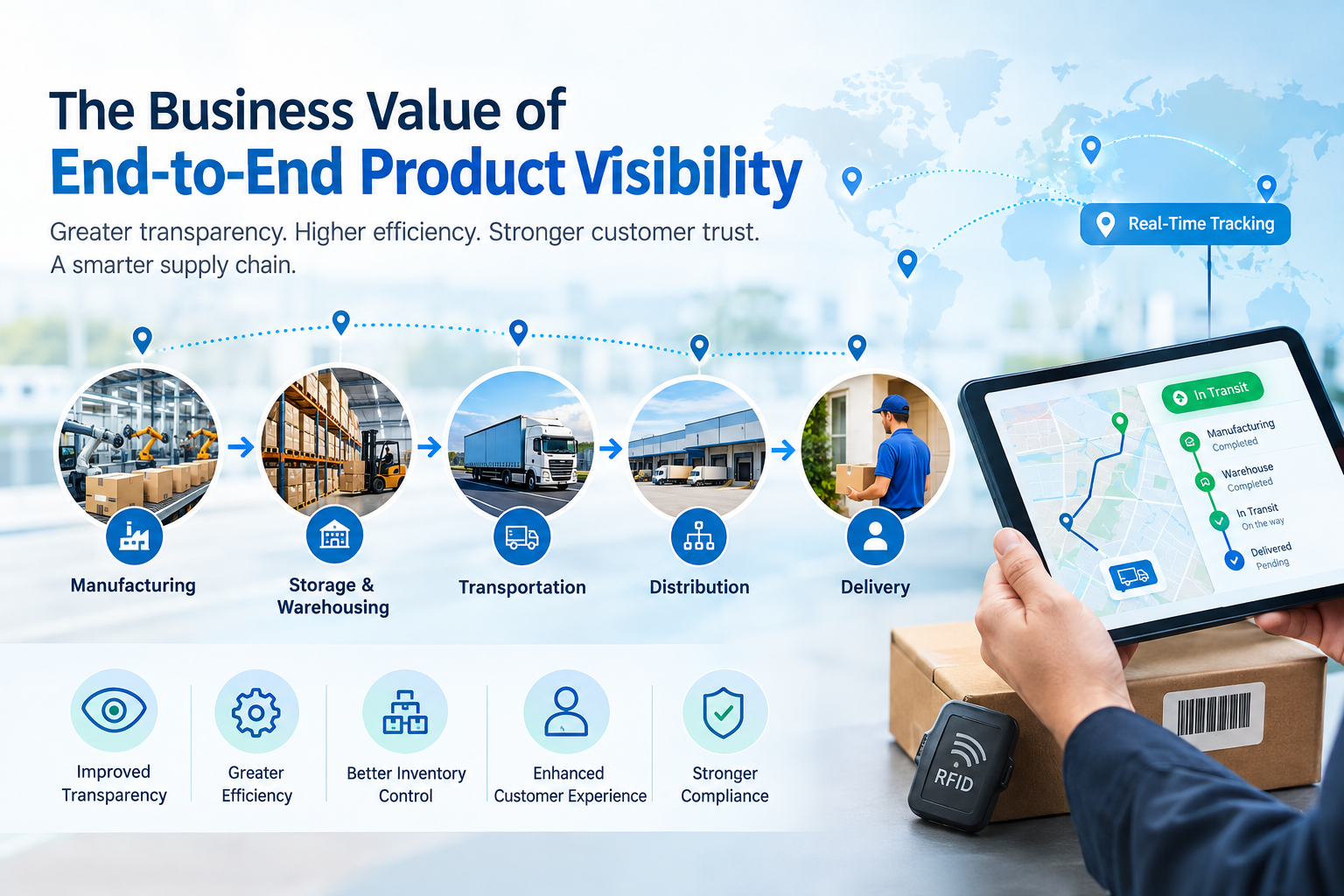
End-to-end product visibility allows businesses to monitor products throughout their journey, from manufacturing and storage to transportation, distribution, and final delivery. With better visibility, companies can identify delays, manage inventory, improve customer service, and make faster business decisions.
What Is End-to-End Product Visibility?
End-to-end product visibility is the ability to track and monitor a product across its complete journey through the supply chain.
Instead of relying on separate systems for manufacturing, warehousing, transportation, and delivery, businesses can connect information from different stages into a more complete view.
For example, a manufacturer can monitor when a product is produced, stored in a warehouse, shipped to a distributor, and finally delivered to a customer.
How End-to-End Product Visibility Works
Product visibility combines tracking technologies, connected systems, and business data to provide information about products and their movement.
A typical process can include:
- Product identification
- Production tracking
- Warehouse monitoring
- Shipment tracking
- Distribution monitoring
- Delivery confirmation
- Data analysis and reporting
When these stages are connected, businesses can gain a clearer understanding of their supply chain.
Key Data Sources for Product Visibility
Businesses can collect product and shipment information from several sources, including RFID tags, barcodes, IoT sensors, GPS devices, warehouse management systems, transportation management systems, and cloud platforms.
Combining these sources helps businesses create a more connected view of product movement.
Why End-to-End Product Visibility Matters for Businesses
Limited visibility can make it difficult to understand where products are or why delays are occurring. Manual processes can also increase the possibility of errors.
End-to-end product visibility helps businesses access relevant information across different supply chain stages.
Improves Supply Chain Transparency
Businesses can see product movements across manufacturing, warehousing, transportation, and delivery. This makes it easier to identify gaps and understand what is happening at different stages.
Helps Reduce Delays and Operational Costs
When businesses can identify delays early, they can take corrective action before problems become larger. Better visibility can also help reduce unnecessary handling, manual tracking, and inefficient processes.
Supports Better Business Decisions
Accurate and timely data allows managers to make informed decisions about inventory, transportation, production, and customer orders.
Key Business Benefits of End-to-End Product Visibility
Implementing product visibility can provide several operational and customer-facing benefits.
Real-Time Product Tracking
Businesses can monitor product locations and movement using technologies such as RFID, GPS, barcodes, and IoT devices.
This can provide useful information about shipment status and help teams respond to unexpected events.
Improved Inventory Management
Better visibility helps businesses understand what inventory is available, where it is located, and how it is moving.
This can support better stock management and reduce the risk of unnecessary inventory buildup or stock shortages.
Faster Issue Detection and Resolution
When a shipment is delayed or a product moves outside an expected process, visibility systems can help teams identify the issue more quickly.
Early detection allows businesses to investigate and resolve problems before they significantly affect operations.
Better Customer Experience
Customers increasingly expect accurate information about their orders. Businesses with better product visibility can provide more reliable updates about order and delivery status.
This improves communication and gives customers greater transparency.
Improved Regulatory Compliance
Some industries require detailed information about product movement, handling, and distribution.
A connected visibility system can help businesses maintain records and provide traceability information when required.
Technologies That Enable Product Visibility
Modern product visibility depends on several technologies working together.
RFID and Barcode Technology
RFID and barcode systems provide businesses with ways to identify and track products.
Barcodes are commonly scanned at different stages, while RFID can enable identification without requiring direct line-of-sight scanning in many use cases.
IoT and Real-Time Tracking
IoT devices can collect information about products, vehicles, equipment, and environmental conditions.
For example, sensors can monitor location, temperature, humidity, or other conditions during transportation.
Cloud-Based Data Platforms
Cloud platforms can bring information from different systems together. This can make supply chain data easier to access, share, and analyze across business teams.
AI and Data Analytics
AI and analytics can help businesses identify patterns in supply chain data. Companies can use these insights to identify potential issues, analyze performance, and support more proactive decision-making.
How End-to-End Product Visibility Improves Supply Chain Performance
Visibility becomes particularly valuable when products move through multiple locations and business partners.
From Manufacturing to Distribution
During production, businesses can track products and associate them with relevant production information. Once products enter storage or distribution, tracking data can continue through the next stages.
From Distribution to Delivery
During transportation, businesses can monitor shipments and receive updates about their progress.
This can help logistics teams identify delays and communicate more accurate information to customers and partners.
Monitoring Products Across the Entire Journey
The main value of end-to-end visibility comes from connecting different stages rather than monitoring each stage separately.
A connected visibility approach can provide a more complete picture of the product journey.
Challenges in Implementing End-to-End Product Visibility
Although product visibility offers several benefits, implementation can involve challenges.
Data Integration Challenges
Businesses often use different software systems across departments and locations. Connecting these systems can require careful planning and integration.
Implementation and Technology Costs
Hardware, software, integration, training, and maintenance can create initial costs. Businesses need to select solutions that match their operational requirements.
Data Security and Privacy
Connected systems generate and share significant amounts of business data. Companies need appropriate security controls to protect sensitive information.
Lack of Standardized Data
Different suppliers, logistics providers, and internal departments may use different data formats and processes. Standardization can make information easier to combine and analyze.
How Businesses Can Implement End-to-End Product Visibility
Businesses can take a structured approach when developing a product visibility strategy.
Identify Visibility Gaps
Start by identifying where product information is currently unavailable, delayed, or difficult to access.
Choose the Right Tracking Technologies
Select technologies based on the products, environment, tracking requirements, and business objectives. Options may include RFID, barcodes, IoT sensors, GPS, or a combination of technologies.
Integrate Data Across Business Systems
Connect tracking data with relevant systems such as ERP, warehouse management, transportation management, and customer-facing platforms.
Monitor and Optimize Performance
After implementation, businesses should regularly review visibility data and identify opportunities to improve processes.
Industries That Benefit From Product Visibility
End-to-end product visibility can be useful across industries where products move through multiple supply chain stages.
Manufacturing
Manufacturers can track raw materials, work-in-progress items, finished products, and shipments.
Healthcare and Pharmaceuticals
Healthcare and pharmaceutical organizations can use traceability systems to monitor products and support controlled supply chains.
Retail and E-Commerce
Retailers can improve inventory visibility and provide customers with better order and delivery information.
Logistics and Transportation
Logistics companies can monitor shipments, vehicles, and delivery processes to improve operational visibility.
Food and Agriculture
Food and agriculture businesses can track products through production, storage, processing, distribution, and delivery.
The Future of End-to-End Product Visibility
Product visibility is moving toward more connected and automated supply chains.
AI-Powered Supply Chain Visibility
AI can analyze large volumes of supply chain data and help businesses identify patterns and potential operational issues.
Predictive Analytics and Automation
Predictive analytics can help companies understand possible future disruptions, while automation can reduce manual monitoring and repetitive tasks.
Connected and Intelligent Supply Chains
As RFID, IoT, cloud platforms, AI, and analytics continue to develop, businesses can build increasingly connected supply chains where product information is available across multiple stages.
Conclusion
End-to-end product visibility gives businesses a clearer view of how products move through the supply chain. From manufacturing and inventory to transportation and final delivery, connected visibility can help companies improve transparency, identify issues, manage inventory, and make better decisions.
As supply chains become more complex, businesses can use technologies such as RFID, barcode systems, IoT, cloud platforms, and AI to build more connected and traceable operations.
For companies looking to improve supply chain performance, product visibility is becoming an important part of creating efficient, responsive, and data-driven operations.
Frequently Asked Questions
Q1. What is end-to-end product visibility?
End-to-end product visibility is the ability to monitor a product throughout its complete journey, from production and storage to transportation, distribution, and final delivery.
Q2. Why is product visibility important for businesses?
Product visibility helps businesses understand where products are, identify delays, manage inventory, improve supply chain transparency, and provide better information to customers.
Q3. How does RFID improve product visibility?
RFID can help businesses identify and track products using radio-frequency technology. It can support faster data collection and product monitoring across different operational stages.
Q4. What technologies are used for product visibility?
Common technologies include RFID, barcodes, IoT sensors, GPS tracking, cloud platforms, AI, analytics, ERP systems, warehouse management systems, and transportation management systems.
Q5. How can businesses implement end-to-end product visibility?
Businesses can begin by identifying visibility gaps, selecting suitable tracking technologies, integrating data across relevant systems, and continuously monitoring and improving their processes.