Supply Chain Traceability: A Complete Guide to End-to-End Visibility
Supply chains have become more complex as businesses source materials, manufacture products, and deliver goods across multiple locations. With so many stages involved, companies need to know where products come from, where they are currently located, and what happens to them throughout their journey.
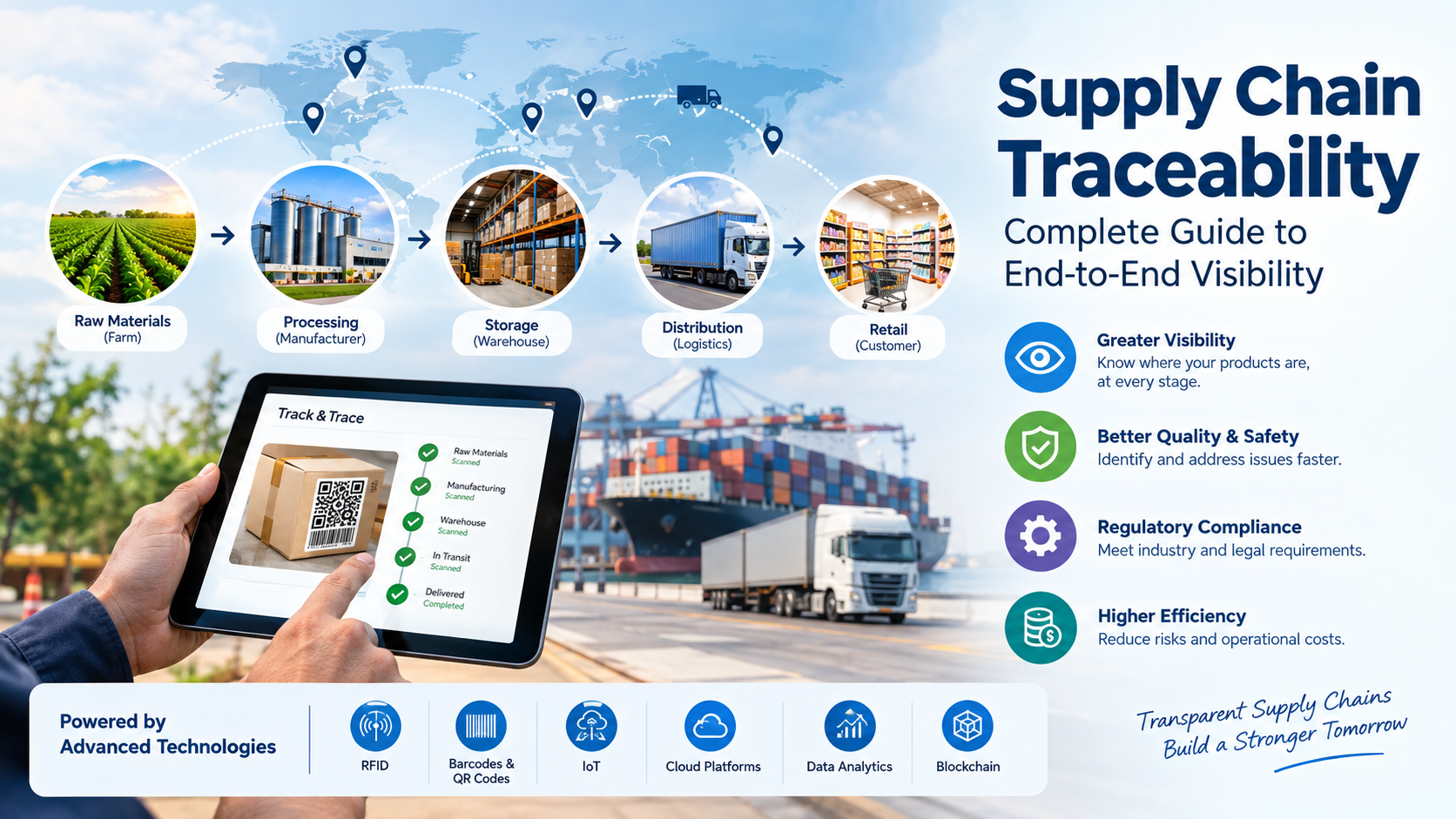
Supply chain traceability helps businesses track products, materials, and information from the point of origin to the final customer. By using technologies such as RFID, barcodes, IoT, cloud platforms, and data analytics, organizations can improve visibility, identify problems faster, and make better supply chain decisions.
In this guide, we will explain what supply chain traceability is, how it works, its benefits, key technologies, challenges, and how businesses can implement a traceability system.
What Is Supply Chain Traceability?
Supply chain traceability is the ability to track and document the movement of products, materials, components, and related information throughout the supply chain.
It creates a record of where a product comes from, what processes it goes through, where it moves, and where it ultimately reaches. This information can help businesses understand their supply chain and respond quickly when problems occur.
For example, a manufacturer may use traceability to track raw materials from a supplier, monitor production, record warehouse movements, and track the finished product during distribution.
How Supply Chain Traceability Works
A typical traceability process includes:
- Identifying products or materials.
- Capturing information at different supply chain stages.
- Recording and storing the data.
- Tracking movement between locations.
- Monitoring products in real time where required.
- Using the collected information for analysis and decision-making.
The exact process depends on the industry, product type, regulatory requirements, and technology used.
Why Supply Chain Traceability Matters
Without proper traceability, businesses may have difficulty identifying where a product came from or where a problem occurred.
Traceability can help organizations:
- Improve supply chain visibility
- Track products and materials
- Identify quality problems
- Support product recalls
- Improve inventory management
- Meet regulatory requirements
- Reduce operational risks
- Provide customers with better product information
How Does Supply Chain Traceability Work?
Supply chain traceability connects information collected at different stages of the product lifecycle.
Product Identification and Data Capture
Products, packages, assets, and materials can be identified using barcodes, QR codes, RFID tags, serial numbers, or other identification methods.
Information such as product ID, batch number, manufacturing date, location, and shipment details can then be captured and stored.
Tracking Products Across the Supply Chain
After identification, products can be tracked as they move between suppliers, factories, warehouses, distribution centers, retailers, and customers.
This provides businesses with greater visibility into product movement and inventory status.
Data Integration and Monitoring
A traceability system can connect information from different business systems, including ERP, WMS, manufacturing, logistics, and inventory platforms.
Integration helps create a more connected view of supply chain activities.
Traceability Data Analysis
Collected data can be analyzed to identify delays, inventory issues, quality problems, and other operational challenges.
Businesses can use these insights to improve processes and make informed decisions.
Key Components of Supply Chain Traceability
An effective traceability system typically combines identification technologies, data collection, software, and analytics.
RFID and Barcode Technology
RFID tags and barcodes are widely used to identify and track products, packages, pallets, and assets.
Barcodes generally require scanning, while RFID can allow compatible systems to identify tagged items without direct line-of-sight scanning.
IoT and Real-Time Tracking
IoT devices and sensors can collect information about location, temperature, humidity, movement, and other conditions.
This can be particularly useful for products that require controlled transportation or storage.
Cloud-Based Traceability Systems
Cloud platforms can centralize supply chain information and make data accessible to authorized users across different locations.
They can also support integration, reporting, and collaboration between supply chain partners.
Data Integration and Analytics
Integration connects traceability information with existing business systems.
Analytics tools can then help organizations identify patterns, monitor performance, and investigate supply chain events.
Benefits of Supply Chain Traceability
Implementing supply chain traceability can provide operational and strategic benefits.
Improved Supply Chain Visibility
Traceability provides businesses with information about product movement and supply chain events.
Better visibility can help teams understand what is happening across different stages of the supply chain.
Better Product Quality and Safety
Businesses can track batches, materials, and production information to help identify potential quality problems.
If an issue is discovered, traceability data can help determine which products or batches may be affected.
Faster Identification of Issues
When supply chain problems occur, organizations can use traceability records to investigate where and when an issue happened.
This can reduce the time required for root cause analysis.
Improved Regulatory Compliance
Many industries have specific requirements for product tracking, documentation, safety, and reporting.
A structured traceability system can help businesses maintain the information required to support compliance processes.
Reduced Operational Costs
Better visibility can help organizations identify inefficiencies, reduce manual processes, improve inventory management, and minimize errors.
The actual cost savings depend on the business process and implementation.
Supply Chain Traceability Across Different Industries
Traceability is used across industries where businesses need visibility into products, materials, and processes.
Food and Agriculture
Food businesses can use traceability to track ingredients, batches, processing activities, storage conditions, and distribution.
This can support food safety investigations and product recalls.
Pharmaceuticals and Healthcare
Pharmaceutical supply chains require detailed information about products, batches, storage, and distribution.
Traceability can help organizations monitor products throughout their supply chain.
Manufacturing
Manufacturers can track raw materials, components, production stages, finished goods, and shipments.
This can support quality management and production visibility.
Retail and E-commerce
Retailers can use traceability to track products from suppliers through distribution centers and stores or directly to customers.
It can also support inventory visibility and product authentication processes.
Logistics and Transportation
Logistics companies can use tracking technologies to monitor shipments, vehicles, containers, and other assets.
This can provide greater visibility into transportation activities.
Technologies Used in Supply Chain Traceability
Modern traceability systems often combine several technologies rather than relying on a single solution.
RFID
Radio Frequency Identification uses tags and readers to identify and track objects.
RFID can be useful for inventory, warehouse, asset, and logistics applications.
Barcodes and QR Codes
Barcodes and QR codes provide a practical way to identify products and connect them with digital information.
They are widely used because they can be relatively simple to deploy and operate.
Internet of Things (IoT)
IoT sensors can collect information from physical objects and environments.
Businesses can use this information for location monitoring, condition monitoring, and real-time visibility.
Artificial Intelligence and Analytics
AI and analytics can help businesses analyze large volumes of supply chain data.
Potential applications include demand analysis, anomaly detection, risk monitoring, and predictive insights.
Blockchain
Blockchain can provide a distributed record of transactions between participating organizations.
In some supply chain applications, it can support data sharing and record verification. However, blockchain is not required for every traceability implementation.
Challenges of Supply Chain Traceability
Although traceability provides significant visibility, implementation can also present challenges.
Data Accuracy and Quality
Traceability depends on accurate data. Incorrect, incomplete, or delayed information can reduce the usefulness of the system.
Businesses need appropriate processes for data capture and validation.
Integration With Existing Systems
Companies may already use ERP, warehouse, manufacturing, logistics, or inventory systems.
Connecting these systems with a traceability platform can require technical planning and integration work.
Implementation Costs
Hardware, software, integration, training, and maintenance can contribute to implementation costs.
Organizations should evaluate their requirements and choose a solution that fits their operational needs.
Lack of Supply Chain Visibility
Businesses often work with multiple suppliers, logistics providers, and partners.
Getting consistent data from different organizations can be challenging and may require common standards and collaboration.
How to Implement a Supply Chain Traceability System
Businesses should approach traceability as a structured process rather than simply installing tracking technology.
Identify Traceability Requirements
Start by identifying what needs to be tracked.
This could include raw materials, components, finished products, shipments, assets, batches, or environmental conditions.
Select the Right Technology
Choose identification and tracking technologies based on the business requirements.
Depending on the use case, this could include RFID, barcodes, QR codes, IoT sensors, GPS, cloud platforms, or analytics tools.
Integrate Supply Chain Data
Connect the traceability platform with relevant business systems.
Integration can help create a consistent flow of information between suppliers, warehouses, production facilities, logistics operations, and other stakeholders.
Monitor and Improve the System
After implementation, businesses should regularly monitor data quality, system performance, user adoption, and operational results.
Traceability systems can be improved over time as business requirements change.
Future of Supply Chain Traceability
Supply chains are becoming increasingly connected and data-driven.
AI-Powered Traceability
AI can help organizations analyze large volumes of supply chain data and identify unusual patterns, risks, or potential disruptions.
Real-Time Supply Chain Visibility
IoT devices, connected systems, and cloud platforms are enabling businesses to collect and share supply chain information more quickly.
Digital Product Passports
Digital product passports can provide structured information about products, materials, and lifecycle-related data.
They may become increasingly relevant for organizations that need greater product transparency.
Connected and Intelligent Supply Chains
The future of traceability is likely to involve greater integration between physical products, digital systems, sensors, analytics, and supply chain partners.
This can help businesses move toward more connected and responsive supply chain operations.
Conclusion
Supply chain traceability provides businesses with greater visibility into the movement and history of products, materials, and assets. By combining technologies such as RFID, barcodes, IoT, cloud platforms, and analytics, organizations can build more connected and transparent supply chains.
As supply chains become more complex, traceability can help businesses understand their operations, respond to issues, improve processes, and provide better information to customers and supply chain partners.
For organizations looking to improve supply chain visibility, implementing a traceability strategy based on their specific products, processes, and business requirements can be an important step toward a more connected supply chain.
Frequently Asked Questions About Supply Chain Traceability
Q1. What is supply chain traceability?
Supply chain traceability is the ability to track products, materials, and related information throughout different stages of the supply chain, from origin to final destination.
Q2. Why is supply chain traceability important?
It can help businesses improve visibility, investigate quality issues, manage recalls, support compliance, and understand product movement throughout the supply chain.
Q3. What technologies are used for supply chain traceability?
Common technologies include RFID, barcodes, QR codes, IoT sensors, GPS, cloud platforms, data analytics, and, in some use cases, blockchain.
Q4. What is the difference between supply chain tracking and traceability?
Tracking generally focuses on knowing where an item is or where it has moved. Traceability provides a broader record of an item’s history, including its origin, processing, movement, and associated supply chain information.
Q5. How can businesses implement supply chain traceability?
Businesses can start by identifying what needs to be tracked, selecting appropriate identification and monitoring technologies, integrating supply chain data, and continuously improving the system.