Tracking Products Across Complex Multi-Tier Supply Chains
Modern supply chains are becoming more complex as businesses work with multiple suppliers, manufacturers, distributors, logistics providers, and other partners across different locations. A single product may pass through several supply chain stages before reaching the final customer.
This complexity makes it difficult for businesses to know where products are, who handled them, and whether they moved through the supply chain as expected. Multi-tier supply chain tracking helps businesses improve visibility by connecting product information across different levels of the supply network.
With technologies such as RFID, barcodes, IoT sensors, GPS, cloud platforms, and digital traceability systems, companies can monitor products more effectively and build a more transparent supply chain.
What Is Multi-Tier Supply Chain Tracking?
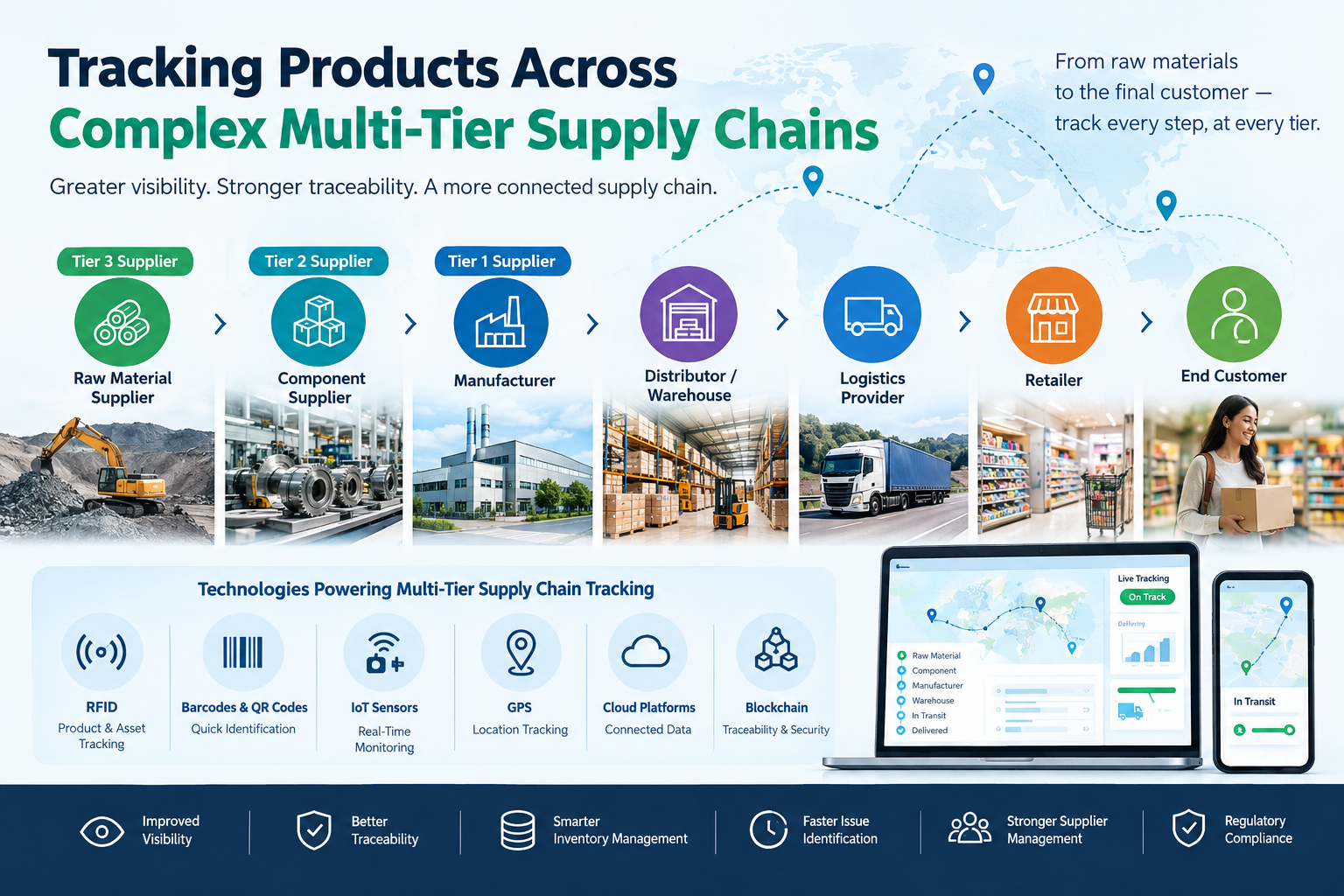
Multi-tier supply chain tracking is the process of monitoring products, materials, components, and shipments across multiple levels of a supply chain.
A multi-tier supply chain can include:
- Raw material suppliers
- Tier 1 suppliers
- Tier 2 suppliers
- Tier 3 suppliers
- Manufacturers
- Warehouses
- Distributors
- Logistics providers
- Retailers
- Final customers
Instead of tracking products only between a business and its direct suppliers, multi-tier tracking provides visibility across multiple supplier and distribution levels.
Understanding Tier 1, Tier 2, and Tier 3 Suppliers
Tier 1 suppliers usually work directly with the manufacturer or primary business.
Tier 2 suppliers provide materials or components to Tier 1 suppliers, while Tier 3 suppliers may provide the raw materials used further upstream.
For example, an automotive manufacturer may purchase components from a Tier 1 supplier. That supplier may source smaller components from Tier 2 suppliers, while Tier 2 suppliers may depend on raw material providers at Tier 3.
Without proper tracking, businesses may have limited visibility into these upstream relationships.
How Products Move Across Multiple Supply Chain Tiers
Products and materials can move through many stages before reaching their destination. At each stage, information such as product identification, location, quantity, shipment status, and handling history may need to be recorded.
A connected tracking system allows this information to be collected and shared across the supply chain.
Why Traditional Tracking Methods Are Not Enough
Traditional tracking methods often depend on spreadsheets, emails, manual records, and disconnected systems. These approaches can make it difficult to obtain real-time information.
When data is fragmented, businesses may struggle to identify delays, inventory discrepancies, damaged products, or the source of a supply chain problem.
Why Tracking Products Across Multi-Tier Supply Chains Is Challenging
Tracking products across a complex supply chain presents several challenges.
Limited Visibility Beyond Tier 1 Suppliers
Businesses often have detailed information about their direct suppliers but limited information about suppliers further upstream.
This creates visibility gaps that can make it difficult to understand where materials originated or how they moved through the supply network.
Fragmented Supply Chain Data
Different suppliers and logistics partners may use different systems, databases, product identifiers, and reporting processes.
Combining this information into one reliable view can therefore be challenging.
Manual Tracking and Data Errors
Manual data entry can result in incorrect quantities, duplicate records, missing information, and delayed updates.
These errors can affect inventory planning and product traceability.
Delays in Sharing Product Information
When supply chain partners do not share information in real time, businesses may discover problems only after they have affected production, inventory, or delivery schedules.
Compliance and Traceability Challenges
Many industries require businesses to maintain records about products, materials, suppliers, and movement through the supply chain.
Without reliable tracking, maintaining accurate traceability records can become difficult.
How Multi-Tier Supply Chain Tracking Works
A multi-tier tracking system connects product information from different supply chain stages and creates a more complete view of product movement.
Product Identification and Digital Records
Products and materials can be assigned unique identifiers using technologies such as barcodes, QR codes, RFID tags, or other digital identification methods.
These identifiers allow businesses to associate products with relevant information throughout their lifecycle.
Data Collection at Each Supply Chain Stage
Information can be collected whenever a product enters or leaves a facility, changes ownership, reaches a warehouse, or moves between locations.
The collected information can include:
- Product ID
- Supplier information
- Quantity
- Location
- Shipment status
- Date and time
- Batch or lot information
- Handling history
Real-Time Tracking and Monitoring
IoT devices, GPS technologies, RFID systems, and connected sensors can help businesses monitor products and shipments.
Depending on the use case, companies can track location, temperature, humidity, movement, and other conditions.
Connecting Suppliers, Manufacturers, and Distributors
Cloud-based platforms can connect information from different supply chain participants.
This makes it easier for authorized users to access relevant information and identify potential issues across multiple supply chain tiers.
Technologies Used for Multi-Tier Supply Chain Tracking
Several technologies can support multi-tier supply chain tracking.
RFID for Product and Asset Tracking
RFID uses radio-frequency technology to identify and track tagged products or assets.
Unlike traditional barcode scanning, RFID can allow multiple tagged items to be identified without requiring direct line-of-sight in many operational environments.
Barcodes and QR Codes
Barcodes and QR codes are widely used for product identification and tracking.
They can provide a cost-effective way to associate products with digital information and tracking records.
IoT Sensors and Real-Time Monitoring
IoT sensors can collect information from products, vehicles, warehouses, and other supply chain assets.
For temperature-sensitive products, for example, sensors can monitor environmental conditions during transportation and storage.
GPS and Location Tracking
GPS can help businesses monitor the location of vehicles, shipments, and high-value assets.
Location data can provide greater visibility into transportation activities and delivery progress.
Cloud-Based Supply Chain Platforms
Cloud platforms can bring information from different supply chain systems into a centralized environment.
This can help businesses monitor inventory, shipments, suppliers, and product movements from a single interface.
Blockchain for Supply Chain Traceability
Blockchain can provide a shared digital record of transactions and product events.
It may be useful in situations where multiple organizations need a tamper-resistant record of supply chain activities, although implementation requirements and business needs should be evaluated carefully.
Benefits of Multi-Tier Supply Chain Tracking
Effective multi-tier supply chain tracking can provide several operational benefits.
Improved Supply Chain Visibility
Businesses can gain a clearer understanding of where products and materials are located across different supply chain stages.
Faster Identification of Product Issues
When products can be traced through different supply chain stages, businesses can more quickly identify where a problem occurred.
Better Inventory Management
Accurate tracking data can help businesses understand inventory levels and product movement, supporting better planning and replenishment.
Reduced Product Loss and Delays
Real-time information can help businesses identify shipment delays, misplaced products, and other issues earlier.
Improved Supplier Management
Tracking information can help businesses understand supplier activity and identify supply chain dependencies.
Better Regulatory Compliance
Accurate product records can make it easier to maintain documentation and trace products when industry regulations require detailed supply chain information.
How to Implement Multi-Tier Supply Chain Tracking
Businesses should approach implementation systematically rather than introducing technology without first understanding their supply chain.
Map All Supply Chain Tiers
Start by identifying suppliers, manufacturers, warehouses, distributors, logistics providers, and other relevant participants.
Understanding the complete supply network helps identify visibility gaps.
Define Tracking Requirements
Determine what needs to be tracked.
For example, a business may need to track:
- Product location
- Inventory
- Batch numbers
- Supplier information
- Shipment status
- Temperature
- Product movement
- Delivery events
Select the Right Tracking Technology
The appropriate technology depends on the product, industry, operating environment, budget, and tracking requirements.
RFID may work well for automated identification, while GPS may be more appropriate for vehicle tracking and IoT sensors may be useful for monitoring environmental conditions.
Integrate Data Across Supply Chain Partners
Connecting supplier, warehouse, manufacturing, and logistics data can create a more complete view of the supply chain.
APIs, cloud platforms, and system integrations can help exchange relevant information between different systems.
Monitor and Analyze Supply Chain Data
Once tracking is operational, businesses should continuously monitor the data.
Analytics dashboards can help identify delays, inventory issues, supplier dependencies, and other patterns that require attention.
Use Cases of Multi-Tier Supply Chain Tracking
Multi-tier tracking can be applied across several industries.
Pharmaceutical and Healthcare Supply Chains
Pharmaceutical products may require detailed tracking from manufacturing through distribution.
Traceability systems can help businesses monitor batches, shipments, storage conditions, and product movement.
Food and Beverage Traceability
Food businesses can track ingredients, batches, processing stages, storage, and distribution.
This can support faster identification of products affected by quality or safety issues.
Automotive Supply Chains
Automotive products contain components sourced from numerous suppliers.
Multi-tier tracking can help manufacturers understand the movement and origin of components across complex supplier networks.
Retail and Consumer Goods
Retailers can track products from suppliers through warehouses and distribution centers to stores and customers.
This can improve inventory visibility and product availability.
Manufacturing and Industrial Supply Chains
Manufacturers can track raw materials, components, work-in-progress products, finished goods, and industrial assets across different locations.
Best Practices for Tracking Products Across Multi-Tier Supply Chains
Businesses can improve the effectiveness of their tracking systems by following several practices.
Standardize Product Identification
Use consistent product identification methods across relevant supply chain stages.
Standardized identifiers make it easier to connect product information from different systems.
Maintain Accurate and Centralized Data
Tracking systems are only useful when the underlying data is reliable.
Businesses should establish processes for maintaining accurate product, supplier, inventory, and shipment information.
Establish Supplier Data-Sharing Processes
Suppliers should understand what information needs to be collected and shared.
Clear data-sharing requirements can reduce information gaps between supply chain partners.
Use Real-Time Monitoring Where Needed
Not every product requires continuous real-time monitoring.
Businesses should identify critical products, shipments, and processes where real-time visibility provides meaningful operational value.
Regularly Audit Supply Chain Data
Regular data audits can help identify missing records, incorrect information, and gaps in supplier reporting.
Future of Multi-Tier Supply Chain Tracking
Supply chain tracking is becoming increasingly connected and data-driven.
AI-Powered Supply Chain Visibility
AI can analyze large amounts of supply chain data to identify patterns, anomalies, and potential disruptions.
Predictive Analytics
Predictive analytics can help businesses analyze historical and real-time data to anticipate potential delays, demand changes, or inventory problems.
IoT-Enabled Traceability
IoT devices can continuously collect information from products, vehicles, warehouses, and production environments.
Digital Supply Chain Twins
Digital twins can create virtual representations of supply chain operations, helping businesses analyze processes and evaluate potential scenarios.
Conclusion
Tracking products across complex multi-tier supply chains is becoming increasingly important as businesses depend on larger and more interconnected supplier networks.
Multi-tier supply chain tracking provides businesses with greater visibility into product movement, supplier relationships, inventory, shipments, and traceability records.
By combining technologies such as RFID, barcodes, IoT, GPS, cloud platforms, and analytics, businesses can create more connected and transparent supply chains.
The right approach depends on the organization’s products, suppliers, industry requirements, and operational goals. Businesses that establish clear tracking processes and connect data across supply chain partners can build stronger visibility and improve their ability to manage complex supply networks.
Frequently Asked Questions
Q1. What is multi-tier supply chain tracking?
Multi-tier supply chain tracking is the process of monitoring products, materials, and components across multiple levels of a supply chain, including Tier 1, Tier 2, and Tier 3 suppliers.
Q2. Why is tracking across multiple supply chain tiers important?
It helps businesses improve visibility beyond their direct suppliers and understand how products and materials move through different stages of the supply network.
Q3. What technologies are used for multi-tier supply chain tracking?
Common technologies include RFID, barcodes, QR codes, GPS, IoT sensors, cloud platforms, analytics, and blockchain-based traceability systems.
Q4. How does RFID improve supply chain tracking?
RFID can automatically identify tagged products and assets, helping businesses capture product movement information with less manual scanning.
Q5. How can businesses improve visibility across Tier 2 and Tier 3 suppliers?
Businesses can improve visibility by mapping their supplier network, establishing data-sharing requirements, standardizing product identification, integrating supply chain systems, and using digital tracking technologies.