Category: How Businesses Build a Complete Traceability Framework

  • What Makes a Track and Trace System Scalable?

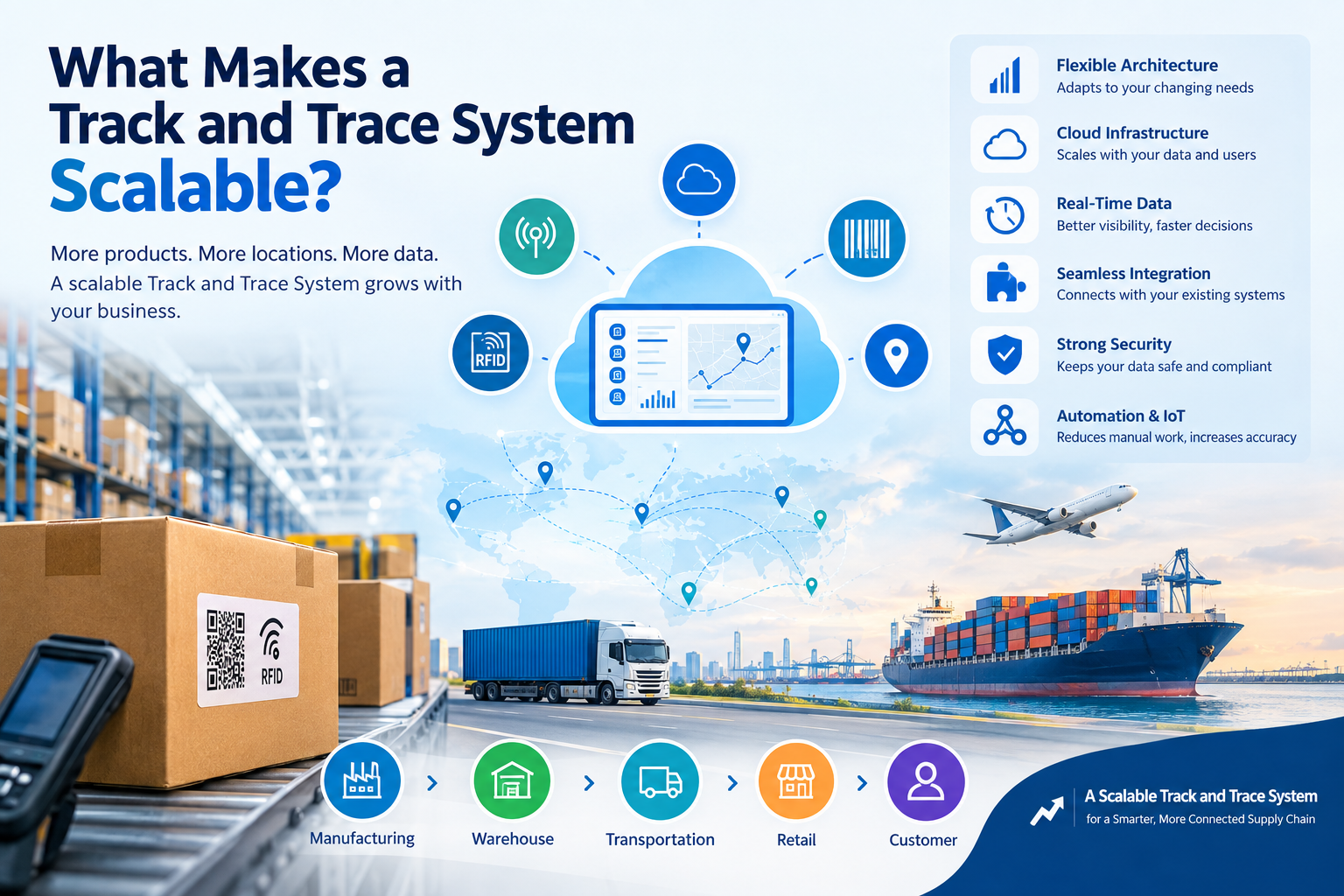
    What Makes a Track and Trace System Scalable?

    As businesses grow, their supply chains become more complex. More products, suppliers, warehouses, shipments, and customers mean more data needs to be captured and managed. A basic tracking system may work for a small operation, but it can become difficult to manage as the business expands.

    This is where a scalable Track and Trace System becomes important. A scalable system can handle increasing data, users, locations, products, and transactions without affecting performance or visibility.

    But what exactly makes a Track and Trace System scalable? Let’s explore the key factors, technologies, benefits, and challenges involved.

    Why Scalability Matters in a Track and Trace System

    The Growing Need for Product Traceability

    Modern businesses need better visibility across the entire supply chain. They need to know where products are, where they came from, what processes they have passed through, and where they are going.

    As operations grow, manually managing this information becomes difficult. A scalable Track and Trace System helps businesses collect, organize, and access traceability data efficiently.

    What Does Scalability Mean in Traceability?

    Scalability means that a system can grow with the business.

    For example, a company may start by tracking a few thousand products from one warehouse. Later, it may need to track millions of products across multiple warehouses and countries.

    A scalable system should be able to support this growth without requiring a complete replacement of the technology.

    What Is a Scalable Track and Trace System?

    A Scalable Track and Trace System is a technology solution designed to track products, assets, shipments, and processes as business operations expand.

    It can support increasing numbers of products, users, locations, and data points while maintaining reliable performance.

    How a Track and Trace System Works

    A Track and Trace System generally collects information at different stages of the supply chain. Data can be captured using technologies such as barcodes, QR codes, RFID tags, IoT devices, and sensors.

    The collected information can then be stored and processed through software platforms, allowing businesses to monitor products and activities in real time.

    Key Features of a Scalable System

    A scalable system should provide:

    • Flexible architecture
    • Cloud-based infrastructure
    • Real-time data processing
    • Easy integration
    • Automated data collection
    • Strong security
    • Multi-location support
    • Reliable performance
    • Analytics and reporting

    These capabilities allow businesses to expand their tracking operations without creating unnecessary complexity.

    Key Factors That Make a Track and Trace System Scalable

    Flexible System Architecture

    A flexible architecture allows businesses to add new features, users, locations, and integrations as their requirements change.

    Instead of building a system that works only for today’s requirements, businesses should choose technology that can adapt to future needs.

    Cloud-Based Infrastructure

    Cloud technology can make scaling easier because businesses can increase computing and storage resources as their data requirements grow.

    Cloud-based Track and Trace Systems can also provide centralized access to information across different warehouses, offices, production facilities, and distribution centers.

    Real-Time Data Processing

    As the number of tracked products increases, the amount of data also grows.

    A scalable system should be capable of processing large amounts of information quickly. Real-time data processing helps businesses monitor inventory, shipments, production activities, and other supply chain operations.

    Easy Integration With Existing Systems

    Businesses rarely use only one software platform. They may already have ERP, WMS, CRM, inventory management, transportation management, or manufacturing systems.

    A scalable Track and Trace System should integrate with these platforms through APIs and other integration methods.

    This reduces data duplication and helps create a connected technology environment.

    Support for Increasing Data Volumes

    Every tracked product can generate multiple data points. When thousands or millions of products are involved, the volume of information can become significant.

    A scalable system needs suitable databases, data-processing capabilities, and storage infrastructure to manage this growth efficiently.

    Multi-Location and Global Scalability

    Growing businesses may operate across multiple warehouses, factories, stores, and distribution centers.

    A scalable system should allow organizations to manage traceability across multiple locations from a centralized platform while maintaining appropriate access controls.

    Automated Data Capture Technologies

    Manual data entry becomes increasingly difficult as operations grow.

    Technologies such as RFID, barcode scanning, QR codes, IoT sensors, and automated identification systems can capture information more efficiently and reduce manual errors.

    Technologies That Support Scalable Traceability

    RFID and Barcode Technology

    RFID and barcode technologies provide reliable ways to identify and track products and assets.

    Barcodes are commonly used for individual product identification, while RFID can enable automated identification without requiring direct line-of-sight scanning.

    IoT Sensors and Connected Devices

    IoT devices can collect real-time information about products, vehicles, equipment, and environmental conditions.

    For example, sensors can monitor location, temperature, humidity, or movement during transportation.

    Cloud Computing

    Cloud infrastructure provides flexible computing and storage resources. This makes it easier to support growing amounts of traceability data and increasing numbers of users.

    APIs and System Integration

    APIs allow different software applications to exchange information.

    For example, a Track and Trace System can exchange data with an ERP or warehouse management system, helping businesses maintain consistent information across platforms.

    AI and Data Analytics

    As traceability data increases, analytics can help businesses identify patterns, delays, anomalies, and operational problems.

    AI can also support predictive analysis and help organizations make faster, data-driven decisions.

    Challenges of Scaling a Track and Trace System

    Managing Large Volumes of Data

    More products and tracking events create more data. Without appropriate infrastructure, system performance can decline.

    Businesses should therefore plan their data storage and processing requirements before significant growth occurs.

    Integration With Legacy Systems

    Older business applications may not easily connect with modern Track and Trace platforms.

    Using APIs, middleware, or integration platforms can help overcome these challenges.

    Maintaining Data Accuracy

    Large-scale tracking is only useful when the underlying information is accurate.

    Automated data capture, validation processes, and regular system monitoring can help maintain data quality.

    Security and Compliance Requirements

    As more business and supply chain data is collected, security becomes increasingly important.

    Scalable systems should include appropriate authentication, authorization, encryption, monitoring, and data management practices.

    How Businesses Can Build a Scalable Track and Trace System

    Start With Clear Business Requirements

    Before implementing a system, businesses should identify what they need to track, where data will be collected, who will use it, and what information needs to be reported.

    Choose Flexible and Future-Ready Technology

    Businesses should select platforms that can support additional products, users, locations, devices, and integrations as operations expand.

    Plan for Business Growth

    Scalability should be considered from the beginning rather than after the system reaches its limits.

    Companies should estimate future data volumes, locations, transactions, and users when selecting their technology architecture.

    Focus on Integration and Interoperability

    A Track and Trace System should work with the existing technology ecosystem.

    Strong integration capabilities make it easier to connect different business systems and create a unified flow of information.

    Monitor and Optimize System Performance

    Regular performance monitoring helps identify bottlenecks before they become major problems.

    Businesses should review system speed, data processing, storage requirements, integrations, and user activity as operations grow.

    Benefits of a Scalable Track and Trace System

    Improved Supply Chain Visibility

    Businesses can gain better visibility into products, inventory, shipments, and processes across the supply chain.

    Better Operational Efficiency

    Automated tracking reduces manual work and can improve the efficiency of supply chain operations.

    Faster Decision-Making

    Real-time information allows teams to identify issues and respond faster.

    Reduced Errors and Product Losses

    Automated identification and tracking can reduce manual data-entry errors and improve product visibility.

    Support for Long-Term Business Growth

    The biggest advantage of scalability is flexibility. Businesses can expand their operations without having to replace their entire tracking infrastructure.

    Industries That Benefit From Scalable Traceability

    Manufacturing

    Manufacturers can track raw materials, work-in-progress products, finished goods, and production processes.

    Logistics and Transportation

    Logistics companies can monitor shipments, vehicles, packages, and delivery activities across multiple locations.

    Healthcare and Pharmaceuticals

    Healthcare and pharmaceutical organizations can use traceability to monitor products throughout the supply chain and support product identification and compliance requirements.

    Retail

    Retailers can track inventory movement from suppliers and warehouses to stores and customers.

    Food and Agriculture

    Food and agriculture businesses can improve visibility across production, processing, storage, and distribution.

    Conclusion

    A Scalable Track and Trace System is more than a tool for knowing where a product is. It is a technology foundation that helps businesses maintain visibility as their operations grow.

    Flexible architecture, cloud infrastructure, real-time processing, system integration, automated data capture, and strong security are some of the key elements that make a Track and Trace System scalable.

    By investing in scalable traceability technology, businesses can improve supply chain visibility, reduce manual processes, manage growing data volumes, and prepare their operations for future growth.

    Frequently Asked Questions

    Q1. What is a scalable Track and Trace System?

    A scalable Track and Trace System is a solution that can handle growing numbers of products, users, locations, and data without significantly affecting system performance.

    Q2. Why is scalability important in a Track and Trace System?

    Scalability allows businesses to expand their supply chain operations without replacing their tracking system. It helps manage increasing data volumes, products, warehouses, and users efficiently.

    Q3. What technologies make Track and Trace Systems scalable?

    Cloud computing, RFID, barcodes, QR codes, IoT sensors, APIs, automation, and data analytics can help make Track and Trace Systems more scalable and flexible.

    Q4. Can a Track and Trace System support multiple locations?

    Yes. A scalable Track and Trace System can support multiple warehouses, factories, stores, and distribution centers through a centralized platform.

    Q5. How does cloud technology improve Track and Trace scalability?

    Cloud technology provides flexible storage and computing resources that can be increased as business requirements grow. It also makes centralized access to traceability data easier.

    Q6. Can RFID and IoT be integrated with a Track and Trace System?

    Yes. RFID and IoT devices can automatically collect tracking information and send data to the Track and Trace platform, improving visibility and reducing manual data entry.

    Q7. What are the benefits of a scalable Track and Trace System?

    Key benefits include improved supply chain visibility, better operational efficiency, reduced manual errors, faster decision-making, easier integration, and support for long-term business growth.

    Q8. How can businesses choose a scalable Track and Trace System?

    Businesses should evaluate system architecture, integration capabilities, cloud support, data-processing capacity, security, automation features, and the ability to support future business growth.

  • How Businesses Build a Complete Traceability Framework

    How Businesses Build a Complete Traceability Framework

    How Businesses Build a Complete Traceability Framework

    Businesses today need more than basic product tracking. They need complete visibility into where products come from, where they are located, how they move through the supply chain, and what happens at every stage. A complete traceability framework helps businesses connect people, processes, data, and technology to achieve end-to-end supply chain visibility.

    From manufacturing and logistics to retail, healthcare, food, and pharmaceuticals, traceability enables organizations to monitor products, identify problems quickly, improve compliance, and make better operational decisions.

    What Is a Complete Traceability Framework?

    A complete traceability framework is a structured system that enables businesses to track and record the movement, transformation, and history of products, materials, or assets throughout the supply chain.

    Definition of Supply Chain Traceability

    Supply chain traceability involves collecting and connecting information from different stages of the supply chain. This may include suppliers, manufacturers, warehouses, distributors, transportation providers, retailers, and customers.

    A well-designed framework creates a connected flow of information that allows businesses to determine the origin, location, status, and movement of products.

    Why Traceability Matters for Businesses

    Without proper traceability, businesses may struggle to identify where a product came from or where a problem occurred. A traceability framework makes it easier to detect issues, investigate disruptions, manage recalls, and maintain accurate records.

    Key Components of a Traceability Framework

    A complete framework generally includes:

    • Product or asset identification
    • Data collection
    • Real-time tracking
    • Supply chain integration
    • Data storage
    • Monitoring and analytics
    • Reporting and compliance

    Why Businesses Need End-to-End Traceability

    Modern supply chains involve multiple suppliers, facilities, transportation networks, and distribution channels. This complexity makes visibility increasingly important.

    Improving Supply Chain Visibility

    End-to-end traceability allows businesses to understand what is happening across different stages of their supply chain. Managers can monitor inventory, shipments, production processes, and product movement from a centralized system.

    Reducing Product Loss and Errors

    Accurate tracking can help organizations identify misplaced products, inventory discrepancies, shipment errors, and process inefficiencies.

    Meeting Compliance and Regulatory Requirements

    Many industries require businesses to maintain detailed records about products and processes. A digital traceability framework can help organizations maintain accurate records and provide information when required.

    Improving Customer Trust

    Customers increasingly want information about product origin, quality, safety, and authenticity. Transparent traceability can help businesses provide greater confidence in their products.

    Key Components of a Complete Traceability Framework

    A successful traceability system combines several technologies and processes.

    Product and Asset Identification

    Every product, batch, shipment, or asset should have a unique identifier. Businesses can use barcodes, QR codes, RFID tags, serial numbers, or other identification methods.

    Data Collection and Capture

    Data should be captured at important points throughout the supply chain. Information can include production details, warehouse movements, shipment information, timestamps, and product status.

    Real-Time Tracking

    Real-time tracking provides businesses with current information about products and assets. This can be particularly valuable for logistics, warehousing, cold-chain operations, and high-value assets.

    Supply Chain Data Integration

    A traceability framework should connect information from different systems, including ERP, WMS, TMS, CRM, IoT platforms, and other business applications.

    Data Storage and Management

    Collected information needs to be stored securely and organized so that authorized users can quickly access the required information.

    How to Build a Complete Traceability Framework

    Building a complete traceability framework requires a structured approach.

    Step 1: Define Traceability Goals

    Businesses should first identify what they want to achieve. Objectives may include improving inventory visibility, reducing losses, meeting compliance requirements, improving product quality, or tracking shipments.

    Step 2: Map the Supply Chain

    The next step is to map the complete product journey. Identify suppliers, production facilities, warehouses, transportation stages, distributors, and other important points.

    This helps businesses determine where tracking and data collection should take place.

    Step 3: Select Tracking Technologies

    Businesses should choose technologies according to their operational requirements. RFID may be suitable for automatic identification, while QR codes and barcodes can provide cost-effective product tracking.

    IoT sensors can be useful when businesses need real-time information about location, temperature, humidity, or other environmental conditions.

    Step 4: Connect Data Sources

    The next step is integrating tracking technologies with existing business systems. Integration allows information collected from different sources to be connected and analyzed.

    Step 5: Implement Real-Time Monitoring

    Businesses can use dashboards and monitoring platforms to track products, shipments, inventory, and assets in real time.

    Real-time alerts can also help teams respond quickly to delays, unexpected movements, or operational problems.

    Step 6: Analyze and Optimize Traceability Data

    Traceability should not only be used for tracking. Businesses can analyze historical and real-time data to identify trends, bottlenecks, risks, and opportunities for improvement.

    Technologies Used in Traceability Frameworks

    Modern traceability frameworks can combine multiple technologies.

    RFID Technology

    RFID enables businesses to identify and track products or assets using radio-frequency signals. It can support automated data capture without requiring direct line-of-sight scanning.

    Barcode and QR Code Tracking

    Barcodes and QR codes provide a simple and cost-effective way to identify products, packages, and shipments throughout the supply chain.

    IoT and Sensors

    IoT devices and sensors can collect real-time information such as location, temperature, humidity, movement, and equipment status.

    Cloud-Based Traceability Platforms

    Cloud platforms allow businesses to centralize traceability data and provide authorized users with access to information across different locations.

    AI and Analytics

    Artificial intelligence and analytics can help organizations identify patterns, detect anomalies, forecast potential problems, and improve supply chain decision-making.

    Blockchain for Traceability

    Blockchain can provide a shared and tamper-resistant record of transactions and product information. It can be useful in supply chains where multiple organizations need to share trusted information.

    Benefits of a Complete Traceability Framework

    A properly implemented framework can deliver several operational benefits.

    Greater Supply Chain Visibility

    Businesses gain a clearer view of product and asset movement across the supply chain.

    Faster Issue Detection and Resolution

    When problems occur, organizations can use traceability data to identify the affected products, locations, and processes more quickly.

    Improved Inventory Management

    Accurate tracking can help businesses maintain better inventory records and reduce discrepancies.

    Better Compliance

    Digital records can make it easier to maintain documentation and demonstrate compliance with applicable standards and regulations.

    Reduced Operational Costs

    Automation and better visibility can reduce manual data entry, errors, product losses, and unnecessary operational activities.

    Challenges in Building a Traceability Framework

    Despite its benefits, implementing traceability can present several challenges.

    Data Integration Challenges

    Businesses often use multiple legacy systems that were not originally designed to communicate with each other. Integrating these systems can require careful planning.

    Implementation Costs

    Hardware, software, integration, training, and maintenance can create initial implementation costs.

    Data Accuracy and Quality

    A traceability system is only useful when the information it receives is accurate. Businesses need processes to maintain data quality.

    Legacy System Integration

    Older ERP, warehouse, manufacturing, or logistics systems may require additional integration layers to work with modern traceability technologies.

    Scalability and Security

    As businesses grow, the volume of traceability data can increase significantly. Systems need to be scalable while protecting sensitive business information.

    Best Practices for Implementing Traceability

    Businesses can improve implementation results by following several best practices.

    Standardize Data Across the Supply Chain

    Using consistent product identifiers, data formats, and processes makes information easier to connect and analyze.

    Automate Data Collection

    Automated data capture through RFID, IoT devices, scanners, and sensors can reduce manual errors and improve efficiency.

    Use Real-Time Monitoring

    Real-time dashboards and alerts help businesses respond quickly to supply chain disruptions and operational issues.

    Ensure Data Security

    Access controls, authentication, encryption, and secure integrations should be used to protect traceability information.

    Continuously Measure Performance

    Businesses should monitor KPIs such as tracking accuracy, inventory accuracy, order visibility, data quality, and response time to identify areas for improvement.

    Future of Supply Chain Traceability

    Traceability is becoming increasingly connected, automated, and data-driven.

    AI-Powered Traceability

    AI can help businesses analyze large volumes of supply chain information and identify potential risks before they become major problems.

    IoT-Enabled Supply Chain Visibility

    IoT devices will continue to provide real-time information about products, vehicles, equipment, and environmental conditions.

    Predictive Analytics

    Predictive analytics can help businesses anticipate delays, demand changes, equipment problems, and other supply chain risks.

    Digital Product Passports

    Digital product passports can provide structured information about products, including their origin, materials, lifecycle, and other relevant information.

    Conclusion

    Building a complete traceability framework requires more than implementing a tracking technology. Businesses need to connect identification systems, data collection, real-time monitoring, business applications, analytics, and well-defined processes.

    A strong framework provides end-to-end visibility across the supply chain, helping organizations improve operational efficiency, reduce errors, support compliance, and respond faster to problems.

    As technologies such as RFID, IoT, AI, cloud computing, and advanced analytics continue to develop, traceability will become an increasingly important part of modern supply chain management.

    Businesses that invest in scalable and connected traceability frameworks can create greater visibility, accountability, and resilience across their operations.

    FAQs: Complete Traceability Framework

    Q1. What is a complete traceability framework?

    A complete traceability framework is a system that tracks products, materials, assets, and related information throughout the supply chain, from origin to final destination.

    Q2. Why is a complete traceability framework important?

    It helps businesses improve supply chain visibility, reduce errors and losses, identify problems faster, support regulatory compliance, and improve customer confidence.

    Q3. What are the key components of a traceability framework?

    Key components include product identification, data collection, real-time tracking, system integration, centralized data management, monitoring, analytics, and reporting.

    Q4. Which technologies are used for supply chain traceability?

    Common technologies include RFID, barcodes, QR codes, IoT sensors, cloud platforms, AI, analytics, and blockchain.

    Q5. How does RFID support traceability?

    RFID enables businesses to automatically identify and track products or assets using radio-frequency signals, reducing manual scanning and improving tracking accuracy.

    Q5. How can businesses build a complete traceability framework?

    Businesses can start by defining objectives, mapping the supply chain, selecting appropriate tracking technologies, integrating data sources, implementing monitoring systems, and continuously analyzing performance.

    Q6. What are the benefits of end-to-end traceability?

    End-to-end traceability can provide better supply chain visibility, improved inventory management, faster issue resolution, better compliance, reduced operational errors, and greater supply chain efficiency.

    Q7. What challenges do businesses face when implementing traceability?

    Common challenges include integration with legacy systems, implementation costs, data quality issues, employee training, scalability, and data security.

    Q8. Can AI improve supply chain traceability?

    Yes. AI can analyze traceability data to identify anomalies, predict potential disruptions, detect patterns, and support faster and more informed supply chain decisions.

    Q9. What is the future of supply chain traceability?

    The future of traceability is expected to involve greater use of AI, IoT, real-time analytics, cloud platforms, automation, and digital product passports to create more connected and transparent supply chains.