As businesses grow, their supply chains become more complex. More products, suppliers, warehouses, shipments, and customers mean more data needs to be captured and managed. A basic tracking system may work for a small operation, but it can become difficult to manage as the business expands.
This is where a scalable Track and Trace System becomes important. A scalable system can handle increasing data, users, locations, products, and transactions without affecting performance or visibility.
But what exactly makes a Track and Trace System scalable? Let’s explore the key factors, technologies, benefits, and challenges involved.
Why Scalability Matters in a Track and Trace System
The Growing Need for Product Traceability
Modern businesses need better visibility across the entire supply chain. They need to know where products are, where they came from, what processes they have passed through, and where they are going.
As operations grow, manually managing this information becomes difficult. A scalable Track and Trace System helps businesses collect, organize, and access traceability data efficiently.
What Does Scalability Mean in Traceability?
Scalability means that a system can grow with the business.
For example, a company may start by tracking a few thousand products from one warehouse. Later, it may need to track millions of products across multiple warehouses and countries.
A scalable system should be able to support this growth without requiring a complete replacement of the technology.
What Is a Scalable Track and Trace System?
A Scalable Track and Trace System is a technology solution designed to track products, assets, shipments, and processes as business operations expand.
It can support increasing numbers of products, users, locations, and data points while maintaining reliable performance.
How a Track and Trace System Works
A Track and Trace System generally collects information at different stages of the supply chain. Data can be captured using technologies such as barcodes, QR codes, RFID tags, IoT devices, and sensors.
The collected information can then be stored and processed through software platforms, allowing businesses to monitor products and activities in real time.
Key Features of a Scalable System
A scalable system should provide:
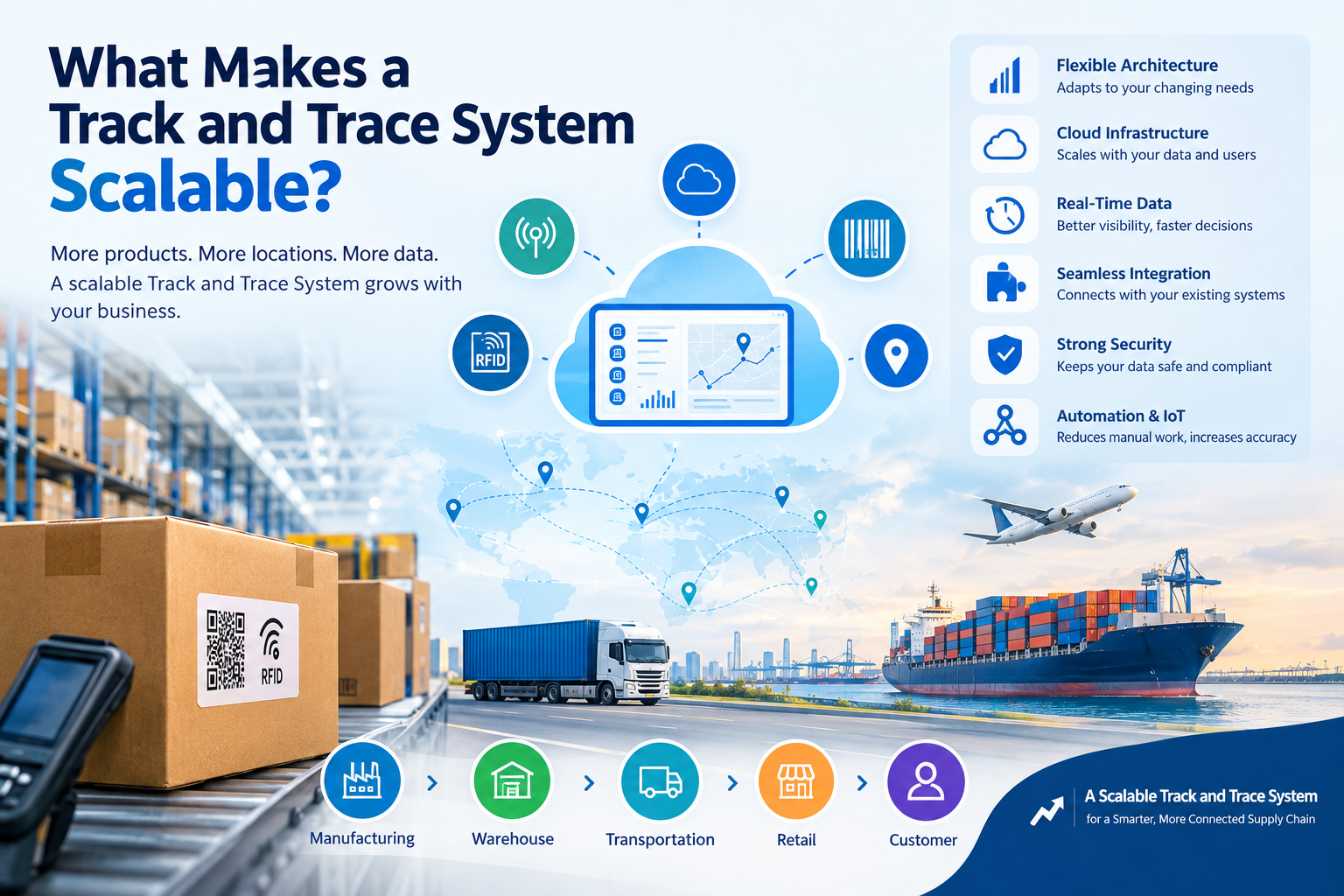
- Flexible architecture
- Cloud-based infrastructure
- Real-time data processing
- Easy integration
- Automated data collection
- Strong security
- Multi-location support
- Reliable performance
- Analytics and reporting
These capabilities allow businesses to expand their tracking operations without creating unnecessary complexity.
Key Factors That Make a Track and Trace System Scalable
Flexible System Architecture
A flexible architecture allows businesses to add new features, users, locations, and integrations as their requirements change.
Instead of building a system that works only for today’s requirements, businesses should choose technology that can adapt to future needs.
Cloud-Based Infrastructure
Cloud technology can make scaling easier because businesses can increase computing and storage resources as their data requirements grow.
Cloud-based Track and Trace Systems can also provide centralized access to information across different warehouses, offices, production facilities, and distribution centers.
Real-Time Data Processing
As the number of tracked products increases, the amount of data also grows.
A scalable system should be capable of processing large amounts of information quickly. Real-time data processing helps businesses monitor inventory, shipments, production activities, and other supply chain operations.
Easy Integration With Existing Systems
Businesses rarely use only one software platform. They may already have ERP, WMS, CRM, inventory management, transportation management, or manufacturing systems.
A scalable Track and Trace System should integrate with these platforms through APIs and other integration methods.
This reduces data duplication and helps create a connected technology environment.
Support for Increasing Data Volumes
Every tracked product can generate multiple data points. When thousands or millions of products are involved, the volume of information can become significant.
A scalable system needs suitable databases, data-processing capabilities, and storage infrastructure to manage this growth efficiently.
Multi-Location and Global Scalability
Growing businesses may operate across multiple warehouses, factories, stores, and distribution centers.
A scalable system should allow organizations to manage traceability across multiple locations from a centralized platform while maintaining appropriate access controls.
Automated Data Capture Technologies
Manual data entry becomes increasingly difficult as operations grow.
Technologies such as RFID, barcode scanning, QR codes, IoT sensors, and automated identification systems can capture information more efficiently and reduce manual errors.
Technologies That Support Scalable Traceability
RFID and Barcode Technology
RFID and barcode technologies provide reliable ways to identify and track products and assets.
Barcodes are commonly used for individual product identification, while RFID can enable automated identification without requiring direct line-of-sight scanning.
IoT Sensors and Connected Devices
IoT devices can collect real-time information about products, vehicles, equipment, and environmental conditions.
For example, sensors can monitor location, temperature, humidity, or movement during transportation.
Cloud Computing
Cloud infrastructure provides flexible computing and storage resources. This makes it easier to support growing amounts of traceability data and increasing numbers of users.
APIs and System Integration
APIs allow different software applications to exchange information.
For example, a Track and Trace System can exchange data with an ERP or warehouse management system, helping businesses maintain consistent information across platforms.
AI and Data Analytics
As traceability data increases, analytics can help businesses identify patterns, delays, anomalies, and operational problems.
AI can also support predictive analysis and help organizations make faster, data-driven decisions.
Challenges of Scaling a Track and Trace System
Managing Large Volumes of Data
More products and tracking events create more data. Without appropriate infrastructure, system performance can decline.
Businesses should therefore plan their data storage and processing requirements before significant growth occurs.
Integration With Legacy Systems
Older business applications may not easily connect with modern Track and Trace platforms.
Using APIs, middleware, or integration platforms can help overcome these challenges.
Maintaining Data Accuracy
Large-scale tracking is only useful when the underlying information is accurate.
Automated data capture, validation processes, and regular system monitoring can help maintain data quality.
Security and Compliance Requirements
As more business and supply chain data is collected, security becomes increasingly important.
Scalable systems should include appropriate authentication, authorization, encryption, monitoring, and data management practices.
How Businesses Can Build a Scalable Track and Trace System
Start With Clear Business Requirements
Before implementing a system, businesses should identify what they need to track, where data will be collected, who will use it, and what information needs to be reported.
Choose Flexible and Future-Ready Technology
Businesses should select platforms that can support additional products, users, locations, devices, and integrations as operations expand.
Plan for Business Growth
Scalability should be considered from the beginning rather than after the system reaches its limits.
Companies should estimate future data volumes, locations, transactions, and users when selecting their technology architecture.
Focus on Integration and Interoperability
A Track and Trace System should work with the existing technology ecosystem.
Strong integration capabilities make it easier to connect different business systems and create a unified flow of information.
Monitor and Optimize System Performance
Regular performance monitoring helps identify bottlenecks before they become major problems.
Businesses should review system speed, data processing, storage requirements, integrations, and user activity as operations grow.
Benefits of a Scalable Track and Trace System
Improved Supply Chain Visibility
Businesses can gain better visibility into products, inventory, shipments, and processes across the supply chain.
Better Operational Efficiency
Automated tracking reduces manual work and can improve the efficiency of supply chain operations.
Faster Decision-Making
Real-time information allows teams to identify issues and respond faster.
Reduced Errors and Product Losses
Automated identification and tracking can reduce manual data-entry errors and improve product visibility.
Support for Long-Term Business Growth
The biggest advantage of scalability is flexibility. Businesses can expand their operations without having to replace their entire tracking infrastructure.
Industries That Benefit From Scalable Traceability
Manufacturing
Manufacturers can track raw materials, work-in-progress products, finished goods, and production processes.
Logistics and Transportation
Logistics companies can monitor shipments, vehicles, packages, and delivery activities across multiple locations.
Healthcare and Pharmaceuticals
Healthcare and pharmaceutical organizations can use traceability to monitor products throughout the supply chain and support product identification and compliance requirements.
Retail
Retailers can track inventory movement from suppliers and warehouses to stores and customers.
Food and Agriculture
Food and agriculture businesses can improve visibility across production, processing, storage, and distribution.
Conclusion
A Scalable Track and Trace System is more than a tool for knowing where a product is. It is a technology foundation that helps businesses maintain visibility as their operations grow.
Flexible architecture, cloud infrastructure, real-time processing, system integration, automated data capture, and strong security are some of the key elements that make a Track and Trace System scalable.
By investing in scalable traceability technology, businesses can improve supply chain visibility, reduce manual processes, manage growing data volumes, and prepare their operations for future growth.
Frequently Asked Questions
Q1. What is a scalable Track and Trace System?
A scalable Track and Trace System is a solution that can handle growing numbers of products, users, locations, and data without significantly affecting system performance.
Q2. Why is scalability important in a Track and Trace System?
Scalability allows businesses to expand their supply chain operations without replacing their tracking system. It helps manage increasing data volumes, products, warehouses, and users efficiently.
Q3. What technologies make Track and Trace Systems scalable?
Cloud computing, RFID, barcodes, QR codes, IoT sensors, APIs, automation, and data analytics can help make Track and Trace Systems more scalable and flexible.
Q4. Can a Track and Trace System support multiple locations?
Yes. A scalable Track and Trace System can support multiple warehouses, factories, stores, and distribution centers through a centralized platform.
Q5. How does cloud technology improve Track and Trace scalability?
Cloud technology provides flexible storage and computing resources that can be increased as business requirements grow. It also makes centralized access to traceability data easier.
Q6. Can RFID and IoT be integrated with a Track and Trace System?
Yes. RFID and IoT devices can automatically collect tracking information and send data to the Track and Trace platform, improving visibility and reducing manual data entry.
Q7. What are the benefits of a scalable Track and Trace System?
Key benefits include improved supply chain visibility, better operational efficiency, reduced manual errors, faster decision-making, easier integration, and support for long-term business growth.
Q8. How can businesses choose a scalable Track and Trace System?
Businesses should evaluate system architecture, integration capabilities, cloud support, data-processing capacity, security, automation features, and the ability to support future business growth.