In today’s fast-moving business environment, knowing a product’s complete history is important for quality, compliance, and customer trust. Businesses need to know where a product was manufactured, how it moved through the supply chain, and whether it met required quality standards.
Traditional paper-based records can make this information difficult to store, update, and retrieve. Digital Product History Management provides a better approach by storing product information electronically and making it easier to access, track, and manage.
From manufacturing and healthcare to retail, logistics, and food production, digital records can improve product traceability and provide businesses with better control over their operations.
What Is Product History Management?
Product history management is the process of recording and managing information about a product throughout its lifecycle. This may include manufacturing details, batch numbers, inspection records, transportation information, storage conditions, and delivery data.
A complete product history helps businesses understand what happened to a product at every important stage.
What Information Does a Product History Record Include?
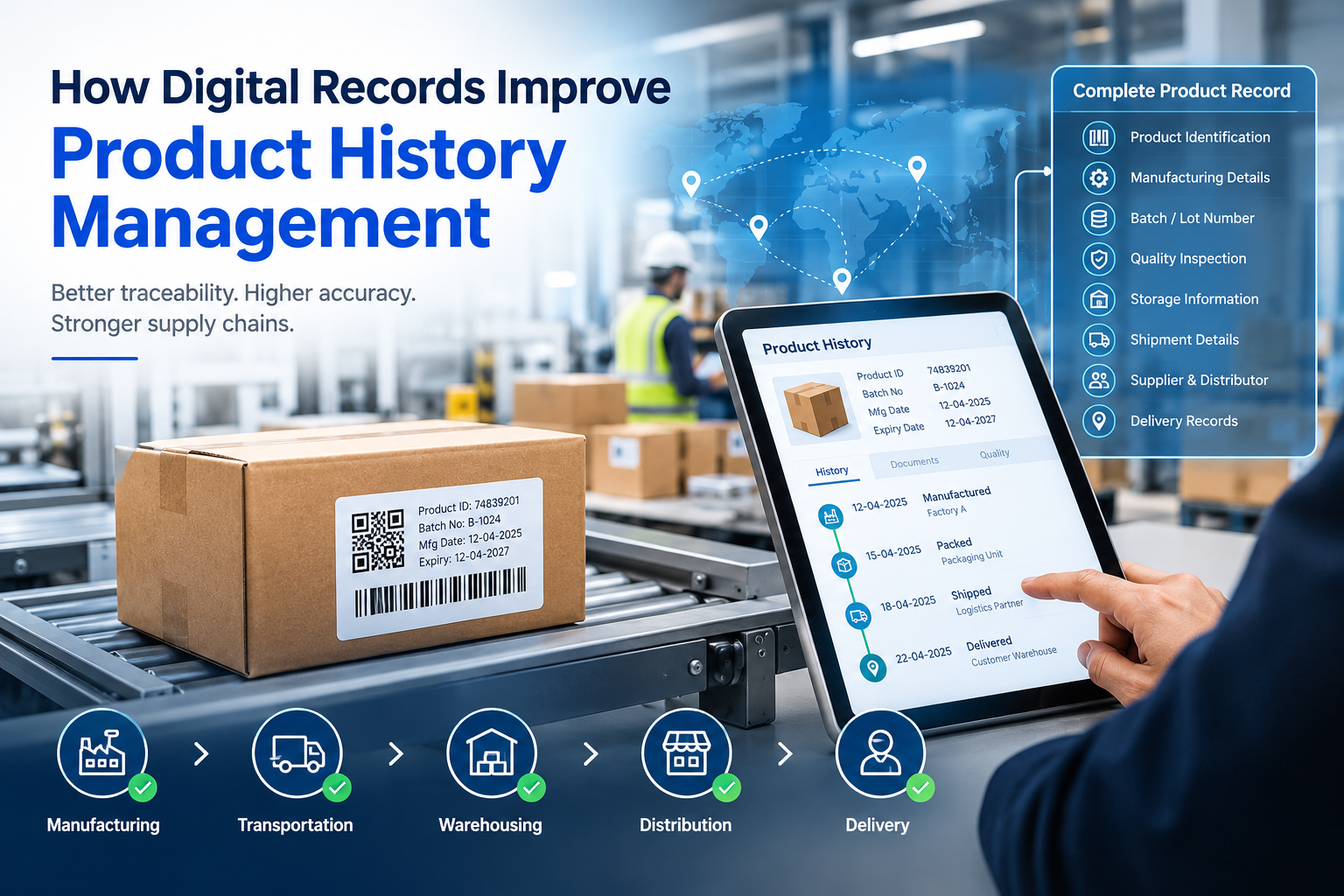
A product history record may contain:
- Product identification number
- Manufacturing date
- Batch or lot number
- Raw material information
- Quality inspection results
- Production records
- Storage information
- Shipment details
- Supplier and distributor information
- Delivery records
Keeping this information organized allows businesses to quickly identify problems and understand the complete journey of a product.
Why Accurate Product History Matters
Accurate product history helps businesses maintain product quality and meet regulatory requirements. It also makes it easier to investigate product defects, manage recalls, and answer customer questions.
Without reliable records, finding the source of a problem can take considerable time and may lead to inaccurate decisions.
What Are Digital Records?
Digital records are electronic versions of business and product information stored in databases, cloud platforms, enterprise software, or other digital systems.
Instead of maintaining physical documents, businesses can record and update product information digitally.
How Digital Product Records Work
Digital records can collect information from different stages of the product lifecycle. Data can be entered manually or captured automatically using technologies such as barcodes, RFID, IoT devices, and automated software systems.
The information can then be stored in a centralized system where authorized employees can access it when required.
Digital Records vs. Paper-Based Records
Paper records can be difficult to organize, search, update, and share. They can also be damaged or misplaced.
Digital records provide faster access to information and make it easier to search, update, analyze, and share product data. Businesses can also create backups and apply access controls to protect important information.
How Digital Records Improve Product History Management
Digital records can transform the way businesses manage product information by improving visibility, accuracy, and accessibility.
Improve Product Traceability
Digital records make it easier to follow a product from manufacturing to distribution and delivery.
Businesses can connect information from different stages and create a complete product history. This makes it easier to identify where a product came from and where it was delivered.
Provide Real-Time Access to Product Information
Authorized employees can access digital product information whenever they need it.
For example, a warehouse employee can quickly check a product’s batch number, location, or shipment status without searching through physical files.
Reduce Manual Errors
Manual data entry and paper documentation can result in errors such as incorrect product numbers, missing information, or duplicate records.
Automated data collection can reduce these errors and improve the reliability of product information.
Improve Data Accuracy and Consistency
Digital systems can standardize how product information is collected and stored.
This helps businesses maintain consistent records across manufacturing facilities, warehouses, suppliers, distributors, and other locations.
Support Regulatory Compliance
Many industries need to maintain accurate records for compliance and auditing.
Digital records can provide a clear history of product-related activities and make it easier to produce documentation when required.
Make Audits Easier
Searching through paper documents during an audit can be time-consuming.
With digital records, businesses can quickly search for specific products, batches, transactions, or quality records. This can make the audit process more organized and efficient.
Improve Supply Chain Visibility
Digital product records connect information from different parts of the supply chain.
Businesses can gain better visibility into production, inventory, transportation, and delivery activities, helping them identify delays and operational problems more quickly.
Key Benefits of Digital Product History Management
Implementing Digital Product History Management can provide several operational and business benefits.
Faster Information Retrieval
Employees can search digital databases and find product information much faster than searching through physical files.
Better Inventory and Production Tracking
Digital records can help businesses monitor products, batches, and inventory as they move through production and storage.
Improved Quality Control
Historical product information can help quality teams identify recurring problems and investigate defects more efficiently.
Better Decision-Making
Accurate historical data gives managers useful information for analyzing operations and making informed decisions.
Increased Customer Trust
Customers want businesses to provide safe, reliable, and traceable products. Maintaining accurate digital records can help companies provide greater transparency about product origins and handling.
How Digital Records Support End-to-End Product Traceability
Product traceability requires businesses to maintain information about a product throughout its journey.
Digital records can connect this information and create a centralized product history.
Tracking Products From Production to Delivery
A product can be tracked through manufacturing, packaging, warehousing, transportation, and final delivery.
Technologies such as RFID and barcode systems can automatically capture product movements and update digital records.
Maintaining a Complete Product History
Each important event can be added to the product record. This creates a timeline showing what happened to the product at different stages.
A complete history can be particularly useful when investigating quality issues or product recalls.
Connecting Product Data Across the Supply Chain
Suppliers, manufacturers, logistics providers, warehouses, and distributors may all handle the same product.
Digital systems can connect information from these different stages, providing better end-to-end visibility.
Technologies Used for Digital Product Records
Several technologies can support digital product history management.
RFID and Barcode Technology
RFID tags and barcodes provide unique identification for products, packages, assets, or shipments.
Businesses can scan these identifiers to capture product information and update digital records.
IoT and Real-Time Tracking
IoT devices can collect information about product location, temperature, humidity, movement, and other conditions.
This is particularly useful for products that require controlled storage or transportation.
Cloud-Based Data Management
Cloud platforms allow product information to be stored centrally and accessed by authorized users from different locations.
This can help organizations manage product information across multiple facilities and supply chain partners.
AI and Data Analytics
AI and analytics can help businesses analyze historical product data and identify patterns.
For example, companies may use data analysis to identify recurring quality problems, predict operational issues, or improve supply chain performance.
Challenges of Implementing Digital Records
Although digital records provide many benefits, businesses may face challenges during implementation.
Data Security and Privacy
Product information must be protected against unauthorized access, data loss, and cyber threats.
Businesses should use appropriate security controls, authentication, backups, and access permissions.
Integration With Existing Systems
A company may already use ERP, warehouse management, manufacturing, or supply chain systems.
The new digital record system should integrate with existing technology to avoid creating isolated data.
Employee Training and Adoption
Employees need to understand how to use new digital tools correctly.
Proper training can help reduce mistakes and improve adoption across the organization.
Initial Implementation Costs
Moving from paper records to digital systems may require investment in software, hardware, employee training, and system integration.
However, the long-term benefits can make digital transformation valuable for organizations that need better traceability and product visibility.
Best Practices for Digital Product History Management
Businesses can follow several practices to build an effective digital product history system.
Standardize Product Data
Create consistent formats for product IDs, batch numbers, dates, locations, and other important information.
Use Unique Product Identification
Use barcodes, RFID tags, serial numbers, or other identifiers to distinguish products and batches accurately.
Keep Records Updated
Product records should be updated whenever an important event occurs, such as production, inspection, shipment, receipt, or delivery.
Secure and Back Up Product Data
Use appropriate access controls and regular backups to protect important product information from unauthorized access or accidental loss.
Future of Digital Product History Management
The future of product history management will become increasingly connected and automated.
Businesses are expected to use technologies such as AI, IoT, cloud computing, RFID, and advanced analytics to create more intelligent traceability systems.
AI-Powered Traceability
AI can analyze large volumes of product and supply chain data to identify unusual patterns and potential problems.
IoT-Based Product Monitoring
IoT sensors can provide real-time information about product location and environmental conditions, helping businesses monitor products throughout transportation and storage.
Automated Compliance and Reporting
Digital systems can automatically collect and organize records, making compliance reporting and audits more efficient.
Conclusion
Digital records are changing how businesses manage product information. By replacing disconnected paper documents with centralized digital systems, organizations can improve Digital Product History Management, product traceability, data accuracy, and supply chain visibility.
Technologies such as RFID, barcodes, IoT, cloud platforms, and AI can further improve the way product information is captured and analyzed.
For businesses that need reliable product traceability and better control over their supply chain, moving toward digital product records can be an important step toward more efficient and transparent operations.
Frequently Asked Questions
Q1. What is digital product history management?
Digital product history management is the process of electronically recording, storing, and managing information about a product throughout its lifecycle.
Q2. How do digital records improve product traceability?
Digital records connect information from manufacturing, storage, transportation, and delivery, making it easier to track a product’s journey.
Q3. What technologies are used to maintain digital product records?
Common technologies include RFID, barcodes, IoT devices, cloud platforms, databases, and AI-powered analytics.
Q4. Are digital product records better than paper records?
Digital records are generally easier to search, update, share, analyze, and back up than paper records.
Q5. How do digital records help businesses with compliance?
Digital records provide organized and accessible documentation that can help businesses demonstrate product history, quality checks, and other required information during audits or compliance processes.