How Digital Traceability Helps Reduce Supply Chain Blind Spots
Modern supply chains involve multiple suppliers, manufacturers, warehouses, distributors, logistics providers, and customers. With so many moving parts, businesses can easily lose visibility into what is happening at different stages of the supply chain. These gaps in visibility are commonly known as supply chain blind spots.
Digital supply chain traceability helps businesses reduce these blind spots by providing better visibility into products, materials, inventory, shipments, and processes. Using technologies such as RFID, barcodes, IoT, cloud platforms, and data analytics, organizations can track products and access important supply chain information in near real time.
What Is Digital Supply Chain Traceability?
Digital supply chain traceability is the process of digitally tracking and recording the movement of products, materials, and information throughout the supply chain.
Instead of relying on manual records or disconnected systems, businesses can use digital technologies to create a connected view of supply chain activities. This makes it easier to understand where a product came from, where it is currently located, and what happened to it at different stages.
How Digital Traceability Works
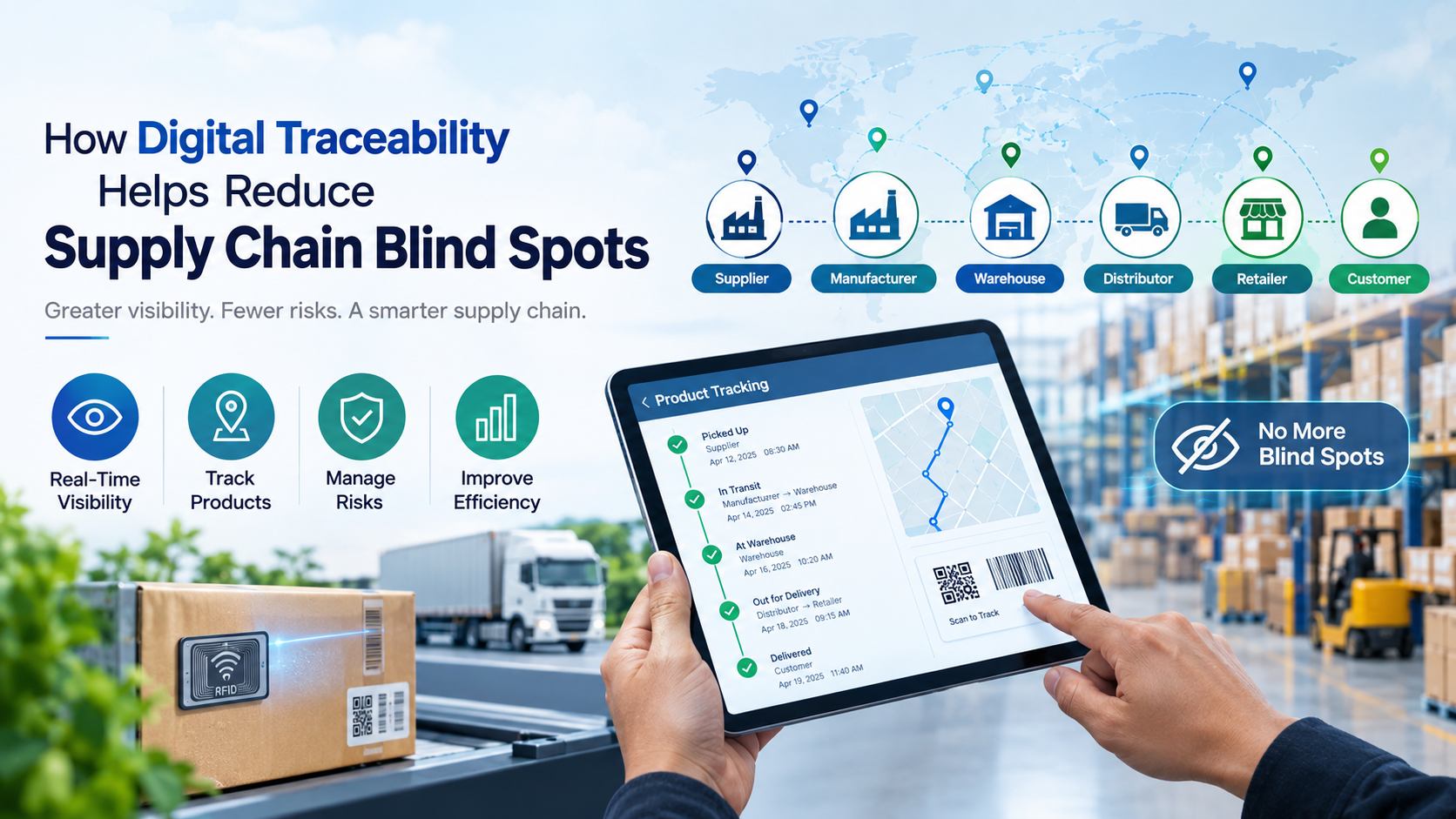
Digital traceability connects different stages of the supply chain and collects information as products move through them.
For example, a product may be:
- Sourced from a supplier
- Sent to a manufacturing facility
- Stored in a warehouse
- Transported to a distributor
- Delivered to a retailer
- Purchased by a customer
At each stage, digital systems can capture relevant information such as location, quantity, status, movement, and timestamps.
Key Technologies Behind Digital Traceability
Several technologies can support digital traceability, including:
- RFID tags and readers
- Barcodes and QR codes
- IoT sensors
- GPS tracking
- Cloud-based platforms
- Enterprise resource planning systems
- Artificial intelligence and analytics
- Warehouse management systems
Together, these technologies help businesses create a more connected and transparent supply chain.
What Are Supply Chain Blind Spots?
Supply chain blind spots are areas where businesses have limited or no visibility into supply chain activities.
A company may know that an order was shipped but may not know exactly where it is, why it has been delayed, or whether the shipment was handled correctly. Similarly, a manufacturer may know how much inventory is available in its warehouse but have limited visibility into supplier inventory.
Common Causes of Supply Chain Blind Spots
Some common causes include:
- Manual data entry
- Disconnected software systems
- Limited supplier visibility
- Lack of real-time tracking
- Poor inventory management
- Communication gaps
- Inaccurate or outdated information
- Complex multi-tier supplier networks
These problems become more serious when businesses operate across multiple locations and work with numerous suppliers and logistics partners.
How Blind Spots Affect Supply Chain Performance
Supply chain blind spots can lead to delayed deliveries, inventory shortages, excess stock, higher operating costs, compliance problems, and poor customer experiences.
When businesses cannot see what is happening, they often react to problems after they occur instead of identifying and addressing them early.
How Digital Traceability Reduces Supply Chain Blind Spots
Digital supply chain traceability provides businesses with better visibility across different stages of their operations.
Instead of depending entirely on manual updates, companies can collect and share data digitally.
Improves Real-Time Supply Chain Visibility
One of the biggest advantages of digital traceability is improved visibility.
Businesses can monitor the movement and status of products, shipments, and inventory using connected systems. This allows supply chain teams to identify potential issues sooner and make better decisions.
Tracks Products Across the Supply Chain
Digital identification technologies such as RFID, barcodes, and QR codes can help businesses track products from one location to another.
This creates a digital record of product movement and makes it easier to determine where an item is and where it has been.
Identifies Delays and Disruptions
Digital traceability can help businesses identify unusual delays, shipment problems, inventory discrepancies, and other disruptions.
For example, if a shipment remains at a particular location longer than expected, the business can investigate the issue rather than waiting until the customer reports a late delivery.
Improves Supplier and Inventory Visibility
Supplier-related blind spots can create major challenges for manufacturers and retailers.
Digital systems can provide better visibility into supplier orders, inventory levels, product movement, and delivery status. This helps organizations make more informed purchasing and production decisions.
Enables Faster Problem Resolution
When a problem occurs, traceability data can help businesses identify where the issue started.
For example, if a product batch has a quality problem, a company can use traceability records to identify the relevant batch, supplier, production stage, or distribution point. This can make investigations and corrective actions faster.
Key Benefits of Digital Supply Chain Traceability
Implementing digital traceability can provide several benefits beyond basic tracking.
Better Supply Chain Visibility
Businesses gain a clearer view of products, inventory, shipments, suppliers, and operations.
Improved Operational Efficiency
Automated data collection reduces the need for repetitive manual processes and can help employees spend more time on higher-value activities.
Reduced Supply Chain Risks
Better visibility allows companies to identify potential disruptions and take action earlier.
Better Compliance and Product Tracking
Many industries require organizations to maintain accurate records about products and their movement. Digital traceability can help businesses maintain more reliable records and support compliance requirements.
Improved Customer Trust
Customers increasingly want information about where products come from and how they move through the supply chain. Better traceability allows businesses to provide more accurate information and build greater trust.
Technologies Used for Digital Traceability
Digital traceability is supported by several technologies that work together to collect, process, and share supply chain information.
RFID and Barcode Technology
RFID and barcode systems provide businesses with digital product identification.
Barcodes are widely used because they are relatively simple and cost-effective. RFID can provide additional automation because tags can be detected without requiring direct line-of-sight scanning in many implementations.
IoT Sensors and Connected Devices
IoT devices can collect information about products and their surrounding conditions.
Depending on the application, sensors can monitor information such as location, temperature, humidity, movement, or other environmental conditions.
Cloud-Based Traceability Platforms
Cloud platforms allow supply chain data to be stored and accessed across different locations.
This can help suppliers, manufacturers, warehouses, and logistics teams work with more consistent information.
AI and Data Analytics
AI and analytics can help businesses identify patterns and unusual activities within supply chain data.
For example, historical data can be analyzed to identify potential delays, demand patterns, inventory issues, or operational risks.
Digital Traceability Use Cases Across Industries
Digital supply chain traceability can be applied across many industries.
Manufacturing
Manufacturers can track raw materials, work-in-progress products, finished goods, and components across production facilities and warehouses.
Healthcare and Pharmaceuticals
Healthcare organizations and pharmaceutical companies can use traceability to monitor medicines, medical products, and other sensitive items throughout their distribution networks.
Retail and Consumer Goods
Retailers can improve inventory visibility and track products as they move from suppliers to distribution centers and stores.
Food and Agriculture
Traceability can help organizations track food products from farms and suppliers through processing, distribution, and retail.
This can support quality management, product recalls, and supply chain transparency.
Logistics and Transportation
Logistics companies can use digital tracking technologies to monitor shipments, vehicles, containers, and delivery status.
This provides customers and logistics teams with better visibility into transportation operations.
How to Implement Digital Supply Chain Traceability
Businesses should approach traceability as a gradual process rather than trying to transform the entire supply chain at once.
Identify Supply Chain Blind Spots
Start by identifying where visibility is currently missing.
Look at suppliers, inventory, warehouses, transportation, production, and customer delivery processes to determine where information gaps exist.
Define Tracking and Visibility Requirements
Determine what needs to be tracked and what information needs to be available.
For example, a business may need to track product location, batch numbers, inventory levels, shipment status, or environmental conditions.
Choose the Right Traceability Technology
Select technologies based on business requirements.
RFID may be useful for automated identification, while barcodes may be appropriate for simpler applications. IoT sensors can be useful when businesses need continuous information about location or environmental conditions.
Integrate Traceability With Existing Systems
Traceability systems should ideally work with existing business platforms such as ERP, WMS, TMS, and other enterprise applications.
Integration helps create a more connected flow of information.
Monitor and Optimize Performance
After implementation, businesses should regularly review traceability data and identify opportunities for improvement.
The goal is not simply to collect more data but to use that data to make better supply chain decisions.
Challenges of Implementing Digital Traceability
Although digital traceability provides significant benefits, businesses may face several challenges during implementation.
Data Integration Challenges
Companies often use multiple systems that were developed at different times. Connecting these systems can require careful planning and technical integration.
Implementation Costs
Hardware, software, integration, training, and maintenance can create initial costs. Businesses should evaluate the expected operational benefits before selecting a solution.
Supplier Adoption
A supply chain often includes many external partners. Achieving consistent traceability may require suppliers and logistics providers to adopt compatible processes and technologies.
Data Security and Privacy
Supply chain systems contain valuable business information. Organizations should implement appropriate security controls to protect sensitive data and control access.
The Future of Digital Supply Chain Traceability
Digital traceability is expected to become increasingly important as supply chains become more connected and data-driven.
AI-Powered Supply Chain Visibility
AI can analyze large amounts of supply chain data and help businesses identify patterns, anomalies, and potential risks.
Predictive Analytics and Risk Detection
Instead of simply showing what has already happened, advanced analytics can help businesses anticipate possible disruptions and take preventive action.
Connected and Autonomous Supply Chains
As IoT, automation, AI, and cloud technologies continue to develop, supply chains can become more connected and responsive.
This can help businesses move from reactive supply chain management toward more proactive decision-making.
Conclusion
Supply chain blind spots can make it difficult for businesses to understand what is happening across suppliers, inventory, production, transportation, and distribution.
Digital supply chain traceability helps address these challenges by connecting supply chain data and providing better visibility into product movement and operations. Technologies such as RFID, barcodes, IoT, cloud platforms, and AI can work together to create a more transparent and responsive supply chain.
For organizations looking to improve visibility, reduce operational risks, and respond faster to disruptions, digital traceability can be an important part of a modern supply chain strategy.
Frequently Asked Questions
Q1. What is digital supply chain traceability?
Digital supply chain traceability is the use of digital technologies to track products, materials, information, and activities throughout the supply chain.
Q2. How does digital traceability reduce supply chain blind spots?
It provides better visibility into product movement, inventory, suppliers, shipments, and other supply chain activities, helping businesses identify information gaps and problems faster.
Q3. What technologies are used for supply chain traceability?
Common technologies include RFID, barcodes, QR codes, IoT sensors, GPS, cloud platforms, AI, analytics, ERP systems, and warehouse management systems.
Q4. What are the benefits of digital traceability?
Key benefits include improved visibility, faster problem identification, better inventory management, reduced risks, improved compliance, and greater operational efficiency.
Q5. Which industries use digital traceability?
Digital traceability is used across manufacturing, healthcare, pharmaceuticals, retail, food and agriculture, logistics, transportation, and other industries where product and supply chain visibility are important.